You don't have to write a set of contents for each AI engine. After tracking B2B clients’ sources of references to ChatGPT, Perplexity, Google AI Overviews and Claude, we see a stable pattern: a content that is actually quoted, usually in several engines at the same time, only a few references to a single engine. So the point of multi-engineer content investment is not to spread the fire to every platform on average, but to identify the "repeated" content and position it.
Citation overlap, higher than most teams think.
When most marketing teams planned GEO, the instinct was to use the engine as a separate route, so they wanted to write a copy for ChatGPT, a copy for Perplexity and a copy for Google. The actual list of references shows that there is a large overlap of sources in different engines. The reason is not hard to understand: these engines are all on the same public web page, and they all prefer the same feature page, with clear definitions, clear answers in front of the paragraph, clean structures, and deep enough. A page that answers a question directly is selected by one engine and usually by another.
This means that the basic work you do on a single piece of content can generate returns in multiple engines at the same time. In turn, if an article could not be quoted in one engine, it could be reproduced in four versions and could not be saved, the problem was that the content itself was not enough.
The situation in our hands: a SaaS client's price comparison page was not quoted by any engine. We put the conclusion at the beginning of each section, add a clear comparative table, and describe the product name and the number of programs. Within two weeks, this page began to appear in Perplexity and ChatGPT sources, and Google AI Overviews later followed. The same modification, the three engines together, is what the overlap brings.
That's 80%: what it looks like to be quoted across the engine.
There are common features to what you eat across the engine. These features do not bind the preferences of any one engine, but the signals that all search-type AI is looking for:
- The reality is the same: the name of the company, the product location, the core number, the same way in which you are quoted between your home site and the outside references, the engine dares not contradict itself.
- Preface the answer: the first or two sentences of the paragraph will be completed, followed by details to facilitate clean engine extraction.
- Referenceable data blocks: A list of specific numbers, comparisons, steps, easier to remove than adjectives.
- The theme is complete: the sub-issues under the same theme are addressed, so the engine judges you have authority on the subject.
- The structure is clear: The title level, the list, the answer format, makes it easier for the machine to position the segment.
These five items are that 80%. They're not gorgeous, but they decide if you're on the engine list. When we did the GEO audit for our clients, we saw a difference in visibility, not a special game in one of the engines, but in this basic disk. Let's fill this up, then move on.
That's 20%: real engine differentials.
There's a difference between engines. It's just that they're bigger than they're supposed to be, and you know where the 20% power goes. Google AI Overviews is highly dependent on existing natural rankings and structured data, and if a page is scheduled well in the traditional search and schema is fully marked, the chances of using it are clearly higher. Perplexity prefers freshness and directly quoted statistics, and a response often lists multiple sources of information for analogies, lists, etc. ChatGPT's search mixed the model with both knowledge and immediate access, and the density of your brand being mentioned throughout the network, even if it does not have a link, will affect whether it recognizes you.
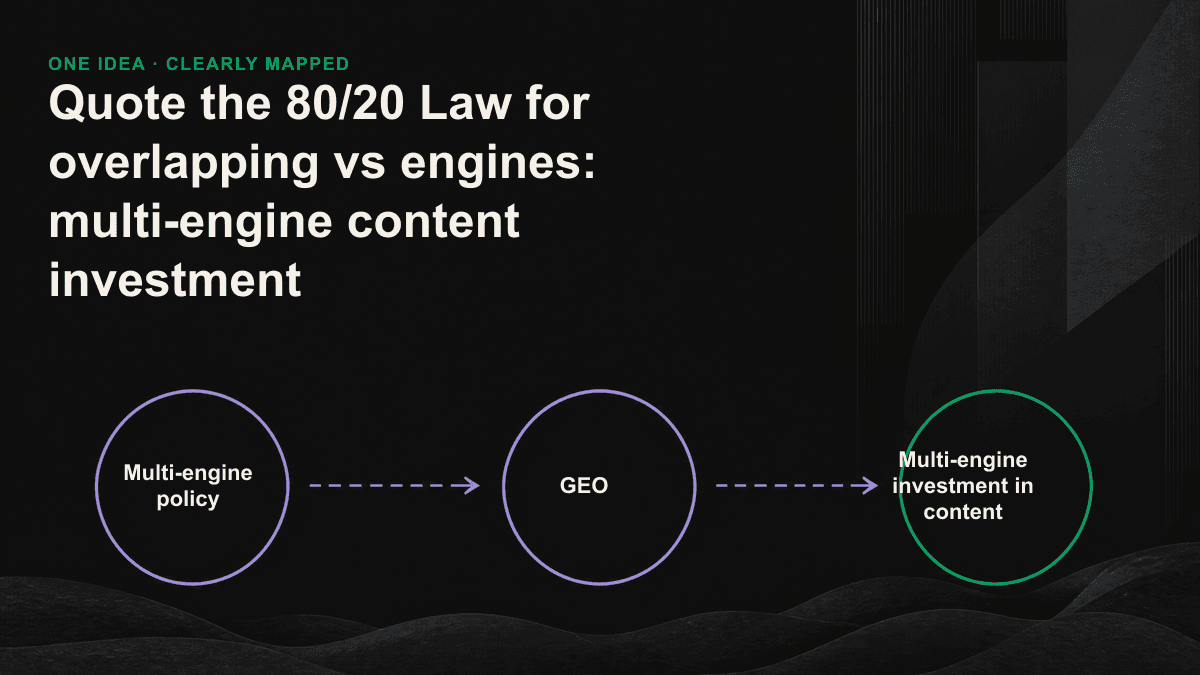
80/20. How do we allocate the budget?
Split the time and budget into two pieces. Eighty percent of this is on the basis of cross-engine convergence: physical consistency, front-line answers, citation data, theme cover, and you're going up in every engine. The remaining 20 percent, pick one of the most important engines for your buyer, and make it more sexual. How? See where your buyer actually makes the decision. B2B SaaS's technocrats are now heavily using ChatGPT and Perplexity to make their initial selections, and the two achievements are posted on the brand's Internet to refer to density, and the comparatives that can be cited by Perplexity; if your buyers are more dependent on Google's general search, the two achievements reinforce the Schema and nature ranking. It's the same 20%, the wrong place is the white flower.
- First measure the baseline: using a tool like AI visibility monitoring to see your current reference to engines and overlap rates, don't feel like it.
- Completing the engine gap: priority is given to repairing the basics and improving multiple engines at a time.
- Choose a main engine: choose the buyer's path, and throw the 20 percent.
- Fixed rhythm update data: Quoted numbers and comparisons are updated quarterly to maintain fresh signals.
A few common error configurations
The most common waste is publishing nearly identical content for each engine. That dilutes the authority of your domain and makes your own pages compete with one another. Another mistake is optimizing only for Google AI Overviews even though the buyer may already have narrowed the options in ChatGPT. A third is chasing every new engine before the core setup is complete, while that engine's retrieval behavior is still unsettled.
Where do we start?
Let's figure out two things: how high your content is currently at the citation overlap of the engines, and which engine is the 20% of the power that should be invested. These numbers will determine your content for the next three months, not by guess. If you want to know if your gap falls on the base plate or on the engine, you can schedule a 30-minute GEO diagnostic session. We'll use the actual quotes you have, not the generals.