Hiring the largest or best-known global GEO agency does not automatically place a brand in Traditional Chinese AI answers. The decisive question is whether the team understands how AI engines retrieve, rank, and cite Traditional Chinese material. Agency size, price, and an impressive English-market portfolio say little about that capability.
The Core Difference Is the Corpus, Not the Budget
Language models have far less clean material in Traditional Chinese than in English and more noise from Simplified Chinese sources. When someone asks in Traditional Chinese, "Who is the best B2B SaaS consultant in Taiwan?" the model has fewer authoritative signals to use than it would for the same query in English. This creates two effects: a small amount of strong local content can close a visibility gap quickly, but stale or inaccurate Simplified Chinese sources can also contaminate the answer more easily.
Most large international agencies developed their processes for an English corpus. Their entity work, content structure, and citation strategy assume that models can draw from a large network of dense, cross-referenced English pages. Applying the same assumptions to Traditional Chinese ignores a very different information environment. The common result is a large content program that earns few citations.
Which Sources Do AI Engines Trust in Traditional Chinese?
Citations depend on the sources an AI engine retrieves and trusts for a particular language and region. In Traditional Chinese B2B queries, Perplexity, ChatGPT Search, and Google AI Overviews often use a very different source mix from their English answers.
- Taiwan media and industry publications: iThome, Business Next, Business Weekly, and TechOrange can become trusted sources for specific local topics.
- Community discussion: Dcard, PTT, and public Facebook groups influence how models interpret local brand reputation.
- Official and structured information: Brand sites with clear FAQs, pricing, service pages, and schema are more likely to be treated as factual sources.
- Chinese and English entity alignment: Whether a model recognizes both names as the same brand directly affects citation consistency across languages.
A team with long experience in Taiwan knows which publications matter for each topic and how to build legitimate signals across them. International teams often lack that local map and fall back on the source list that works in English, producing a lower hit rate.
Mixed Traditional and Simplified Chinese Is an Overlooked Risk
Models sometimes answer a Traditional Chinese question with material drawn from Simplified Chinese or treat a Simplified Chinese page as the brand's authoritative source. If a brand has substantial noise in Simplified Chinese but weak local signals in Traditional Chinese, the answer may cite unrelated material or even confuse it with a competitor without the team noticing.
Why a Local Team Sees Gaps That Others Miss
The first step is to see how the brand currently appears in Traditional Chinese AI answers: which questions mention it, which competitors displace it, and which sources support the response. That audit must use natural Traditional Chinese queries. Translated English prompts do not measure the same market.
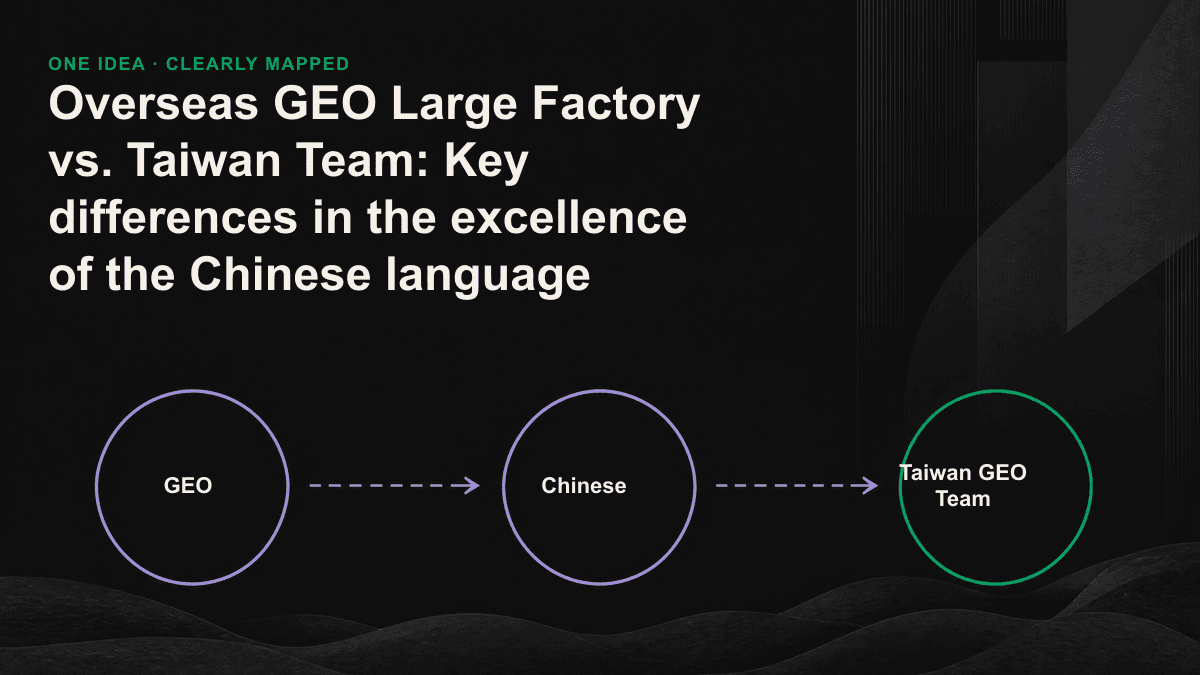
This work usually reveals one of three gaps: the brand is absent from an important question, it is mentioned but supported by the wrong source, or stronger Traditional Chinese content from a competitor pushes it aside. Each problem requires a different fix. Brand Radar and similar visibility tracking tools turn those observations into a signal that can be monitored continuously instead of a one-time impression.
The Compounding Value of Communication, Time Zones, and Local Cases
These are operational advantages, not soft extras. GEO requires a repeated cycle of testing Traditional Chinese queries, reviewing citation changes, adjusting content, and testing again. A team that shares working hours, can discuss nuance in Chinese, and understands Taiwan's industries may complete two or three rounds while a global team is still translating and aligning context. Local casework also becomes an asset. Experience across Taiwan B2B clients builds a working map of which sources tend to control each topic.
How to Choose Between the Two
A global agency is not inherently the wrong choice. If the primary market is English and the objective is visibility in English AI answers, its corpus expertise can be valuable. But when buyers ask in Traditional Chinese and customers are in Taiwan, local-language execution becomes a deciding capability, and a Taiwan team has a structural advantage.
Test several Traditional Chinese questions that matter to the business in ChatGPT and Perplexity. Record which brands appear and which sources support them. If your brand is missing or the answer relies on noisy Simplified Chinese material, you have found the gap. Book a 30-minute GEO diagnostic session for a complete Traditional Chinese visibility review using your own queries.