Perplexity cites you, probably not because you are ranked first on Google, but because your paragraphs are good enough to extract. After we dismantled 300 Perplexity answers and opened the source pages they actually cited one by one, the clearest rule is that the influence of structured content is not uniform across all domains, but highly depends on the domain. In topics such as product comparison, finance, and health that require precise facts, a table or definition sentence that can be captured in one piece is almost a ticket to enter the citation list; when it comes to news or opinion questions, the same effort will have much less effect. This article explains the differences between various fields.
How are these 300 answers divided?
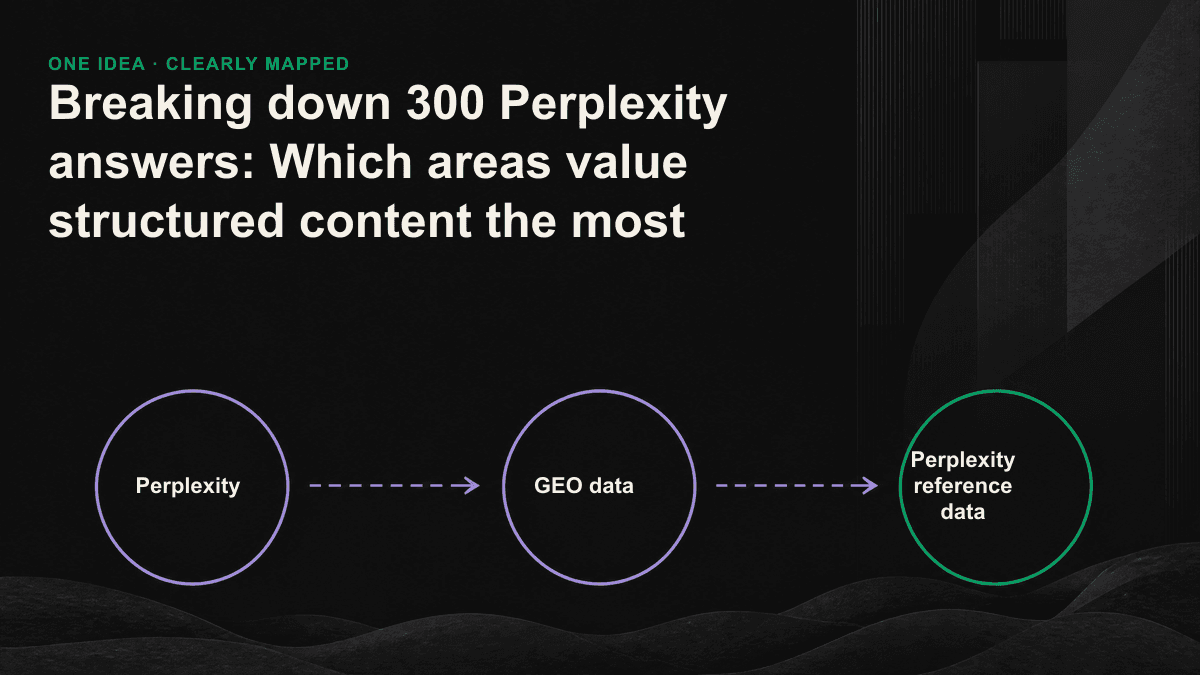
We selected ten common B2B and consumer decision-making areas, and threw out about thirty real queries in each area, deliberately covering three types of questions: "comparative", "definitive" and "operational". For each answer, we don’t look at who ranks first, but open each source page it cites to see what the quoted paragraph looks like - whether it is a table, a set of lists, or a sentence buried in the middle of the narrative paragraph. The focus of this Perplexity reference data from beginning to end is not the ranking, but the form.
- The form of the cited paragraph: table, list of items, definitional sentence, or general narrative paragraph
- Whether the source page is marked with structured information such as FAQPage, HowTo, and Product
- How close is the literal correspondence between the cited sentence and the user's question?
- The last updated time displayed on the source page
- The same answer cites several different domains.
Let’s make it clear first: this is Tenten’s own sample, not a census of the entire network. If you change a group of queries, the numbers will fluctuate. But when ten fields are compared on the same table, the gap between the fields is so large that it doesn’t look like noise, and the direction is very stable.
The five most important areas of structured content
After breaking down the form of cited paragraphs by field, the proportion of table and list citations in five fields is significantly higher than that of others. The ranking here is not based on traffic or commercial value, but on "whether the content is structured or not, how much impact it has on whether it can be cited." The following are ranked according to the degree of impact from high to low.
- B2B SaaS product comparison and tool review: More than 70% of quoted paragraphs come from specification sheets or pricing lists, and pure narratives can hardly capture the answer. When users ask "What is the difference between A and B?" Perplexity often directly pulls out a certain column of a comparison table.
- Finance, Insurance and Rates: When asked about interest rates, fees, and qualifications, the answer is almost exclusively columns and tables. A paragraph of text that hides rates in the middle of a sentence is no better than a small three-column table.
- Medical and Health: Definition sentences, list of symptoms, dosages and procedures are most likely to be quoted in entire paragraphs. But this field is particularly sensitive to source authority. Structure is just the ticket, and authority determines the order.
- Regulations, taxation and compliance: Provisions, applicable objects, and effective dates are all content with a high extraction rate. By splitting "Who is applicable, when will it take effect, and what preparations should be made" into three clear sentences, the probability of being cited will obviously increase.
- Development and technical documentation: code blocks, parameter tables, step-by-step instructions. Perplexity reads technical documents almost like a structured database.
Let’s take a situation we often encounter: a tool comparison article. The main text describes the differences between the two products in great detail, but it is all described in words. It ranks third on Google, but Perplexity is never cited. After we organized the core differences into a six-column specification table, with each column corresponding to a dimension that users would really ask about, within two weeks, references to this article began to appear in the same batch of queries. Not a word is added to the content depth, but the answers are put into a container that the model can move at once.
What the five areas have in common is straightforward: the questions themselves have standard answers. What the user wants is a fact that can be verified, and what Perplexity wants is a piece of content that can be transferred intact without being afraid of making mistakes - the table and the definition sentence satisfy these two things at the same time.
Why these five?
The key is not whether the field is important or not, but whether there is a unique solution to the problem. When the user asks for verifiable facts, the model tends to select the fragments with the lowest ambiguity and the easiest way to align the problem to be quoted. Tables, lists, and definition sentences just minimize the ambiguity. It also makes sense from the perspective of the model: it quotes a passage, which is equivalent to endorsing that sentence. The semantic boundaries between the definition sentence and the table are clear, and the chance of making mistakes when extracted is low; a narrative that relies on the context to be established can easily be taken out of context. Low risk is another way of saying high citation rate. On the contrary, when the content requires readers to weigh it themselves and there is no standard answer at all, the model does not rely so much on the structure, but looks back to see whether the source is authoritative and new enough.
In which areas does structuring not help much?
News and current affairs, opinions and thought leadership, lifestyle and travel are the three categories with the lowest structural dividends in this batch of samples. News is about timeliness and media authority, opinion is about unique angles and narratives, and travel is about first-person experience. Using rigid tables on these topics will fail to attract high citations and will reduce the original readability and persuasiveness. What you should really invest in this kind of content is the frequency of updates, the credibility of the author, and a perspective that others cannot write.
Turn this thing into an executable action
- First, position each piece of content: Is it a precise fact type or a narrative opinion type? This step determines whether you want to change its structure.
- Condensate the most critical answer of the entire article into a definition sentence or a small list that can be captured in one piece, and place it at the front of the paragraph.
- All comparative content should be paired with a specification or pricing table, and field names should match what users are actually asking, not your internal terminology.
- Supplement the corresponding structured information (Product, FAQPage, HowTo), but don’t use schema for the sake of schema, so that the markup matches the content that actually exists on the page.
- Every once in a while, look back to see which paragraphs Perplexity actually quoted from you, and rewrite the ones that were not cited instead of adding more words.
Structure is not a panacea, it is a lever - if you bet on the right area, a small table can be exchanged for citations that last for several months; if you bet on the wrong place, it will just tear a good article into pieces. If you’re not sure which end of the spectrum your topic falls on, and which passages have never actually been picked up by AI, Tenten’s GEO audit will lay out the data for you. To see your gaps first, book a 30-minute GEO diagnostic session.