Perplexity does not read an entire article and then decide whether to cite it. It splits the user's question into sub-questions and looks for the passage that answers each one most directly. Citation therefore depends less on the authority of the whole site than on whether one passage can be extracted cleanly and answer a specific question. That distinction explains why a page can rank well without being cited.
Perplexity reads your website, actually only a few paragraphs
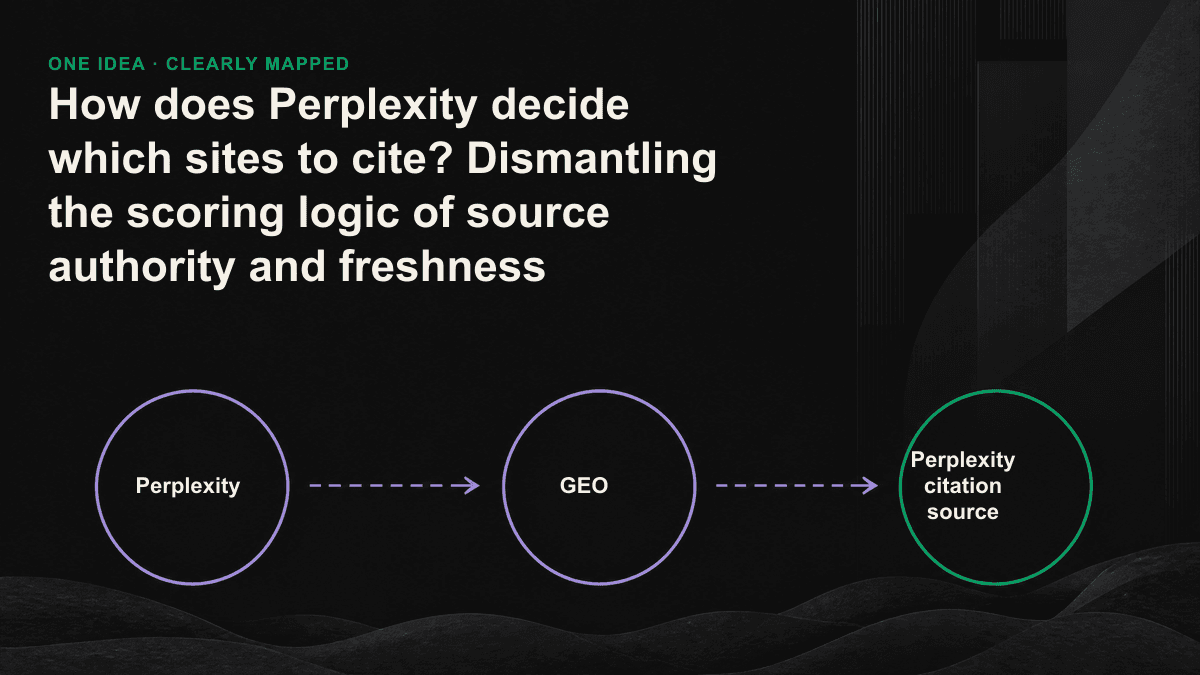
Its process is roughly four steps: problem solving, retrieval, rearrangement, and generation. When a user asks "Which GEO agency is suitable for SaaS in Taiwan?", Perplexity will first break it into several independently searchable sub-questions - which GEO agencies are there, which ones are in Taiwan, and what is needed for SaaS - and retrieve candidate pages from its own index and cooperation sources respectively. What is retrieved is not the entire article, but the cut fragments; then a rearrangement model scores each fragment's answer to the sub-question. Finally, the language model only generates answers based on the paragraphs with the highest scores, and links the quotes back to the corresponding paragraphs. This means that your real competitive field is at the paragraph level, not the article level. If a long article ranked high on the list does not have any paragraph that can independently answer the sub-question, the entire article may not be cited; a page with an average overall weight may have a chance of being cited as long as a certain paragraph is accurate and complete.
You are not competing with other websites for ranking, but with someone else's paragraph for the same citation.— Tenten GEO
Authoritativeness: How does Perplexity determine whether you are trustworthy?
Authority is not a single score, but the impression of several signals stacked together. Perplexity uses both its own index and external search results, so traditional SEO authority signals still apply here: the history of the domain, links to you from other trusted sites, and the consistency of your brand being mentioned online. When the same entity: your company, product, or author: is described in a similar way across multiple independent sources, the model’s confidence that it is a trusted entity increases. On the other hand, if you are the only one talking about yourself on the entire Internet, this kind of isolated evidence will make your score drop.
- Domain trust: Is there a long-term, stable, and theme-focused accumulation of content instead of just writing about everything?
- External corroboration: Whether there are other authoritative websites citing or linking to you to form cross-verification.
- Entity consistency: Can the company name, product name, and author descriptions from different sources match up and be connected to the knowledge graph?
- Transparent provenance: Does the page clearly indicate who wrote it, what it was based on, and when it was updated.
There is a point that is often overlooked here: Perplexity pays special attention to "verifiability". If you declare a number without giving a source, the model will tend to find the page with the source, rather than citing you. Putting claims, data, and sources in the same paragraph is better than having them scattered throughout the article. Verifiability itself is a signal of authority.
Freshness: When does date trump authority?
The weight of freshness is not fixed and depends on the timeliness of the question itself. When asked "The latest proportion of AI searches in 2026", Perplexity will strongly prefer recent pages, and data from a month ago may be regarded as expired; but when asked about evergreen questions such as "What is GEO?", the impact of date is much smaller, and a clear definition article from two years ago will still be cited. For the same domain, the freshness bonus points that can be obtained under different questions are completely different.
Clues to determine timeliness include the year in the question, words like "latest, now, currently," and how quickly the topic itself changes. For this type of query, clear and correct publication and update dates on the page become critical. But be careful about one thing: changing the date of an article three years ago to today but keeping the content intact may fool you into sorting in the short term. Once the content conflicts with other fresh sources, the model will skip you instead - it compares the content, not just the date tag.
Extractability: Let the paragraph answer the question on its own
The first two signals determine whether a page enters the candidate pool; extractability determines whether Perplexity actually selects it. An extractable paragraph leads with the conclusion, stands on its own without relying on earlier text, uses the language of the user's question, and presents parallel information in a list or table when appropriate. This is not a matter of literary style. The passage must make sense after a machine cuts it out of the page.
The easiest way to lose points is to hide the answer behind the setup. You wrote, "Before we delve into the discussion, let's review the background." If the answer does not appear until the fourth paragraph, readers may tolerate the wait, but a retrieval system may extract only the setup. Write the first paragraph under each section so it can answer the question on its own. This also explains why high-authority domains are sometimes skipped: the source may be trustworthy, but the answer is not in an extractable passage.
Turn these four things into a checkable list
The checking method is actually very simple: take the query you want to be quoted, actually go to Perplexity and ask it once to see who it cites and which paragraph it cites, and then compare your page with these four signals one by one. You can see the gap at a glance.
- Authoritativeness: Are there any other credible sources willing to corroborate you on this topic?
- Freshness: Is this query timely? Is my content (not just the dates), up to date?
- Extractability: Can the first paragraph of each subheading be posted separately to answer the question?
- Verifiability: Are the claims, figures, and sources placed in the same paragraph and can they be verified?
A large gap in any one of these four areas can leave a page ranking well but absent from AI answers. To find the citation gap across engines such as Perplexity and ChatGPT, book a 30-minute GEO diagnostic session. We will run your real queries and identify the passage that needs work first.