The pillar page is not a long article, but a set of inner links at the centre. Most teams make it into a long text filled with keywords, and then there's no text, so it's neither a keyword nor an AI engine quote. A really effective support page starts with a key map to break the theme into a home page with more than a dozen sub-topics, and a two-way internal link to bring power to the center. It's about how to connect from the map so that Google and ChatGPT both recognize that you have a system depth on the subject.
What's the problem with the support page?
The search engine and the generative AI engine determine that you understand a subject, not how well a single article is written, but whether you have a complete, connected set of content on the subject. An isolated long article, even with 3,000 words, still has a thin signal; a group of 15 articles that surrounds the same subject, linked to each other, will make it possible for the engine to determine that you are the source of authority in this domain. The pillar page is the front page of the content and New York: it gives the theme an overview portal, simultaneously re-directing each article and allocating its authority through links.
Draw key maps first, not write first.
Most of the failed support pages are losing this step over the map. The correct sequence is to spread the search needs of the whole theme and then decide which are the pillars and which are the sub-themes. This is done by treating a major theme (e.g. the "GEO content strategy") as a centre of outreach on three levels: the theme itself, the sub-themes that make it up, and the long questions that readers really ask under each sub-theme. The main page answers the question "What's the theme and what it contains?" The sub-pages each go into a sub-theme or a long set of questions.
- Central theme: High conversion rates and competitive core words, such as "GEO content strategy", are the goal of the pillar page itself.
- Sub-themes: 6 to 12 orientations, such as keyword research, content structure, internal connections, visibility tracking, each responding to a sub-article.
- Long question: Practical questions for three to eight readers under each sub-theme could be paragraphs in a sub-page or more detailed articles on their own.
- Deliberately: If you don't have a word on the subject, you don't have to stick to a clear range of content, it's easier for the engine to judge what you're talking about.
When you're done with the map, you'll have a list: one pillar, 10 to 15 pages, target queries for each subject. The list itself is a blueprint for the internal connection to the layout because the connection is already in the subject structure.
How do you organize the pillar page?
The pillar page serves two types of scan at the same time: people quickly find their own sub-problem portal, and the AI engine cleans out the definition and focus of each sub-theme. So it's made up of a complete directory with links, not a essay. Each sub-theme has a paragraph on the pillar page: this is a two-to-three sentence that is clear, gives a definition that can be quoted, then links it to an in-depth sub-article. So that the pillar page itself can answer the question of the panorama, and the depth questions will be taken over by the sub-page.
Each section of the pillar page should be both an independent answer that can be removed by AI and a door to deeper articles. And that's how it serves readers, Google and generative AI engines.— Tenten GEO Content Engine Executing Principles
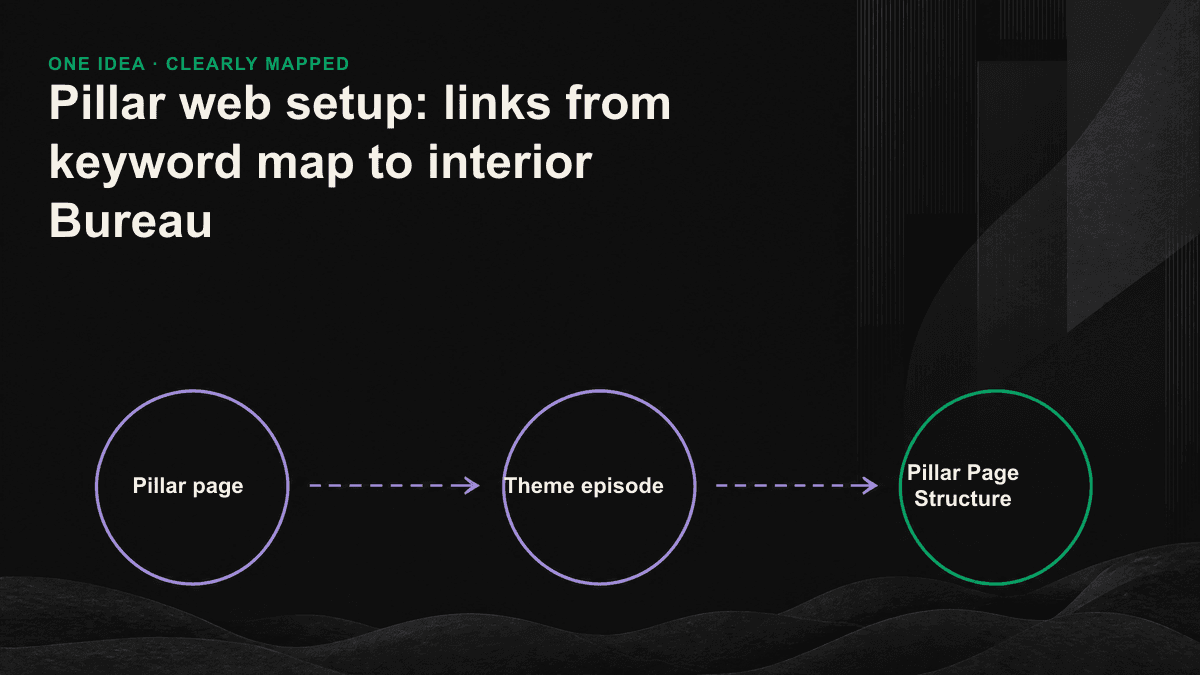
Internal connection: two-way, with anchors
The power of the pillar structure comes from the method of connecting, not just the number of articles. The core rule is a two-way approach: each article goes back to the pillar page and the pillar page goes back to each article. This closed loop allows the engine to see clearly the connection between the center and the satellite, to regroup scattered power on the support page, and to connect the crawlers to recognize the whole group at once. A one-way link (only a pillar, not a page) is the most common loophole, which makes the outflow of power impossible.
- Each sub-article reconnects to the pillar page at least once, in the opening or concluding natural words, not in a pile of links.
- The pillar page is linked to each sub-theme in a sub-theme, where the anchor text uses the object of the sub-topic instead of "television" to "know more".
- The horizontal connection between highly related sub-articles, such as the Keyword Research link to the Content Structure, creates a web of images rather than only wheeled radiation.
- The anchor text has to describe the destination content so that the engine will determine from the link text what the page is talking about, which is particularly important for AI.
Anchor text is an overlooked lever. A precise descriptive anchor adds a topic label to each link, helping an engine understand the destination before opening the page. Consistent anchors across the content set reinforce the same topical signal.
Three reasons why most pillar pages are not working
- There are no pillars: a 3,000-word text is used as a pillar, and there is no deep satellite article underneath, which is equivalent to a wheel without a tampon, unable to hold the title.
- The link just couldn't come back: the pillar page was linked to a sub-page, but the sub-page was not connected to the center, the weight was drained, and the pillar page itself was unable to line up.
- The theme is out of focus: the whole set of content is diluted.
Why is this set of structures particularly effective for GEO?
When the generator answers the question, the source of the structure depth is cited first. A whole architecture of the layouts that clearly describes the "I'm covering this theme in its entirety, I'm certifying each other" as a link. We've seen the same pattern over and over again as we helped clients track AI with Brand Radar: When a group of content is organized from scattered articles with a two-way link, the frequency of designations by ChatGPT, Perplexity will increase significantly, because it is easier for the engine to confirm that you are that the whole subject matter stands, rather than merely one article that happens to be written.
How do you maintain it when it's online?
The pillar structure is not a one-time project. The map changes with the market questions, and the new long question emerges, so you can add a sub-page to the pillar page and update the definition of the pillar paragraph. A quarterly check: which sub-topics have lost their visibility, which new queries have not responded to the page, and which sub-texts have forgotten to go back to the center. This is a setup of maintenance rhythms that, like duplicates, will continue to pile power back to the support page over time.
If you already have many articles but still earn neither rankings nor AI citations, do not start by publishing more. Map the pages you have, identify missing coverage, and find the links that should connect them. In a GEO diagnostic session lasting 30 minutes, we can turn the existing library into a topic map and show which gap to fill first.