The greatest risk for a professional-services firm is being removed from the shortlist before a prospective client decides whom to contact. A startup CFO can ask ChatGPT, “Which accounting firms in Taipei specialize in cross-border equity structures?” and receive three to five names with reasons. If your firm is absent, the buyer may never learn that you exist, and the lost opportunity will never appear in your analytics. This is already happening.
Professional Services Have Always Been an Ask-Someone Purchase
Clients have never chosen high-value, high-trust services such as law, accounting, and management consulting from a keyword ad alone. They asked friends, peers, and industry groups: “Who handled your last acquisition?” The referral chain determined which firms entered consideration. AI search automates that same process at scale and answers faster, often with more structure than a personal contact can provide.
A friend can recommend your firm because they have worked with you. AI has not. It can assess only public evidence, so whom it recommends and why depends on how clearly the web explains your expertise. Even an excellent firm is effectively invisible to AI if it has left no readable professional assets behind.
Three Signals AI Uses to Decide Whom to Recommend
When an AI engine answers a “whom should I hire?” question, it is not choosing at random or simply rewarding the biggest advertiser. It behaves more like a diligent research assistant, looking for public evidence of clear, relevant expertise. In our visibility work with professional-services firms, three signals appear repeatedly.
- Is your expertise readable? The matters you handle and your interpretation of particular laws, regulations, or standards should exist as well-structured articles, not only in a partner's memory or a private presentation.
- Is your identity specific? AI needs to understand whether you are a labor-disputes lawyer, a tax accountant serving foreign companies, or an organizational-transformation consultant. A vaguely positioned firm is difficult to classify and therefore difficult to recommend.
- Do third-party descriptions agree? Media coverage, industry directories, speaking records, and public client reviews all influence how confidently AI can associate your firm with a particular field.
Why “Our Reputation Is Enough” Is Starting to Fail
Many senior partners instinctively say that their business runs on relationships and referrals, not content. Five years ago, that was largely true. Today it is only half the story. Referrals still matter, but the first verification step has moved. A prospect who hears your name from a friend will probably search for you and cross-check the recommendation. If that check happens in AI search and the model has little reliable information about your firm, a strong referral is diluted into uncertainty.
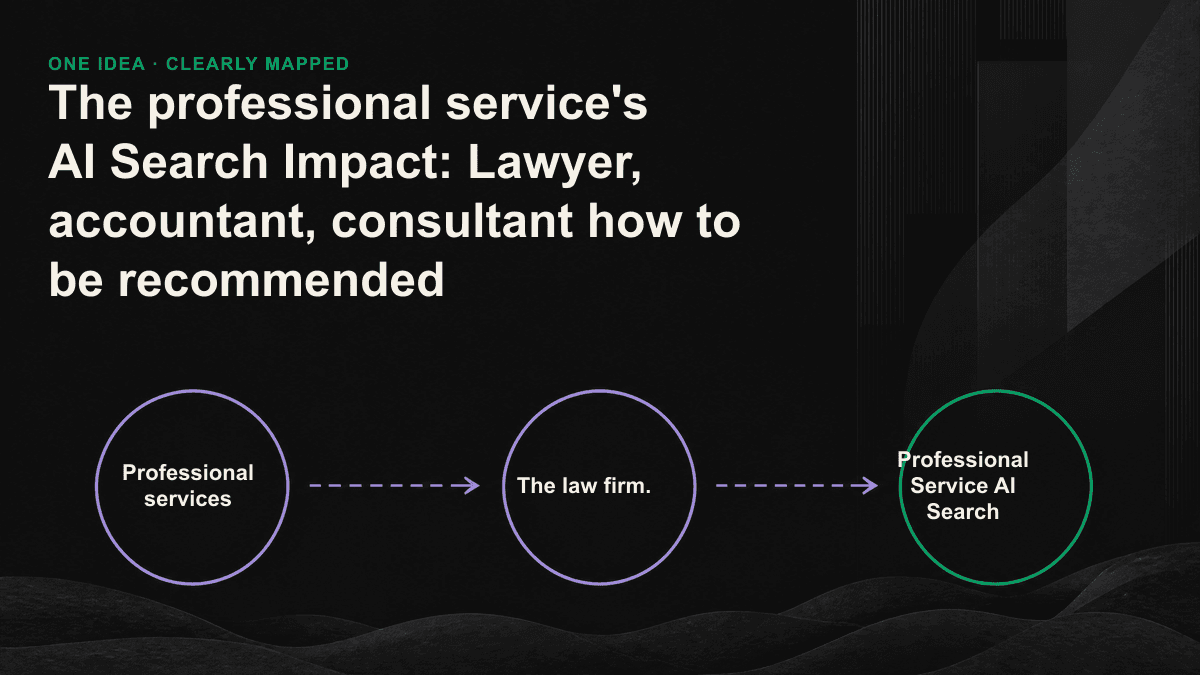
The source of new clients matters even more. Building referrals once required a decade of professional relationships. Now a founder with few connections in Taipei can outsource vendor selection to AI. These buyers are growing quickly, often have flexible budgets, and may have no incumbent provider. They do not ask your former clients; they ask a model. If you are missing from that conversation, the work goes to peers who have invested in visible expertise.
Build Professional Assets That AI Can Cite
The answer is not a flood of thin SEO articles, which can undermine the authority you are trying to establish. AI engines favor content they can extract cleanly and use to answer a specific question. For a professional-services firm, that means turning the real problems you solve every day into structured articles: describe the situation, explain the relevant law or standard, and give a clear professional judgment. AI can understand and cite that work, while human readers can use it to assess whether they trust you.
Find Out How AI Describes Your Firm Today
Before investing in content, ask the question yourself. Open several mainstream AI engines and use the language of your ideal client: “Whom should I hire to handle this problem?” Check whether your firm appears, how it is described, and whether it is associated with the wrong specialty. This takes 10 minutes, yet it is often the first time partners discover that AI's picture of the firm is blank, outdated, or simply incorrect.
We assumed we were well known in our field. Then we asked several AI engines and found that every recommendation went to a competitor, each backed by a persuasive explanation. That was the moment the issue felt urgent.— Partner at a Taipei management consulting firm
From Silent Exclusion to Active Recommendation
Trust has always been the moat around professional services, but trust can develop only after a buyer sees credible evidence. AI search has not changed what clients want; it has changed how they look and which firms qualify to appear in the answer. Most competitors have not yet built a body of citable expertise, so firms that begin now can establish an advantage before the channel becomes crowded. To see how AI currently describes your firm and where its answers fall short, book a 30-minute GEO diagnostic. We will show you the evidence directly.