When the AI engine quotes your content, it rarely reads the whole text and summarizes it. It's on the page looking for a text that can be set up alone and answer a question directly. So what you really need is not an "article," but a paragraph that you can read with a question and take away the context. This paragraph is right, and the chances of being pulled off by ChatGPT, Perplexity, Google AI Overviews are clearly high.
Logic of extracting quotes: AI is looking for a "part that can be moved."
The search process for the generative AI engine is three steps in a simplified way: cut your page into a piece of passage, figure out which one is closest to the user's question, and then use it as the source of the answer. It assesses the target is passage, not the whole story. If your answers are scattered in three paragraphs, and the readers put together themselves, the one that comes out of the engine will be crippled, so it prefers to choose a full competition paragraph.
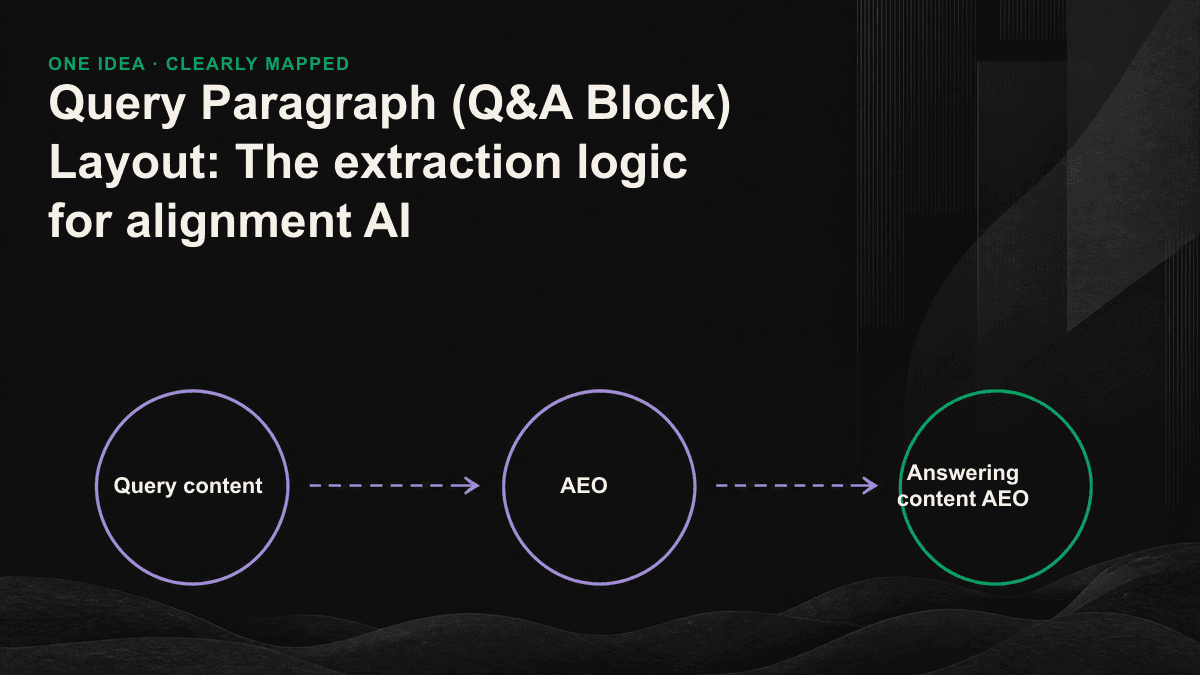
The answer paragraph is valid because it is born to match this cut-off logic. The title of a clear question, followed by the text that finishes the answer, is itself a clean piece of passage. Engines don't have to cross the line, and they don't have to guess what you want to answer -- questions are written on the title.
What's Q&A Block look like?
Start with one test: if you lift the passage out of the article and place it on a blank page, can someone who has not read the surrounding text still understand it and get the answer? If yes, it passes. If no, revise it. This cut-and-read test determines whether an engine can extract the passage and use it on its own.
- The title uses a real question-word to add to the description of the user search, such as "How does the question-and-answer content increase the AEO citation rate?" * Not * better content format *
- The first sentence is the straightball answer, 40 to 80, finish the core and finish at the top.
- The answer is self-sufficiency: there is no "as mentioned above" or "as mentioned above" to look back.
- Nouns are clear in the paragraph, initials appear for the first time or term is explained on the spot.
- Add one to two specific numbers or conditions when necessary so that the answer can be verified and not ambiguous
Order matters. Give the answer first, then the reason. That matches the engine's tendency to use the first sentence as a summary and the way people scan a page. If you bury the point under several lines of setup, the engine is likely to extract the setup instead of the conclusion.
Four types of layout errors that make the answer shredded
The first thing that's most common is to tear down the answer to a single question under a few small markers, and it takes the reader three times to get it down, and the engine only gets the fragments. The second is that the title is short, not short, and that "pricing strategy" does not match any of the natural questions, and the engine does not know what the answer is. The third is that the answer is buried in a long paragraph, and the first two or three sentences are set in context, which is equivalent to hiding the one most deserving of being removed. The fourth is that the same question has been answered twice on the page, and the language is inconsistent, and the engine is not sure which part of the letter, or simply not.
Invert from keyword: Which Q was to answer?
The hard part of the question-and-answer content is not in the layout, but in the selection. You're not going to answer what you want to say, but what the users really ask and what AI is not. In practice, we will be asking questions from three places: the "others ask" section of the search results, the "Perplexity" engine, which is being asked about it, and the words that business and customer services are asked every day. Consider these questions as Qs, which are closer to real queries than the beautiful titles you have decorated.
And guess what AI's trying to quote, let's see who it's quoting now and what it's missing. That gap is your next Q& A Block question.
Once online, how do you know if it was quoted?
The layout is not the end. You have to take the target question, actually go to ChatGPT, Perplexity, Google AI Overviews, and ask each other who it refers to, whether it has you or not, and whether it has been taken away from you. This thing has to run again on a regular basis because the engine answers change. AI visibility monitoring of Tenten is the automation of this tracking: regularly monitoring your visibility in the AI engines, the quoted paragraphs, and the questions you are missing, so that the content team knows where the next Q& A should be.
Let's get one of them out of here.
There's no need to change the entire site. Picking out three of the most important business issues, writing each of them a self-contained Q& A Block, and going back in two weeks to ask AI if they've been taken away. The cycle runs along and expands to the entire repository. If you want to know what answers you have now are not seen by the engine, you can schedule a 30-minute GEO diagnostic session, and we can run a test with your actual inquiry, pointing out the most important gaps.