Most of the traditional SEO companies are not doing well, not because of their poor capacity, but because of their cost patterns, delivery processes and measurement indicators, all of which are tied to the "Google ranked number one." When the user's questions were answered directly by ChatGPT, Perplexity, Google AI Overviews, who didn't even click on the website, there was no incentive or tool to track "Is your brand cited by AI?" This is the key point of the choice, not the difference of words.
Let's get this straight.
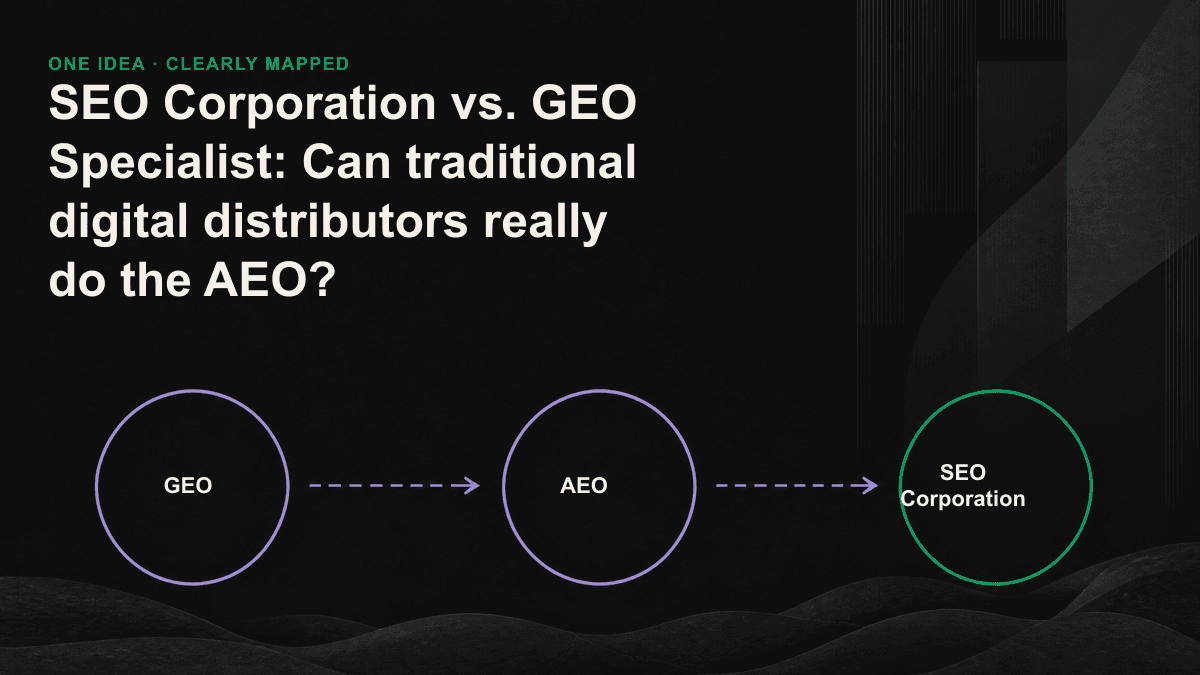
Three abbreviations are often mixed, but the product is completely different. SEO lets the web page line up the blue link list of search results, measured by ranking and organic traffic. The AEO handles the answer box - the phrase that makes your content AI or the Featured Snippet read directly, measured by the number of times taken and quoted. GEO has a broader scope, covering the visibility of the entire generative AI engine: AI will not automatically mention your brand, use your data and list you as one of the recommended options in answering some kind of question.
In other words, SEO fights for a "ordered position," AEO fights for a "readable sentence," GEO fights for a "predict answer in AI's mind." If a company only does the first thing, sells the latter two as an extension of the same thing, it usually starts with the problem.
Where's the traditional digital sales card?
It's not that they don't want to learn, it's that structure that doesn't make it. It lists the four most common walls in practice.
- Measurement indicator error: The monthly newspaper is still reading keyword rankings and GA traffic, but AI quotes that occurred outside the website, and these reports are not being taken at all. You paid, and you couldn't see if AEO was working.
- Content factory habit: Get used to producing long articles, stacking keywords, concluding articles in the middle of the list. AI's engine preference is for preconceptions, self-contained and factually dense paragraphs, which are in the opposite direction.
- Muscles lacking structured data: FAQPage, Article, Organization Schema, physical labels are the foundations of AEO, and many sales-oriented teams will only ask for a copy of the code, which will not be designed for "quoted."
- There is no AI-visible tracking tool: they can't answer the question "When ChatGPT was asked about us last month, how many times," because they don't have this kind of monitoring data.
The deadliest of these four points is the first. You can't manage things without seeing them. A company that can't even show you the results of the AEO will naturally continue to place its resources on a visible ranking, and the AEO will always be a value addition to the proposal.
What's wrong with the GEO agency?
Specializing in the GEO team, delivery sequence is backwards. First you check the gaps in the situation in the main AI engines, then you go back and decide what content and structure you want to change, and then you keep monitoring. As an example of Tenten's execution of the GEO trial, a 30-day review examined three things at the same time: who was the AI engine quoted on your core class questions, whether your web structure could be extracted cleanly, and whether the competition occupied a position in the generation answer? This is different from the traditional SEO audit, which only looks at technical health and keyword gaps.
Six questions. See if a company can do it.
When evaluating the company, don't listen to them saying, "We did it too." Throw the six questions and get out of there.
- How do you measure the AEO results? If the answer is still ranking and flow, the representative does not really do it.
- How do you track the frequency of brands at ChatGPT, Perplexity, Google AI Overviews?
- Can I see an AI-referenced factual report template?
- Where do you actually change the content structure?
- Did you make the structured data, code?
- What's next if after three months AI hasn't quoted me?
Should all of them be replaced by existing SEOs? Not necessarily.
SEO and GEO are not mutually exclusive. The basics of technology, website speed, internal connection, and budget-crawling are the same things that the AI engine eats -- pages that can't climb in, and AI can't read. The logical division of labour is to keep the existing team at the foundation of the technology SEO, and to introduce a GEO partner with the ability to track and extract content with a visual AI capability, with both the answer level and the generating visibility. The two are connected, more realistic than a full package.
Whether a company can do an AEO without looking at what it says and whether it can give you an "AI to quote you" report.
To return to the original question: Will traditional digital distributors be able to do the AEO? Most companies get stuck in the first step because it shakes its established collection logic. If it doesn't work on this one, you should measure your own gaps -- where exactly is your visibility in the AI engine? To figure out where this line falls on you, we can schedule 30 minutes for a GEO diagnostic session, and we'll actually run for you with your own type of problem.