Changing GEO companies is rarely a question of finding better people, mostly because you don't have clear performance criteria and ownership rights. We've taken over a lot of brands, and the last one is not happy for six months, and it turns out that the people who aren't doing it, how they write it, how they do it. In a hurry to change people, usually only dig the same pit again.
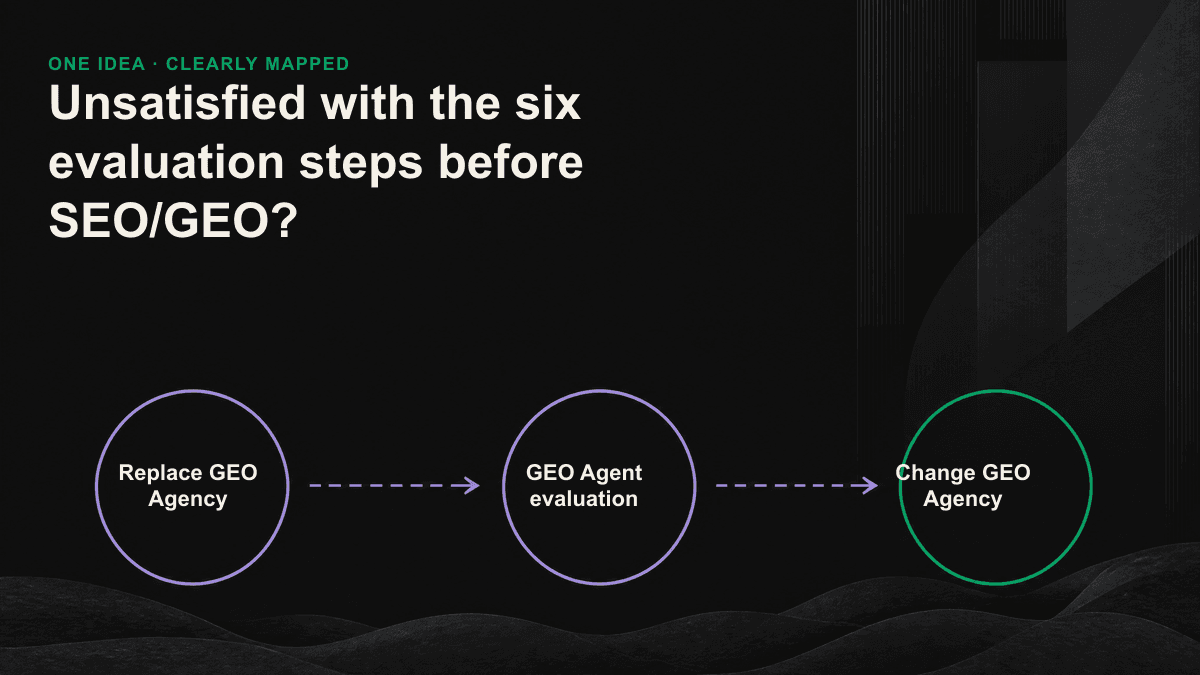
There is a real price for the settlement. You'll lose the content rhythm for a while, you'll lose the quotes accumulated by the AI engine, and the visibility of the transition periods of two to three months is often down. So, before you send the letter, you finish the 6 steps below and make sure you change the factory, not your own judgment.
Step one: first to judge whether the problem lies with the manufacturer or with your measurement.
The most common complaint is "I'm still not able to find myself on ChatGPT." But after all, most of them never set a benchmark: three months ago you were quoted, several times, and who was the competition? Without a starting point, there is no point to talk about. GEO’s effects are already slow, with most of the last three to four months being based on ground-based data, physical consistency, and clean extractable paragraphs. If you judge GEO with "Is this month's phone going to get bigger," 10 manufacturers would be disappointed. Answer yourself honestly: Are you not satisfied with the results, or have you not defined what it means to be fulfilled?
Step 2: Take a look at your real assets.
Most of the agents run you with their own account. Analysis tools, content backstages, visibility tracking, and even original files of your blog articles can be placed under each other's names. Once you tear your face, you can't take these things, you'll start from scratch. Before changing, make sure you have all the following:
- The website analyzes the owner's rights and whether they are attached to your company's account number. Down
- Produced articles, information maps, structured data tags, complete export tape Come on.
- The history and tracking data cited in the AI engine can be exported to your own file
- Domain, CMS, CDN backstage access is controlled by your people.
- Previous monthly reports and locked keywords and original list files
Step three: Open the contract, see the kidnapping and ownership.
Many of the contracts have been written that "results are returned to the client after the settlement has been cleared", but have not written that "the original file must be provided and the account transfer completed upon departure". Those two sentences are much worse. Four things are confirmed: how long will the kidnapping be left, the penalty for early cancellation, the ownership of the content and data, and the transfer of the obligation in writing. If the contract doesn't mention the crossover, you'll probably get stuck in a relationship where you can't do anything. This step takes a lot less time than a subsequent lawsuit.
Step four: Evaluate with proven effectiveness Ren.
When evaluating current manufacturers, don't look at the good-looking empty numbers. The "exposures" "exposures" in the GEO world make little sense because the answer to the AI engine is zero. What really needs to be seen is what your brand is actually quoted, how many times it has been quoted, how wrong it is to describe you at the time of the reference, and how much of the competition is in the same question. These are the hard indicators that match, track and ask the next family.
Step 5: What to ask when interviewing a new vendor?
In the interview with new producers, emphasis is placed on authentication and ownership rather than on how beautiful their briefings are. The next few questions can be quickly removed from the package only. If you don't have a method, you only have adjectives.
- How do you track my quotes at ChatGPT, Perplexity, Google AI Overviews, who owns all this data?
- 90 days ago, what would you do first, how would you set me a benchmark for comparison?
- Will all accounts and content be in my company?
- Show me a case of a quote that you actually did with my industry.
- What was your handover when I was leaving when the contract expired?
Step six: Plan the intersection, avoid seeing the cliff.
The most easily overlooked step is transition. The old plant has already put together structured data, internal connections, physical configurations, and if the new company comes in, it will be re-engineered in the short term - the AI engine will take time to re-establish your consistency. In practice, a one-to-two-month overlap has made the new and old interfaces much safer than today’s cancellation and tomorrow’s offline. The handover list must contain, at a minimum, account privileges, original content files, history of tracking data, and a description of the situation so that the person taking over does not have to retrace it.
The most expensive thing is not to change the company, but to throw away the accumulated visibility of the past six months.
After the six-step review, you should know whether changing agencies is justified and how to do it safely. If the disappointment may come from the provider or from goals that were never defined, quantify the gap first. A GEO audit shows where competitors lead and which issues can be fixed. Set aside 30 minutes for the GEO diagnostic session and we can help decide whether to repair the engagement or replace it.