Ask ChatGPT, Perplexity, or Gemini a Taiwan-focused question in Chinese and the answer may cite a Dcard or PTT post from two or three years ago, or an unfamiliar local news report, instead of the brand's official site. The question type largely determines the source mix. Definitions and factual queries lean toward Wikipedia and news, while reviews, recommendations, and comparisons draw more heavily from forums and user content. Knowing which source type dominates your target questions is more useful than knowing your Google rank alone.
Track the Sources, Not a Ranking
Traditional SEO tracks a keyword's position. An AI answer has no equivalent single rank: a model can read more than a dozen sources, synthesize a response, and display only a few citations. The citation list determines who is visible. When we establish AI visibility monitoring for a B2B client, we begin by opening every target question and recording which domains the model read, trusted, and cited. The focus then shifts from improving one page in isolation to earning a place in the sources the model already uses.
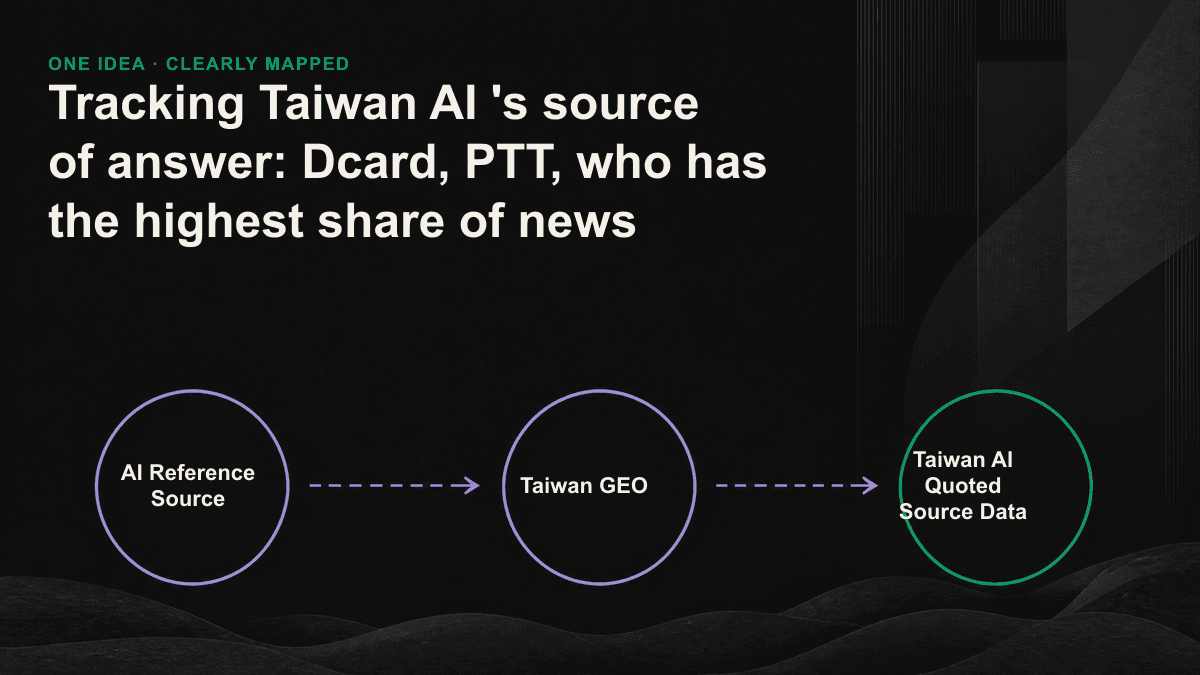
The Source Mix Behind Taiwan AI Answers
The distribution below reflects our long-running observation of Taiwan B2B and consumer queries, not a precise estimate from a public report. Actual shares change with the question, model version, and month. The relative pattern has been stable enough to guide content planning.
- Chinese Wikipedia: The most consistent source across definitions, company backgrounds, and industry concepts.
- News media, including CNA, Economic Daily News, Business Next, and technology publications: Primary sources for current events, market size, fundraising, acquisitions, and policy topics.
- Dcard: A frequent source for reputation, workplace, and consumer-decision queries, especially when the topic concerns younger audiences.
- PTT: Posting volume has declined, but old threads remain widely indexed and often appear in 3C, finance, and specialist long-tail queries.
- Mobile01: An important source for hardware, equipment, enterprise purchasing reviews, and specification comparisons.
- Official brand sites and .gov.tw: Treated as authoritative, but usually cited only when the question points directly to the institution or brand.
Why Forums and User Content Appear So Often
Dcard, PTT, and Mobile01 may trail major publishers in web traffic, yet they often appear disproportionately often in AI citations because their format provides extractable firsthand evidence. People describe a tool in a specific context, discuss both strengths and weaknesses, and answer one another's questions. A product page that promises an "industry-leading solution" gives a model little to cite. A Dcard post stating that a company's support response fell from one day to two hours after implementation gives it a concrete, attributable claim.
Factual Questions Favor News and Wikipedia
Questions framed around "what," "how much," or "which year" tend to pull citations toward Wikipedia and news. Models need statements that are verifiable, dated, and clearly sourced, so personal experience from forums carries less weight. For a B2B brand, that has two implications. An outdated or missing Chinese Wikipedia entry can make the company absent from factual answers. Publishing newsworthy, citable material such as market figures, industry surveys, and named expert views is one of the few reliable ways to enter this source set.
Official Websites and .gov.tw: Authority Does Not Guarantee a Citation
Official and government domains carry authority, but models trust them within defined boundaries. The .gov.tw domain appears frequently in answers about laws, taxes, and public data, then becomes much less common outside those topics. Brand sites behave similarly. A query about Company A's pricing may cite its official page; a query comparing Company A with Company B is more likely to rely on third-party reviews and forums. Authority determines where a source is trusted, not whether it appears in every answer.
What Brands in Taiwan Should Do
- Classify target questions first. Separate factual queries from evaluation queries because each depends on a different source set.
- Strengthen the factual layer. Keep the Chinese Wikipedia entry accurate and publish material journalists can cite, such as original research, attributed figures, and named industry views.
- Build credible third-party coverage. Help real users leave specific experiences on high-citation sources such as Dcard, PTT, and Mobile01; avoid content that reads like undisclosed sponsorship.
- Rewrite official-site copy. Replace "industry-leading" claims with specific, attributable statements and numbers that remain useful when extracted from the page.
- Retest regularly. Citation sources change as models change, so monitoring is an ongoing practice rather than a one-time audit.
Taiwan's AI citation landscape differs from the English-language web. Local forums carry more weight than many brands expect. Instead of guessing how a brand appears in AI answers, run the target questions and inspect the source list behind each one. To see where your brand appears and which sources are missing, book a 30-minute GEO diagnostic session. We will use the questions your buyers actually ask and map the gaps together.