The only worthy pointer for the selection of Taiwan's AI Search Quoting Company is not that it placed itself in the top of the list, but whether it has any way to get your brand quoted in ChatGPT and Perplexity's answers. Most of the "AI Search for Excellence" articles on the market are listed first by the industry itself, neither revealing the test method nor providing a verifiable citation rate. This one goes back: open up a process that anyone can replicate and let the citation rate speak for itself.
Why aren't most of the company rankings on the list? Value
A credible ranking, provided that there are objective, repeatable measurements. But the list you see when you search for "AI Search for Quote" is almost entirely based on the owner's own network or content sales. The list usually lacks three things: a clear rating item, a repertoireable test set, and the original results that third parties can verify themselves. In the absence of these three, the rankings are just ads wrapped in data. The real question to ask is simple -- has the number of times the client's brand was quoted in the AI answer changed?
How do we measure the citation of ChatGPT and Perplexity?
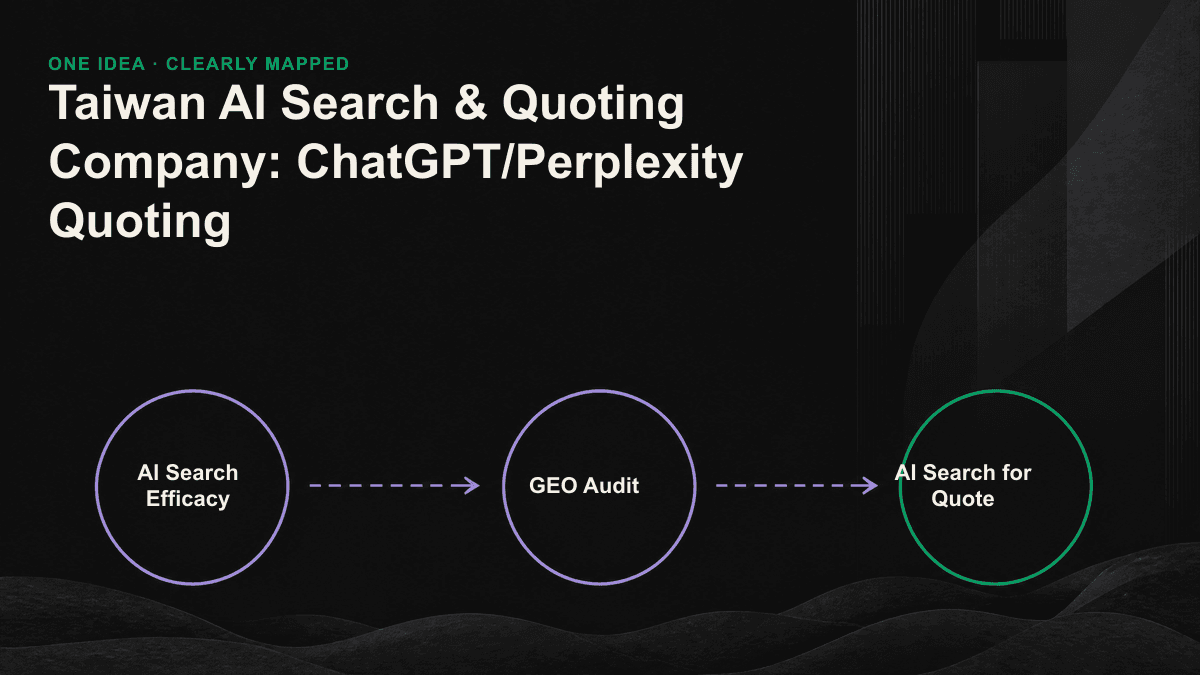
Tenten, when doing the GEO audit, will create a fixed "buyer problem library" for each client, which will typically contain words such as "noises", "noises" and problem resolution questions ranging from 30 to 50. These questions simulate the actual buyers who actually type in ChatGPT, Perplexity, Google AI Overviews, rather than the hard brand name. The testing process is as follows:
- Throw the same set of questions into the ChatGPT, Perplexity, Gemini engines, running three rounds each to smooth the random.
- Records whether each response is named or linked to the target brand, and calculates the `citation rate', i.e. the number of questions cited divided by the total number of topics.
- Documenting the frequency of the competition at the same time and calculating the relative volume, which is also the core of Brand Radar’s tracking field.
- Keep a screenshot of each response linked to the source so that the client can rerun and verify itself.
The point of this approach is not how beautiful the numbers are, but how repetitive they are. Anyone who takes the same library, the same engine and runs again every other week should get close to the end. If a company says that it has a nice citation rate, but does not have a library and original screenshot, that number is meaningless.
Actual finding: three companies, citing results that are far and wide.
There are three broad categories of service providers in Taiwan who have received the AI search for the best, and the difference in the results is clear.
- Traditional SEO agents transposed: still focused on keyword density and external connections, rarely rewritten as "screwed references". The citation rate for class problems is usually low because the AI engine does not find clean paragraphs.
- Pure content farm type: A large number of shallow-texting frames may be quoted sporadically in the short term, but without structured data and factual density, the answers are often covered by more powerful sources.
- A GEO-centric professional team: Pushing the content gap from the library, promoting paragraph-by-section citation, adding Schema and the reality anchor. It is clear that the citation rate for this type of crossword and problem queries is higher.
The source of the gap is not the budget, but whether it was designed as the first target to be drawn by AI. In the eyes of ChatGPT, it is almost non-existent.
High-citation companies, all four of them. Yes.
- The content is divided into "Question-Answer" and each part is singled out as a complete answer, not dependent on context.
- Following the main message closely the specific number, situation or source, the engine was determined to be highly factual and credible.
- Mark the answers clearly with FAQPage, Article, etc., and reduce the chance of being misread.
- Keep tracking the citation rate changes, and treat AI visibility as a long-term monitoring indicator like organic traffic, rather than a closed case.
In the AI search, a quote is much more valuable than a keyword on page 10. There is no improvement in the citation rate, which is equal to no improvement.
Select Taiwan 'AI' to search for the list of inspection companies that have been given an advantage.
- Could it provide a re-emergible trial library, not just a promise?
- Does it reveal a measurement method that allows you to run a rerun at ChatGPT, Perplexity?
- Does it deliver a variation in reference rates and relative volume, or is it just a flow and ranking screenshot?
- Does it have a good content, written for "sniffed," or does it follow the old keyword stacking?
- Did it leave a mechanism to keep track of visibility after the collaboration?
Instead of believing in any of the lists that put yourself first, you should use the same library to test your current brand several times in the AI answer. If you want to know what kind of queries you're looking at, you can set aside 30 minutes for a GEO diagnostic session, and we'll test your real buyer problems and show you the results.