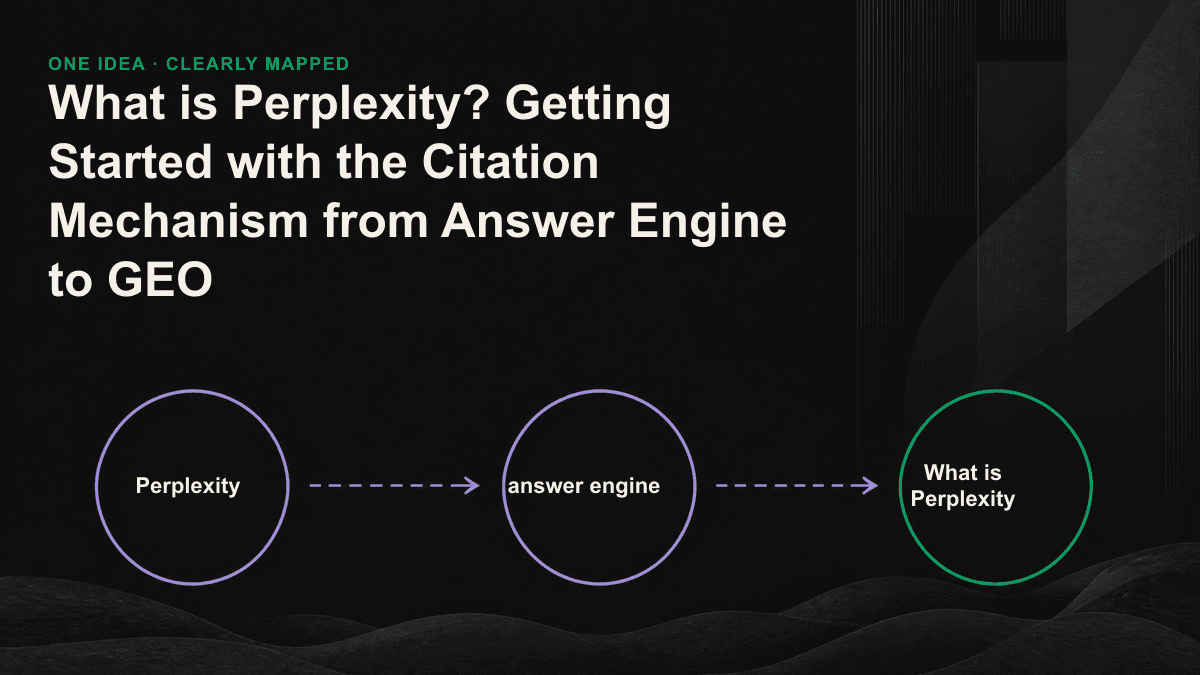
Perplexity is not another Google, but an "answer engine." You ask a question, it directly writes an answer, and puts a number next to the sentence. Click to open the web page it quotes. For those who do B2B marketing, what really determines success or failure is the string of tagged sources: whether your website has been squeezed into those numbers determines whether buyers will see you first when researching solutions.
What is Perplexity
Perplexity was founded by Aravind Srinivas in 2022. Its core is a question and answer interface that connects web search to large language models. You enter a question, and it instantly fetches relevant pages from the Internet. After reading, it generates an integrated answer, and attaches a source link after each argument. By default, it will reference real-time information on the Internet instead of relying solely on old memories during model training. This is also the biggest difference between it and pure chat robots. Traditional search engines throw you ten blue links and ask you to click on them and read them; Perplexity writes the answers first and only leaves the source for you to verify.
This difference will change the user's movement. On Google, people search, scan titles, click on a website, and slowly search for answers on the page. In Perplexity, the answers are given on the first screen. Most people leave after reading the consolidated answers without clicking on the sources one by one. The battlefield of visibility has therefore moved one level forward: what you are fighting for is no longer the number one blue link, but becoming the source named in that answer. For people who are evaluating whether to buy a piece of software, this paragraph is their first impression of you.
How it works: From your question to a footnoted answer
Breaking down the process, Perplexity roughly goes through four steps to answer a question, and the entire section is usually completed within a few seconds.
- Understand the problem: Convert your natural language question into a set of search queries, and break it into several sub-questions if necessary.
- Instant search: Search the Internet and retrieve a batch of candidate pages. This step determines which websites have a chance to advance to the next round.
- Filtering and sorting: Read the content of candidate pages, and select a few sources that can actually answer based on relevance, timeliness and credibility.
- Generate annotation: Use a language model to integrate the selected content into answers, and mark the source number after the corresponding sentence.
Perplexity How to choose sources, this is the focus of GEO
From our experience in tracking citations for clients, being caught by Perplexity is just the ticket; whether it can actually be cited depends on whether the page can be successfully extracted after being read. Let’s take a common situation: an article is on the first page of Google, and the content is solid, but the answers are scattered throughout the article. There is no single sentence that can be used as a reference. After the model has finished reading, it will skip it and choose another page. Its source selection preferences do not completely overlap with traditional SEO, and it clearly prefers several types of pages.
- The content is new enough: When encountering issues such as "latest", "2026" and "current status", Perplexity gives priority to pages that have been updated recently. It is difficult for an article that has not been updated in two years to be selected.
- The structure is clear and easy to extract: there are clear title levels, columns and definition sentences, and it is easier for the model to cut out a quotable fragment from it.
- Answer the question at the beginning: If the page answers the question clearly in the first one or two sentences, instead of introducing the topic in three paragraphs, the probability of being cited is obviously higher.
- Credible sources: official documents, author signatures, and pages with clear organizational information are more likely to be adopted than anonymous content.
- Semantics are truly aligned: It’s not about stuffing keywords, but the page is actually talking about what the user is asking, and the language model relies on semantics to determine relevance.
Why Taiwan B2Bs Should Care Now
Perplexity’s user profiles are particularly beneficial for B2B. It attracts people who take the initiative to do research: engineers check technology selections, marketing executives compare tools, and buyers look for evidence before making a decision. These people are exactly the people you want to reach by spending money on advertising, and they are doing their homework with an interface that directly recommends sources. It is difficult to reach this kind of people cheaply through advertising. If they can be recommended when they actively search for information, their value is much higher than a single exposure. Coupled with the scarcity of citations, an answer usually only lists five to eight sources, which is less than the Google homepage; the brands that are stuck first will be cited repeatedly, forming a cumulative advantage. When your competitors become the default answer to a certain key question, and you try to squeeze in, the cost will be much higher.
If you want to be cited by Perplexity, do these four things first
- Answer first: Answer the core question in the first one or two sentences of each page, and put the details and supporting evidence later.
- Fill in the structure: Use clear titles, columns, and definitions so that the model can cleanly cut out a piece of quotable content.
- Maintenance timeliness: You will be asked about the "latest" topic, update it regularly and mark the update date on the page.
- Strengthen credibility: Name the author, identify the organization, and cite primary sources to make the source appear worthy of use.
Three common misconceptions about Perplexity
The first misunderstanding is to think of it as a chatbot. The value and risk of Perplexity lies in sourced answers, not in free dialogue. The second misunderstanding is that if SEO is done well, it will automatically be cited; ranking and being cited are related, but not the same. A page that can be captured but cannot extract the answer will still lose the ranking. The third misunderstanding is that it is too early. Judging from the behavior of Taiwan’s B2B buyer research tools, AI answer interfaces have already entered the early stage of the decision-making process. By the time it becomes mainstream, the adoption advantage of advanced players will have already taken shape.
If you want to know which key issues your website is cited in Perplexity and other AI engines, and to whom, you can book a 30-minute GEO diagnostic session. We'll actually check it using questions that are actually asked in your industry, so you can see where your current citation gaps are.