How dare you call yourself "the strongest GEO agent in Taiwan" not a marketing slogan, but the result of our willingness to put delivery booths on the table to be tested by clients? Most people on the market are still saying "SEO" and we're tracking B2B SaaS clients. They were quoted several times in ChatGPT, Perplexity, Google AI Overviews, by whom, and missing which piece of structure. It's not about the vision, it's about the three things that we do every day and we get evidence.
Let's get this straight: GEO is different from SEO.
Traditional SEO looks at rankings, organic traffic, clicks. GEO looks at another set of things: when potential clients ask AI, "What's a good B2B SaaS consultant in Taiwan," did your brand appear in the resulting answer, which page was quoted, and how AI describes you? There's no blue connection in the middle, and visibility becomes a sign that needs to be actively monitored. Many agents can't even say "how to measure", let alone say "good."
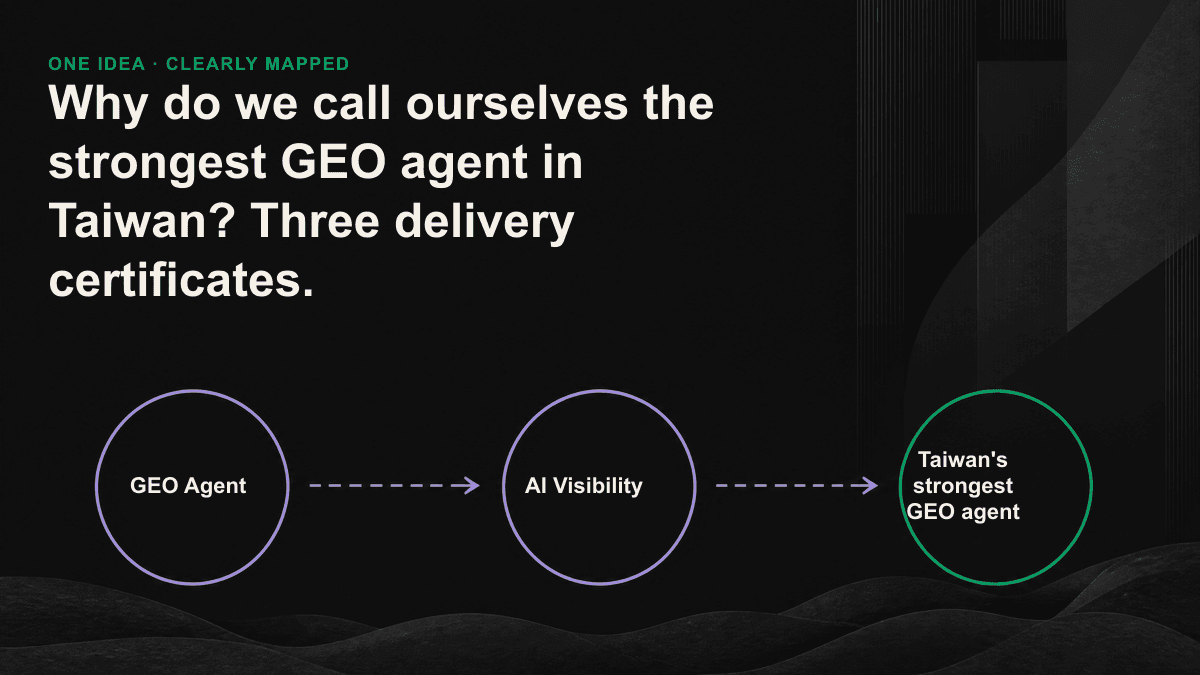
So we've decided that a GEO agent is not strong enough to look at three things: can we measure AI visibility, can we point to specific gaps within a limited time, and can we produce content that is really going to be cited by AI? The following is delivered on a case-by-case basis.
Delivery certificate one: AI visibility monitoring turns AI visibility into a traceable number.
No measure, no merit. Our AI visibility monitoring will create a list of real buyers who will ask AI about their business, run these questions regularly on mainstream generative AI engines, documenting three things: whether your brand has been mentioned, which page is the source of the quoted URL, and which AI has given you an inaccurate description.
- Reference Rates: In a set of key questions about the industry, AI's answer refers to your ratio and monthly trends.
- Source attribution: AI, when quoting you, is the actual page -- often not the front page, but a technical piece that nobody cares about.
- Competitions: In the same question, who is mentioned and who is not mentioned, lets you know where the gap is.
The value of this tracking is that it replaces the vague anxiety that we have in AI with numbers that can be taken to meetings every month and set targets. One of the most frequent reactions of clients when they first saw the report was that, originally, AI was quoting us, and that's the article that we all forget.
Delivery certificate II:30 Days GEO audit, issuing an enforceable list instead of an empty general recommendation
Audit is the easiest to become a pretty, but no one will do it. Our GEO trial is designed to do it backwards: 30 days to deliver a list of impact-based gaps, each with a clear picture of the problem, why AI can't catch it, which file or which structure to change.
The Board has several layers of content: whether the content is organized in a "question-answer" way, whether there are clean and accessible paragraphs on key pages, whether Schema structure labels allow machines to read your services and prices, whether robots and llms.txt have blocked or released the release of AI crawlers, and, most importantly, whether your content does not answer the buyer's questions about AI.
The audit report is good and bad, not to see how thick it is, but to see if the client can hold it and change the first three without us.
We're putting the expected impact and repair costs on every gap mark so that the client decides what to do first. Some of the teams took the list and ran the first few entries themselves and saw an increase in the number of AI citations, which is good for us -- it proves that the gaps are right.
Deliverable Three: A Content Engine Built to Be Quoted, Not Merely Ranked
The reference to the AI engine has its preferences: the paragraph is self-contained, post-opposition evidence, information density, structure is clear enough to be the answer. Our GEO content engine does not write more than a few blogs, but organizes every page based on the logic of this -- each section answers one question on its own, each with numbers or circumstances behind it.
- Make the buyer really ask AI's questions, make it a skeleton of content, instead of trying to spell it first.
- Each article leaves clean paragraphs and FAQ, so that AI does not break the rules.
- Matching the AI Agent policy so that content can stand when AI agents actually do their job, compared to suppliers.
The difference is very practical: an article written for ranking, the keywords are finished; an article written for quotes, has to allow AI to repeat your point. It's a lot harder to write after, and it's where we spend the most effort.
Three things are actually the same line.
These three deliveries are not a stand-alone list of services, but a closed loop: AI visibility monitoring tells you how AI is looking at you now, how the audits point to why and where to change, and the content engine fills the gap with what will be quoted, and then AI visibility monitoring takes another test of progress. Without any ring, GEO goes back to guessing. We dare to call ourselves the strongest because each of us has actually delivered the week, not just a slide.
If you're assessing whether or not you want to go to GEO, the point is not to sign the contract, but to understand the situation. You come to us with a few of your favorite buyers' questions, and in 30 minutes you'll have a specific ruling about your AI visibility that can be taken back for discussion.