You're first in Google's search for "B2B Scheduling Software" but may not exist in ChatGPT, Perplexity and Google AI Overviews. These two events overlapped in 2024, and in 2026 they were two separate competitions. The traditional SEOs are the same as placing all the bets at a shrinking entrance.
The core of the change is not Google disappearing, but the users ask more questions. A technical manager who evaluates the purchases may ask, "What tools are there to integrate Salesforce" and then get a comparison at ChatGPT, and finally check your brand name in Google to confirm your review. If you only show up at the last minute, you don't even have a chance to think about the last two decisions. That's what multi-engine visibility deals with: make sure you're read and quoted everywhere you're asked.
The entrance is cracking, not disappearing.
The time of "search" as a single battle is over. Google pushes the answer up, and AI Overviews generates a summary directly at the top of the page. Users do not have to scroll down, let alone click on your website. At the same time, ChatGPT built a search, Perplexity as a source, Gemini bound the entire Google and each developed an independent content capture and sorting logic. These engines don't necessarily give the same answers, because they read different sources, trusted signals.
- Google traditional blue link: there is still traffic, but the view rate is diluted by AI Overviews above.
- Google AI Overviews: Generate the answer directly to determine whether your contents were taken in.
- ChatGPT: How can the shortlist of right and right be shaped by the search and comparison of the problem?
- Permexity: Central to the logo, listed as the source of a brand endorsement.
- Gemini: Tie Google Workspace and Android in the daily workflow.
Number one, not to be quoted
The most common misunderstanding is that if SEO does well, the AI engine will naturally quote me. In fact, the selection system is different. The traditional rankings are based on a set of links, keyword matching, page experience; when the AI engine produces the answer, it prefers to extract the content of the "constructed, directly answerable, semantic paragraphs". One of the keyword stacks, which hides the focus on the fifth section, Google may still be able to line up, and the AI model will skip it, to quote the source of the answer.
We repeatedly see the same gap in cross-engine visibility reviews: a page ranks in Google's top three for a keyword but is never cited when the corresponding question is asked in ChatGPT or Perplexity. The content is often sound; it was written to be ranked by a search engine, not extracted by a language model. Those two optimization goals have begun to diverge.
What is multiengine visibility tracking?
Multi-engine visibility is not changing the name of SEO ranking. It measures the frequency and location of your brand being mentioned, quoted, recommended in the answers to the various AI engines, under a set of real questions about your business. This requires asking the same questions on a regular basis across the engine, documenting who was cited, how many pages you ranked in, and how many pages you competed for.
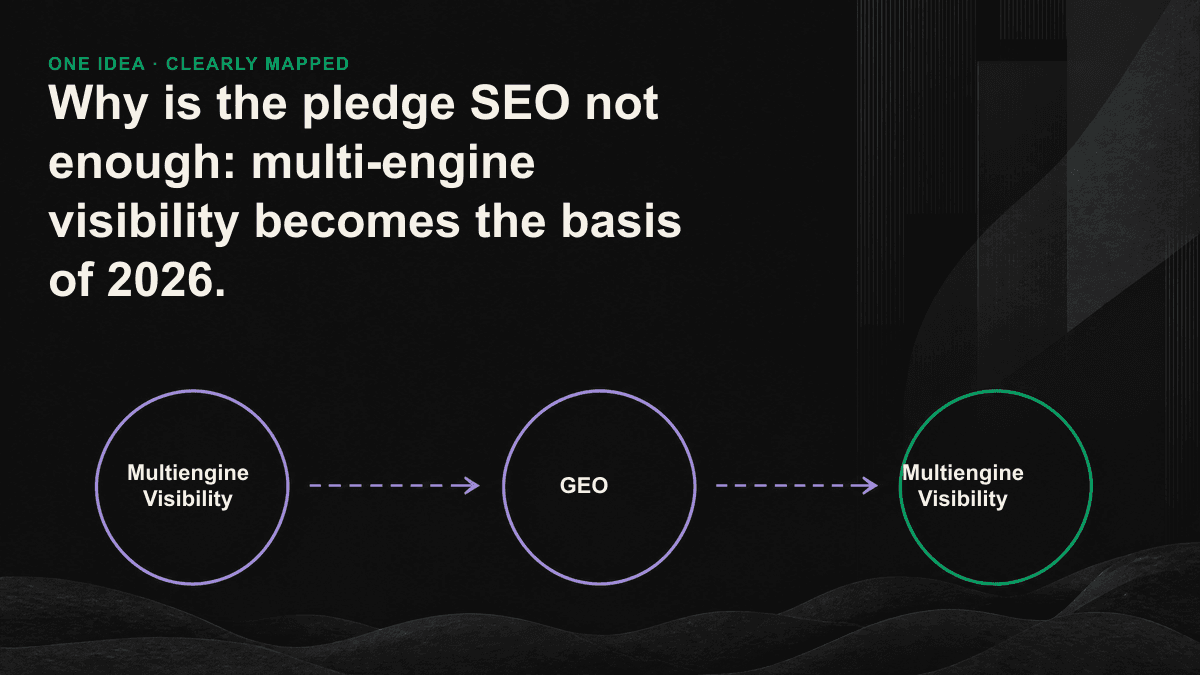
With this map, the resource allocation is based. You'll see you're often quoted in Perplexity, in ChatGPT, and always absent, or a competition almost breaks answers to some kind of question. These gaps are not visible in the traditional SEO tools because they only look at Google's ranking.
There's a different logic of capture and a different order of priority.
There is one thing you have to accept before investing in resources: there is not a single set of content that can accommodate all engines at the same time. They have different sources, new frequency, and interpretation of authoritative signals. It's better to prioritize where your clients actually are, than it's spread out on average.
- Perplexity: Extremely value the sources that can be quoted, breaking the answers into clear paragraphs, with specific numbers, and most easily listed as source.
- ChatGPT: Prefer structure, question-and-answer format, clear-sighted content; highly mentioned brand, more likely to be recommended.
- Google AI Overviews: still eats the foundations of the traditional SEO, but expands the ability to summarize, and the titles and paragraphs are taken directly.
- Gemini: A high connection to Google Index, your established technology, SEO Foundation, will continue to influence.
2026 How to allocate resources
Don't have to cut SEO. Traditional searches continue to be the largest existing source of traffic for most B2B brands, and some of the authoritative signals they signal will spill over to the AI engine. What really needs to be changed is the attitude: to treat SEO as a track in a multi-engine strategy, not as a whole. In practice, the sequence is usually to measure the situation in the engines first, to find the most important places, and then to recast the content into a form that can be sequenced and extracted at the same time.
First measure, then input. There's no cross-engine visibility benchmark, and any content budget is spent on feelings.
Where do we start?
The starting point is not to write more than a few articles, but to know which engines are now read and where they disappear. Lists the real questions that 15 to 20 potential clients will ask, and take a round of questions from ChatGPT, Perplexity, Google AI Overviews, and remember who you were and who you were quoted. This manual drive will immediately show you the most urgent gaps. If you want a system-based, cross-engine baseline and priority repair sequence, you can set aside 30 minutes for a GEO diagnostic sessions to show your visibility map first.