If you want ChatGPT, Perplexity, and Gemini to treat a company as a distinct entity with clear attributes, Chinese Wikipedia can be one of the most effective places to strengthen recognition. It is not a page where a company can simply publish its own profile. Wikipedia has strict inclusion and verification rules. Whether an entry can be created, survive review, and support clean AI citations depends on the independent, verifiable sources behind it.
Why Wikipedia Matters to AI Systems
Chinese Wikipedia is disproportionately useful in the training and retrieval material of major language models because its pages are structured, fact-dense, and supported by visible citations. That makes it a relatively low-ambiguity source of factual anchors. Wikidata matters even more: its structured entity records feed knowledge graphs and AI systems. When someone asks what a company does, those systems often begin with its definition, founding year, industry, and official URL.
This is a core difference between GEO and traditional SEO. SEO asks whether a page can rank for a keyword. An AI system also needs to recognize the underlying entity and distinguish it from companies or products with the same name. A Wikipedia entry linked to Wikidata gives the model an identity record containing the name, aliases, industry, and relationships. Without that record, a model may confuse the company with an unrelated business or conclude that it cannot identify the company at all.
Pass the Notability Threshold Before Writing the Entry
The first threshold on Chinese Wikipedia is notability. In plain language, has the subject received substantial coverage from reliable publications that are independent of it? A company site, brand blog, press release, and sponsored article do not establish notability because they are not independent sources. This is where many companies misunderstand Wikipedia: it is not a place to introduce yourself. It is a page that summarizes how independent sources have covered you.
- Sources that count: In-depth reporting with editorial oversight, attributed research from a credible industry analyst, academic or book references, and reputable awards with public criteria.
- Sources that do not count: The company site and blog, company press releases, content-farm reposts, and directory mentions that offer only a sentence.
- Gray area: Paid features and material labeled as provided by the company often fail the independence test even when they appear in a major publication.
Build the Source Foundation Before the Entry
A weak source base is why most brands get stuck, and it is one of the gaps we address most often in a GEO audit. Do not create an entry first and search for citations afterward. Reverse the sequence: earn enough substantial, independent coverage to support the article before submitting it. We call this source development. The same material serves two purposes: it establishes Wikipedia notability and gives AI systems independent evidence they can cite directly.
- Pursue an editor-reviewed interview or case report in an industry publication instead of distributing a basic press release.
- Turn original data and analysis into attributed research or an annual report that other writers can cite.
- Apply for credible industry awards with public judges and selection criteria.
- Verify that company records in public government or industry-association directories, including .gov.tw sources, are accurate and consistent.
- Keep the company name, founding year, address, and official website consistent across the web. Conflicting entity details directly weaken credibility.
Three Compliance Rules for Editing
Good sources do not rescue a noncompliant edit. Remember three rules. First, disclose conflicts of interest: if you or a paid representative has a financial relationship with the subject, Wikipedia expects disclosure and recommends submitting a draft for community review instead of publishing directly. Second, write from a neutral point of view. State verifiable facts and remove marketing adjectives such as "industry-leading" or "best solution." Third, avoid original research. Every important claim must connect to an independent source; do not add information simply because the company knows it to be true.
Connect the Entry to Wikidata
Entries that AI can cite cleanly share several traits. The opening sentence gives a concise definition, such as "Company A is a Taipei-based business focused on B2B software," naming the subject, location, and industry at once. The infobox provides structured fields such as founding year, industry, and official URL. Finally, the Wikidata item behind the entry exists, contains accurate properties, and matches the name and data used on the official site and LinkedIn. That structured layer supplies raw material to knowledge graphs and AI entity stores.
Wikipedia summarizes how independent sources describe you; it is not a stage for introducing yourself. What you can control is whether credible sources have enough reason and evidence to write about you.— Tenten GEO consulting team
Common Mistakes and Better Approaches
- Creating an entry before independent coverage exists: Develop the source base first and make the entry the final step.
- Writing the entry as sales copy: Use neutral, verifiable statements and let the cited sources support the claims.
- Hiding a conflict of interest: Disclose the relationship and use draft review; transparency gives the page a better chance of surviving.
- Focusing on the entry while ignoring Wikidata: Without a structured entity record, knowledge graphs may not connect the brand correctly.
- Leaving inconsistent facts across the web: Align the name, industry, founding year, and official URL before working on Wikipedia.
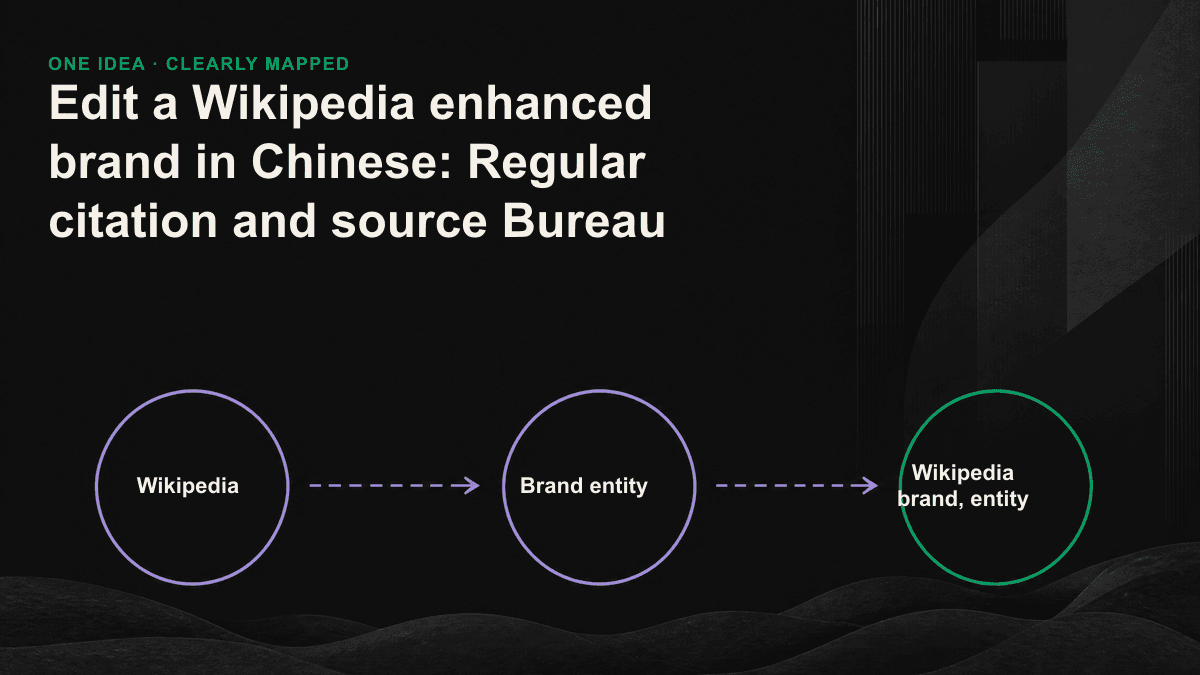
A Wikipedia entry anchors the brand entity in AI memory; it is not the endpoint. Its value extends beyond Wikipedia. The same independent sources also become citation material for ChatGPT, Perplexity, and other engines. If you are unsure whether your current sources support an entry, or want to see how AI engines identify or misidentify your brand, book a 30-minute GEO diagnostic session. We use AI visibility monitoring to inspect the entity profile and gaps across models.