The person who decides whether to buy your SaaS may no longer be a human being. When a user says to ChatGPT, "Help me find a project management software that can connect to Slack, support SSO, and costs less than 5,000 per month," the agent will read ten websites for him, extract key facts, and throw back three options. At that moment, your product page is read as a spec sheet rather than marketing material; unable to extract the price, unable to capture the integration list, unable to understand the differences between the plans, you simply disappear from the shortlist without even a chance to be rejected.
This happened faster than most B2B teams expected. Agentic commerce is not as narrow as "AI helps you check out." It means that the research, comparison, and screening before purchasing are all done by agents, and humans only make the final decision. In other words, there is a gatekeeper in front of the decision-makers you spent efforts to persuade in the past: a program that does not read the brand story and only recognizes structured facts. It can’t read you, and decision-makers can’t see you.
The agent is not the type of user you are familiar with
Think of the agent as an impatient, non-swiping, non-animating visitor. It won’t wait for the hero block to fade in, it won’t be impressed by your community testimonials, and it won’t click through a three-level drop-down menu to find a price. What it does is very mechanical: crawl the page, parse the structure, extract the required fields, compare it with other candidates, and then decide whether to put you on the shortlist for humans to see.
There is a cruel gap hidden here. Your page may look beautiful to people, with large pictures, white space, and well-designed interactions; but what the agent reads may be a bunch of <div>s with broken semantics, the price is in the picture, the solution relies more on JavaScript dynamic loading, and the key specifications are written in the PDF to be downloaded. People can see it, but machines can’t catch it. In the world of agentic commerce, if the machine cannot catch it, it does not exist.
What agents are actually looking for on your page
When we do GEO audits for clients, we use a very crude method: throw the original HTML of the product page to the model and ask it "How much does this product cost, what integrations it supports, and who it is suitable for." If it cannot answer or answers incorrectly, the agent will probably not be able to answer either. In practice, agents are repeatedly looking for these types of facts:
- Price and billing: clear numbers, currencies, and periods, rather than just "contact us for a quote."
- Capabilities and integration: What this software can do and which systems it can connect to, it is best to have a list that can be enumerated.
- Applicable objects and restrictions: It is suitable for teams of several people, which industries, and whether there is any upper limit or prerequisite for use.
- Differences in plans: What are the differences between different plans? Use comparable fields instead of marketing adjectives.
- Trust signals: terms, security compliance, refund policy, agents will filter these first for cautious buyers.
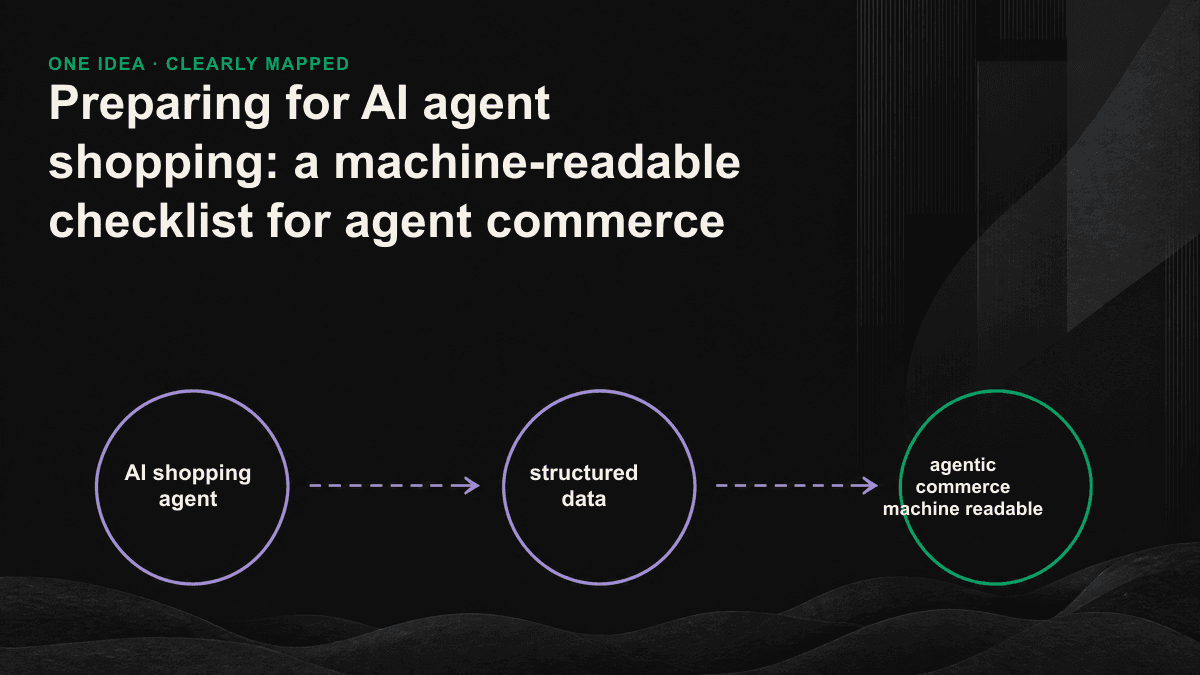
Structured data: from decoration to interface
Many people also regard Schema.org markup as the icing on the cake in the SEO era, and adding it may get a star rating. With agentic commerce, its role changes: it’s the formal interface between you and the agent. Types such as Product, Offer, Organization, and FAQPage mean that you take the initiative to spread out prices, supply status, and frequently asked questions in a format that a machine can understand at a glance, saving the agent from having to guess which part of your layout is the price and which section is the plan.
Semantic HTML and cleanly extractable content
Structured markup handles those explicit fields, and the rest of the text relies on semantic HTML. When the agent extracts the text, it relies on structures such as title hierarchy, lists, and tables to determine which sentences are important and which are parallel options. A page that is layered with <h2> and <h3>, uses a real table to compare plans, and uses a list to list capabilities, the model will be very clean; a page that is all stuffed into <div> and then arranged by CSS will be a bunch of words without hierarchy.
Markdown ideas work well here. If you can clearly describe a page as "Markdown in your mind", with a title, a list, and aligned columns, then it is probably friendly to agents; conversely, a page that must be read visually is usually a page that agents cannot understand. This is why we often recommend customers to use isitagentready to self-check: first confirm that the machine can read it, and then talk about whether it can be read.
Pricing and tradability: the area where agents are most likely to get stuck
By studying and comparing these two paragraphs, most teams can improve by adding structured data. It’s that last paragraph that really stuck: tradability. The contemporary ideal takes one step forward for users to try out, add purchases or make reservations. It requires an entrance that can be operated by a program, clear actions, a stable form, and a next step that can be completed without relying on human judgment. If your next step is to fill out a ten-column form, wait for a call back from the business, and send three letters back and forth for a quote, the agent will stop at this point, returning the user to the manual process, while the user will have already gone to order the next competing product that can go all the way.
We have seen too many product pages. People think that the information is complete, but if we throw it to the model, we can't extract the price. The difference is often just whether the facts are written in a machine-readable form.— Tenten GEO
A machine-readable checklist to get started today
To condense the above into something that can be done, the starting points we give our customers are usually these five items, sorted by the return rate:
- Write price and plan differences into real, crawlable text and tables on the page, don’t hide them in images or PDFs.
- Supplement the main product page with Product, Offer, and FAQPage structured information, and ensure that it is word for word consistent with the page content.
- Use semantic HTML to reorganize the text: title layering, capability lists, and plan tables.
- Write the most frequently asked pre-purchase questions into paragraphs that can be individually extracted with one question and one answer.
- Check whether the "next step" can be completed by the program: trial, reservation, quotation, at least leave a way without waiting for others.
This list doesn't involve redoing the site; most of the items are just adding structure, adding facts, and removing friction to existing pages. The hard part is knowing which piece you are missing: whether the machine can't read it at all, or whether it's read but not enough to be shortlisted. If you want to see what your product page looks like in the eyes of agents and where it is stuck, you can book a 30-minute GEO diagnostic session and we will walk you through it with actual extraction tests.