The previous value of structured data was to help you get rich results such as stars and FAQ drop-downs in Google search results. In the era of AI search, its most critical use has become something else: taking the facts on your website and handing them directly to ChatGPT, Perplexity, and Google AI Overviews in a format that machines can read without ambiguity. Without it, AI can only rely on guesswork to describe your brand; with it, you are handing out a fact sheet that has been proofread. This is especially important for B2B SaaS, because pre-purchase comparison and evaluation increasingly occur in AI conversations rather than ten blue links.
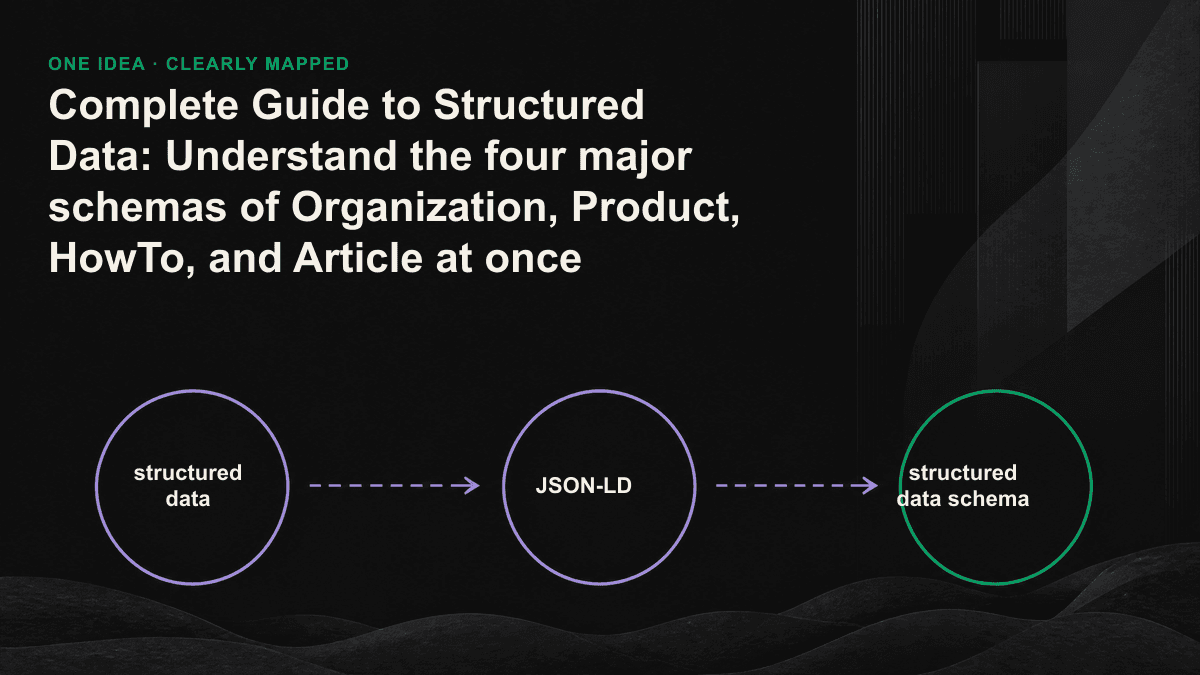
Technically, structured data is a piece of JSON-LD put into the page: a piece of JSON wrapped in a script tag, describing what the page is about, what category it belongs to, and what fields it has. JSON-LD is the most recommended writing method by Google because it is separated from the page content, is easy to maintain, and is also the easiest to parse by AI crawlers. There are four categories that B2B websites should deal with first: Organization, Product, HowTo, and Article. Before you get started, let’s first see clearly what structured data does for AI:
- Eliminate ambiguity: tell the machine "Tenten is a company", not a product or a person's name, and there is no need to rely on context to guess.
- Establish entity links: Use sameAs to point the official website, community, and third-party databases to the same entity, so that AI will not confuse you with a company of the same name.
- Hand over trustworthy fields: Putting facts such as the year of establishment, service type, and contact information into fixed fields will make them easier to quote than hiding them in the content.
- Reduce extraction costs: AI does not have to decipher the entire page of HTML to get clean facts, and the chance of being written into the answer increases.
Organization Schema: Let AI recognize who you are first
Among the four schemas, Organization is the foundation. It is recommended to put it on the homepage and share it with the entire site. It will set up a clear entity node in the knowledge graph for you. All subsequent descriptions of the brand will have a place to hang them. The most common mistake here is not missing fields, but calling the same company different names in different places: Tenten GEO on the homepage, Tenten on the about page, and Tenten Inc at the end of the page. The name, logo, and URL must be aligned verbatim with LinkedIn, Google merchants, and social platforms. The required and recommended fields are as follows:
- name: The official name of the company, which is completely consistent across the entire site and platform. Don’t even mess up the uppercase and lowercase letters.
- url: The main URL of the official website.
- logo: Official logo image URL, used by AI-generated brand cards.
- sameAs: The link array of LinkedIn, official communities, Crunchbase, Wikidata, etc. is the most underestimated but the most important field in GEO.
- contactPoint: customer service or business contact information, so that AI can provide a contact channel when recommending you.
- description, foundingDate, areaServed: one sentence positioning, year of establishment, service scope, fill in it if you can.
Product Schema: Let AI speak to your product
SaaS products can use Product, or more accurately SoftwareApplication type, to organize what you sell, how much you sell, and how others evaluate it into a structure. When the user asks the AI "Are there any recommended B2B GEO tools?", the page field marked with Product is ready, which saves AI effort. For example, divide the plan into three levels: trial, standard, and enterprise, and mark them clearly with offers, so that AI can determine the price range. Key fields:
- name, description: product name and one-sentence description.
- offers: price, currency, plan, fill in if there is public pricing, it can help AI answer questions such as "how much".
- applicationCategory: software category, such as BusinessApplication.
- aggregateRating, review: overall rating and individual reviews.
Be especially careful with aggregateRating and review. Google explicitly prohibits review tags that "rate yourself with stars": You cannot put a company on your own page and then mark a five-star self-evaluation. This will be considered a violation, and in serious cases, the entire rich result page will be removed. Ratings should come from real, verifiable third-party or user reviews. It is better to leave them blank than to make them fake.
HowTo Schema: The double-edged sword of step-by-step content
Let me first tell you a fact that many people don’t know: Google has stopped displaying HowTo’s rich results in search results in September 2023. In other words, if you mark HowTo, the desktop search results will no longer have the step expansion area. Many people think that HowTo is useless. In fact, its value has just changed its place: from "getting Google rich results" to "letting AI cleanly extract steps." When the content is originally a step-by-step instruction, use HowTo to mark each step, tool, and supply clearly, so that the language model does not have to guess the order when retelling the process.
Article Schema: Write E-E-A-T into a machine-readable field
Blog articles, white papers, and resource pages should all have Article schema. Its focus is to turn credibility signals such as author, publication time, and update time into fixed fields, rather than merely to let Google recognize that this is an article. When the AI engine decides who to cite, it will look at whether the author of the content is clear and whether it has been updated recently. Content that is anonymous and does not know when it was written has a significantly lower chance of being cited. The key fields are headline, author, datePublished, dateModified, and publisher; author is recommended to be connected to a Person type entity, with professional background and sameAs, instead of just leaving a name string, turning E-E-A-T's professionalism from empty words into machine-verifiable data.
The pattern we see in customer projects is very consistent: pages with complete entity tags and clear author information have a significantly higher rate of being mentioned correctly in AI answers than pages with only text and no structured data.— Tenten GEO
Common mistakes and where to start
- The tags are inconsistent with the content visible on the page: If ratings or FAQs that are not on the page are marked, Google will determine the manipulation, and in severe cases, the entire site will be downgraded.
- Missing to fill in necessary fields: Each schema has a required attribute. Without the verification tool, an error will be reported directly, and the AI will not be able to obtain complete facts.
- JSON-LD syntax error: one comma is missing, the brackets are not closed, the entire markup will be invalid, and the browser will not issue a warning.
- The entity names are inconsistent across pages, causing the machine to treat the same company as several.
Before you start, use Google's Rich Results Test and Schema.org validator to confirm that the syntax is passed and the required fields are complete. However, passing verification does not mean it is valid: the real acceptance is to ask the AI questions about your brand to see if it parses the entities correctly and references the fields on your page. The order of priority is also very clear. Let Organization go to the homepage first, fill in sameAs, then fill in Article for the content page, fill in Product for the product and pricing page, and finally use HowTo as appropriate. If you are not sure which piece you are missing, or whether AI has recognized you correctly, this is exactly what the 30-minute GEO diagnostic session will help you see: use your actual questions to show you the gaps in structured data and the order in which they should be filled.