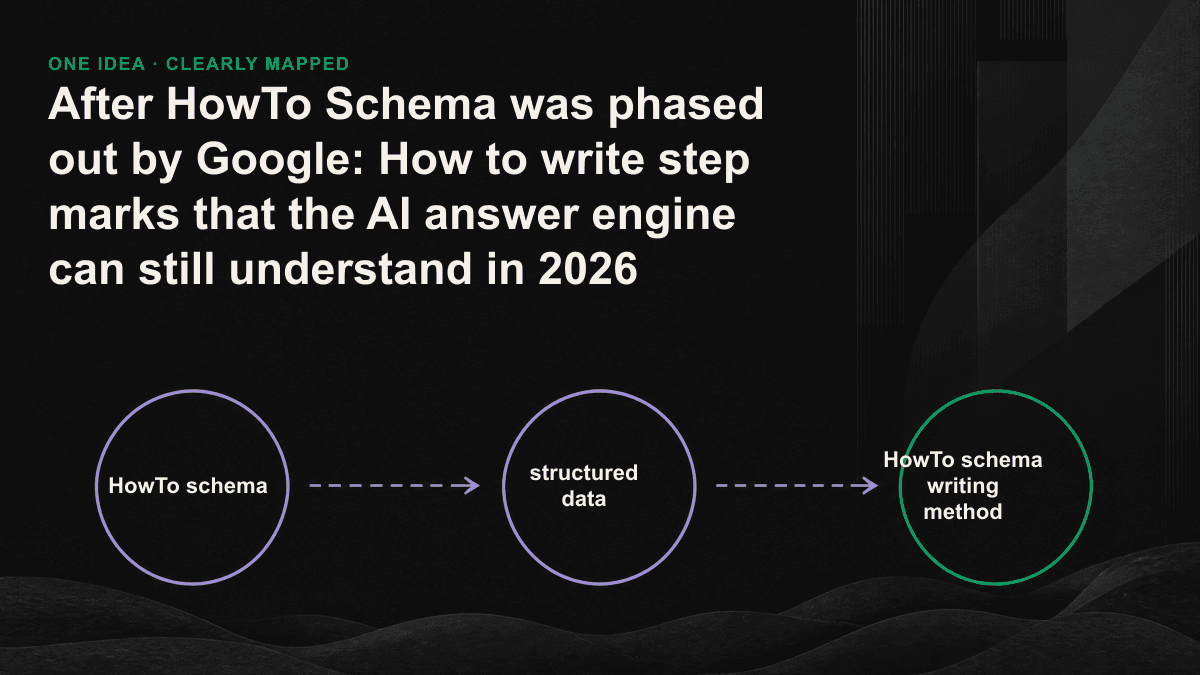
Google removed the HowTo rich results from search results in 2023. Many teams saw the step cards disappear from the layout and cut off the entire HowTo tag. This is a misjudgment. The disappearance of rich results only means that your steps no longer appear in the form of cards under the blue link; the HowTo schema.org type itself has not been abolished, and the AI answer engine that crawls web pages exactly needs this kind of structure that cuts clean steps. The markup needs to continue to be written, but the person you write to has changed from Google Typesetting to ChatGPT, Perplexity and AI Overview.
Google fades out rich results, not structured data
Let’s get the facts straight first. In September 2023, Google first limited the HowTo rich results to desktop computers, and then removed them entirely; the FAQ rich results were also significantly reduced in the same wave, and were only reserved for a few government and medical websites. So now you search for a tutorial on Google, and you don’t see an expanded list of steps, or a thumbnail to click on. This is Google's decision on the layout of search results, not the schema.org vocabulary. The types HowTo, HowToStep, and HowToTool still exist in the specification, the syntax is legal, and the machine can still parse them.
The difference is "who is reading". In the past, the purpose of writing HowTo was to let Googlebot help you grow rich results. Now read your tagged, one more batch to retrieve the AI engine that enhances the generation operation. When they crawl the web page, they will cut the content into segments and then send them to the model; when your steps have been marked with a structure to mark the order and boundaries, the quality of the slices will be high, and it will not be easy to mistakenly connect the content of the third step to the first step when quoting.
Why AI answer engines especially like step structures
“How to X” is the most commonly asked question type of AI assistants. Users want a set of actions they can follow, not a long article where they have to find the key points themselves. When the engine determines that a page can correspond to this intention, it will prioritize extracting fragments in a clear order. The HowTo tag just explains four things at once.
- Sequence: The order of the step array tells the engine which step is first and which step is last, without having to guess from the text.
- Boundary: Each HowToStep is an independent unit, and the two steps will not be glued together or cut off when slicing.
- Correspondence: The name and text fields separate "what is being done in this step" and "how to do it specifically" to facilitate accurate excerpting by the engine.
- Credible: When the marked content is consistent with the visible text on the page, the engine is more willing to treat you as a citable source rather than skipping it.
How to write HowTo that you can still understand in 2026
The skeleton has only two layers: a HowTo in the outer layer and a step array in the inner layer, where each element is a HowToStep. At least a name must be given to HowTo, and a name and text must be given to each step. If necessary, add HowToTool (tool), HowToSupply (material), and the image or anchor URL of each step to facilitate the engine to connect the fragment back to the correct location on the page. Write it in JSON-LD and put it in the head or body of the page.
A simplified example looks like this: { "@context": "https://schema.org", "@type": "HowTo", "name": "How to set up GA4 conversion events", "step": [ { "@type": "HowToStep", "name": "Create a custom event", "text": "Enter the GA4 management interface, click "Events" and add a custom event.", "url": "https://example.com/ga4-guide#step1" }, { "@type": "HowToStep", "name": "Mark as a key event", "text": "In the event list, turn on the "Mark as a key event" switch for this event.", "url": "https://example.com/ga4-guide#step2" } ] }. The url of each step uses an in-page anchor, allowing the engine to point the reference directly back to the corresponding paragraph.
Which page should be placed and which page should not be placed?
HowTo only marks content that really exists on the page and is really "steps to complete one thing." A one-page instructional text, a setup guide, and an installation process are all suitable. Every step in the markup must be found in the visible text; if you impose a HowTo on a product page that only has marketing copy and no actual steps, that is a misuse of structured information and will only hurt trust in the long run. The judgment is simple: if this page is printed, can readers follow it step by step? If not, don’t use HowTo.
How to divide work with Article and Product
A page usually has more than one schema. A reasonable combination of teaching pages is: use Article to explain the title, author, and publication time of the article itself, and use HowTo to explain the operation steps inside. Both of them perform their own duties and do not compete for the same piece of content. If the steps are to teach people to use a product, Product or SoftwareApplication can describe the product ontology, and HowTo describes the operation process. The principle is that each type only tells what it should say. Don't let multiple types describe the same paragraph of text just to stuff keywords.
How to verify and track results
Google's Rich Results Test no longer previews HowTo, so don't use it for acceptance. Use schema.org's official Schema Markup Validator (validator.schema.org) instead. It only checks whether the syntax is legal, regardless of the rich result policy, which is exactly in line with the current purpose. After passing the grammar test, what you should really pursue is the citation: have your steps been captured by the AI answer engine to answer the question, and have your sources been marked? There are endless questions to ask manually about this matter, and you have to rely on tools that can regularly monitor the visibility of AI engines, such as Brand Radar, to record who is cited and in what terms.
The value of HowTo tags has changed from "an extra card on the Google layout" to "let the AI engine extract your steps without making mistakes or missing you."
What you need to do now is very pragmatic: take stock of the instructional pages, add the HowTo that should be added, align the content with the visible text, then use Schema Validator to confirm the grammar, and finally track whether the AI engine has started to reference it. If you are not sure which of your pages are worth marking and whether AI can read them after marking them, you can book a 30-minute GEO diagnostic session. We will use your actual pages to see the gaps and tell you the next step directly.