The AI engine will not read your article from beginning to end and decide whether to cite you or not. It first cuts the page into sections, picks out answers that can be independently established, and puts them directly into the generated replies. So what determines whether you will be named by ChatGPT, Perplexity or Google AI Overviews is often not the quality of the entire article, but whether you put the answer at the beginning of the paragraph. This is the core of the inverted pyramid writing method in GEO: answers first, presentation later.
What is the inverted pyramid writing method talking about?
The inverted pyramid originated from journalism: the most important conclusion is written in the introduction, and details, background, and quotes are arranged in descending order of importance. The reader can grasp the whole picture by just reading the first paragraph. Moving to the scenario of AI engines, this logic is pushed to even more extremes. The engine does treats each paragraph and each section as an answer unit that may be cut out, rather than merely look at the first paragraph. In other words, each piece of your article must be able to answer a question independently without relying on the context.
Traditional SEO is written exactly the opposite. To stack keywords and extend the dwell time, many people are accustomed to telling the background and emotions first, and hiding the real answers in the third and fourth paragraphs. Human readers will patiently scroll down, but AI engines will not. When the search system cannot find a complete answer in your paragraph, it will turn to the next source, and no matter how deep you write, it will not be seen.
Why AI engines prefer “answer first”
The key lies in the way extractive question answering and RAG work. The engine cuts your web page into chunks (chunks) ranging from tens to hundreds of words, converts them into vectors one by one, and then uses the user's questions to compare which chunk has the closest semantic meaning. The hit piece will be fed into a large language model as the basis for generating a reply. If your answer happens to fall at the beginning of a section and is self-sufficient, the probability of it being retrieved and cited will be significantly increased.
When Tenten helps SaaS customers rewrite content, the most common thing they do is to move the conclusion buried in the middle of the paragraph to the beginning of the paragraph. The same article and the same information will be cited more frequently on Perplexity and AI Overviews just by changing the position. The content has not increased, it has just become easier to cut and catch.
- Block hit: The answer is at the beginning of the block. The semantic signal is strongest during vector comparison and is easiest to be retrieved.
- Self-sufficient and readable: The paragraph does not rely on references such as "as mentioned before" or "this method" and can be read independently.
- Reference safety: The engine prefers sentences that directly correspond to the question, reducing the risk of out-of-context quotes and hallucinations.
- Saves computing power: The model can formulate answers without cross-segment reasoning, and the correlation score will naturally be higher.
What does an "extractable" answer paragraph look like?
Give the specifications first, then explain. An ideal atomic answer should be between 30 and 60 words in length. The first sentence should be the complete conclusion. The subject should be clearly stated without the use of pronouns such as "it" and "this" that need to be looked back for. Whatever the question asks, the answer will respond positively. Put definitions, numbers, and conditions into the same paragraph, so that this paragraph can be independently established even if it is separated.
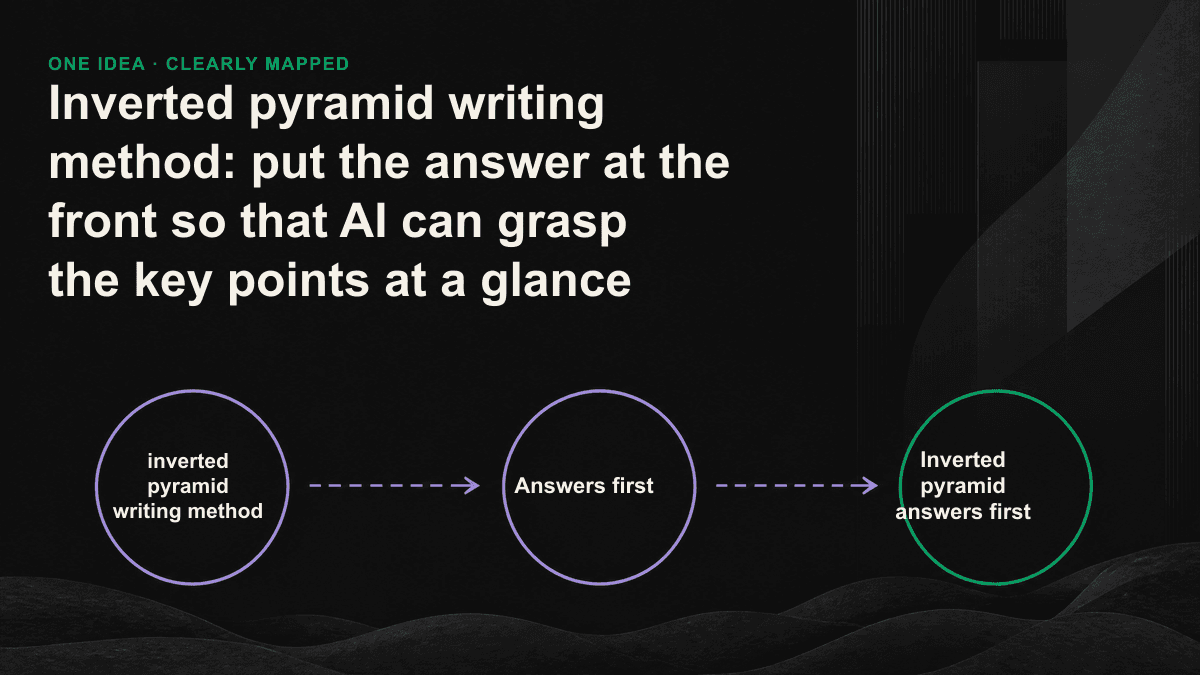
Incorporate the inverted pyramid into the four levels of the entire article
The priority of the answer is not to finish writing the first paragraph, but to repeat the same principle at four levels. If one layer is missing, the engine may miss the connection there.
- Title level: H2 use questions that readers will ask, such as "How long will the GEO audit take?" rather than the vague "About the audit schedule."
- Opening layer: The first sentence of each section should answer the title of the section. Do not use a cutscene as a buffer.
- Paragraph level: The first sentence of each paragraph states the conclusion, followed by the reasons, data and exceptions.
- Sentence level: Put the subject first, tell one thing in one sentence, and avoid long strings of clauses diluting the semantic meaning.
Combined with FAQ and structured tags, the extraction will be cleaner
The inverted pyramid is responsible for the shape of the content, and structured markup is responsible for allowing machines to confirm the boundaries. Organize frequently asked questions into FAQ blocks, use H2 or H3 for the question, and the answer immediately below, control it to 40 to 80 words, and then cover it with FAQPage structured information. This is equivalent to telling the engine: here is a set of questions and corresponding answers, which can be used in the entire paragraph. The question-and-answer format itself is the ultimate form of an inverted pyramid, with questions at the top and answers at the bottom, leaving no explanation in between.
The four most commonly fixed errors during Tenten execution
- Start with a cutscene: "In today's content marketing environment," this kind of sentence occupies a prime position at the beginning of the paragraph, but it does not contain any answers.
- The answer spans two paragraphs: Split the conclusion into two paragraphs. No one of them can give a complete response.
- Abuse of pronouns: The article is full of "this method" and "the above-mentioned tools". Once the paragraphs are extracted individually, they lose their meaning.
- Hide the number at the end: Put the most quotable specific number at the end of the paragraph, which is equivalent to letting the engine guess.
It is not difficult to write the answer first, but the difficult thing is to get rid of the inertia of presentation. You can do a small test with the three articles with the highest traffic on the site: copy out the first sentence of each paragraph. If you can answer the reader's question just by looking at these sentences, it means the structure is correct; if it reads like a bunch of cutscenes, the AI engine may not be able to grasp the key points. If you want to know how much content on your entire site is stuck on this issue, you can schedule a 30-minute GEO diagnostic session, and we will identify which pages should move the answer forward.