Whether the AI engine will cite you, the first test is not how good your writing is, but whether it can determine that "these places that mention you on the Internet are talking about the same company." The most common loss point for traditional Chinese brands is that the name, address, and social link are written separately on each platform, causing the engine to misjudge a company into three or four fuzzy entities, and naturally it will not dare to use you when citing. This article gives you a checklist that you can follow directly to gather scattered signals back into the same brand.
Why entity consistency determines whether the engine dares to reference you
ChatGPT, Perplexity, and Google AI Overviews will first understand the brand as an "entity" before answering questions. Its judgment method is very traditional: it cross-references descriptions of you from official websites, communities, industry directories, wikis, etc. The more consistent your name, address, contact information, and related links are, the more confident it is that these mentions point to the same object, and the more willing it is to name you in its answer. Once the signals are fighting each other, the engine will handle it conservatively and would rather not quote it than put uncertain data into the answer.
Let’s take an actual situation: a SaaS company displays its English name “Acme” on LinkedIn, its official website ends with “Acme Technology,” and its registration with the Ministry of Economic Affairs’ Commerce Department is “Acme Information Co., Ltd.” There is no clear indication that they are the same object. The engine caught these three transactions and could only treat them as independent weak signals. No one was strong enough to be used as the source of the answer. You think you are exposed on three platforms, but in fact you have broken one visibility into pieces that are not powerful enough for three.
Traditional Chinese brands also have several pitfalls that English websites will not encounter. Full-form and half-form brackets and commas are mixed; there are sometimes spaces in the brand name, and sometimes there are no spaces; when Chinese and English are mixed, the English capitalization is not uniform; occasionally a page will appear in a simplified Chinese version. To humans, these are the same name, but to the string comparison engine, they are different characters. Consistency is therefore silently deducted, and you usually don't notice.
Name: Decide on a formal name first, then release a few aliases
Start by picking a "canonical name," usually the one you want to be called by and that appears most often on official documents. Then clearly list the allowed aliases, such as English trademark names or common abbreviations, and do not use other writing methods. After deciding, align the end of the official website, About Us, Organization name in structured data, social account display name, and business directory to this definition. This step doesn't take much time, but it is the basis for all subsequent corrections.
- Which one is the canonical, the official full name (consistent with the company registration) or the external brand name? Is the relationship between the two clearly stated in "About Us" on the official website?
- Correspondence between Chinese and English names: English name capitalization, whether there are spaces, and whether it is the same on every platform
- Full-form and half-form: Whether brackets, commas, and spacers are consistent. It is recommended that half-form punctuation is not included in the brand name.
- Traditional and Simplified: Confirm that no platform has accidentally saved the simplified version
- Whether the "display name" and "handle" of the social account both point to the same brand name
Address and contact information: NAP provides maps and language models
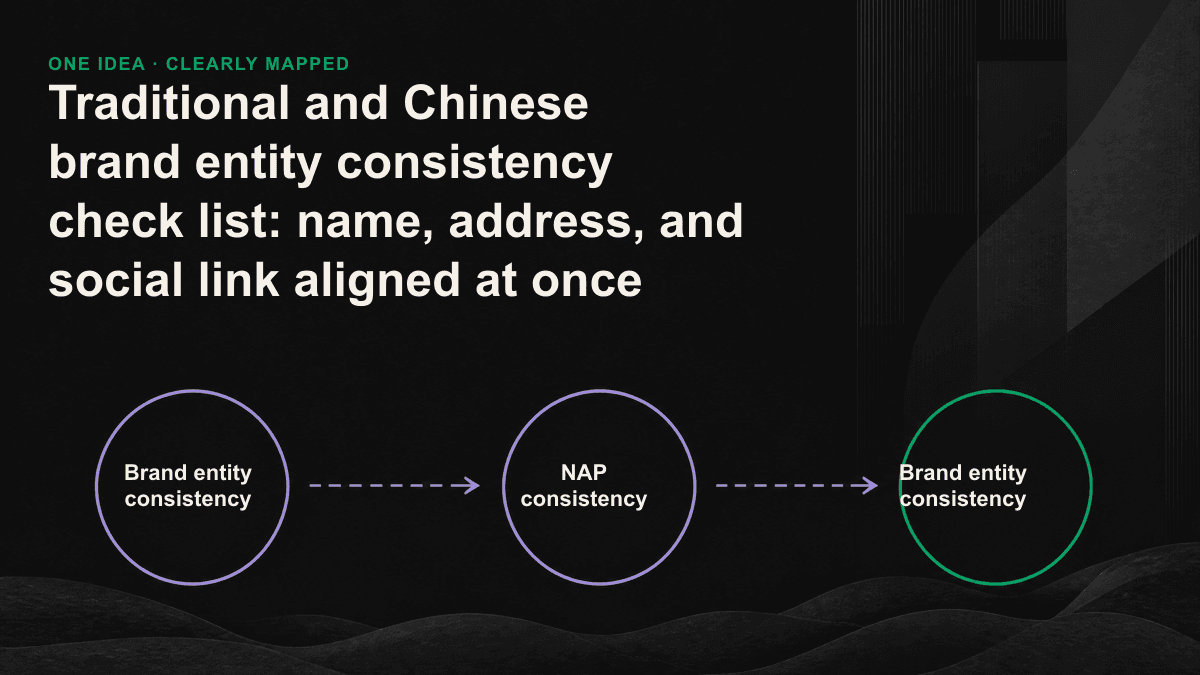
NAP refers to Name, Address, Phone. In the past, it was the focus of local SEO, and now it is also the anchor point for AI engines to judge entities. The address should be written in the same way: the order of county, city, district, road, section and number is fixed, and the format of floor and room numbers should be consistent; the telephone number should be in the same international format, such as starting with +886-2, to avoid writing 02 in some places and (02) in others. These details seem trivial on their own, but the engine relies on the alignment of these fields to recognize you as the same company when you are scattered everywhere.
Community and external connections: Use sameAs to sew the scattered you into one entity
The sameAs field of schema.org is the most direct way for you to actively tell the engine "these links are all mine". In the Organization structured data on the official website, listing all official accounts and authoritative files in sameAs is equivalent to helping the engine directly connect the connections that would otherwise have to be guessed. If Wikidata has your entries, it is the hub of the knowledge graph and deserves to be built and maintained first, because many engines will refer back to it to confirm the identity of the entity.
- Official communities: LinkedIn company page, Facebook page, Instagram, YouTube, X
- Authoritative profile: Wikidata entry, Google Business profile, Crunchbase, or local industry directory
- Content platform: Official blog domain, Medium, SlideShare and other signed accounts
- If there is a listing or legal entity disclosure, public information observatory and other official pages
One-page checklist (just follow it)
- Define the canonical name and allowed aliases and write an internal specification document
- Take inventory of all the platforms where you are exposed: official website, social groups, directories, registration information, media reports, and make a list
- Compare the name, address, and phone number of each platform one by one, and mark the inconsistent fields.
- Use the registration and official website of the Department of Commerce as the authoritative source and update the rest of the platforms
- Add name, address and complete sameAs to the Organization structured data on the official website
- Create or correct Wikidata entries so that the knowledge graph has a clean node
- Re-inventory is conducted every quarter, and the same standards will be applied to all newly opened accounts.
Consistency is not a one-time project, it is a discipline. Every time you open an additional account or change offices, it is an opportunity to blur the entity again.— Tenten GEO Consulting Team
Fix order and the three most common errors
When making corrections, don’t rush to change them all at once. First deal with authoritative sources (registration information, official website), then spread out to communities and directories, and finally add structured data. If the order is wrong, it will easily lead to conflicts, and if you change it halfway, it will create new inconsistencies. There are three most common mistakes: treating the English capitalization of the brand name as a trivial matter, changing the address to only the official website but forgetting the Google merchant, and sameAs only listing one or two communities. These three items each took less than an hour, but happened to be the first fields the engine saw.
After running through the above list, most Traditional Chinese brands can complete the entity signals within a week or two, and the AI engine will be more confident when citing. If you are not sure how consistent your name, address, and links are across platforms, or want to know where the gaps are in the knowledge graph, you can book a 30-minute GEO diagnostic session. We will use your actual data to run an inventory on the spot and pick out the fields that should be filled first.