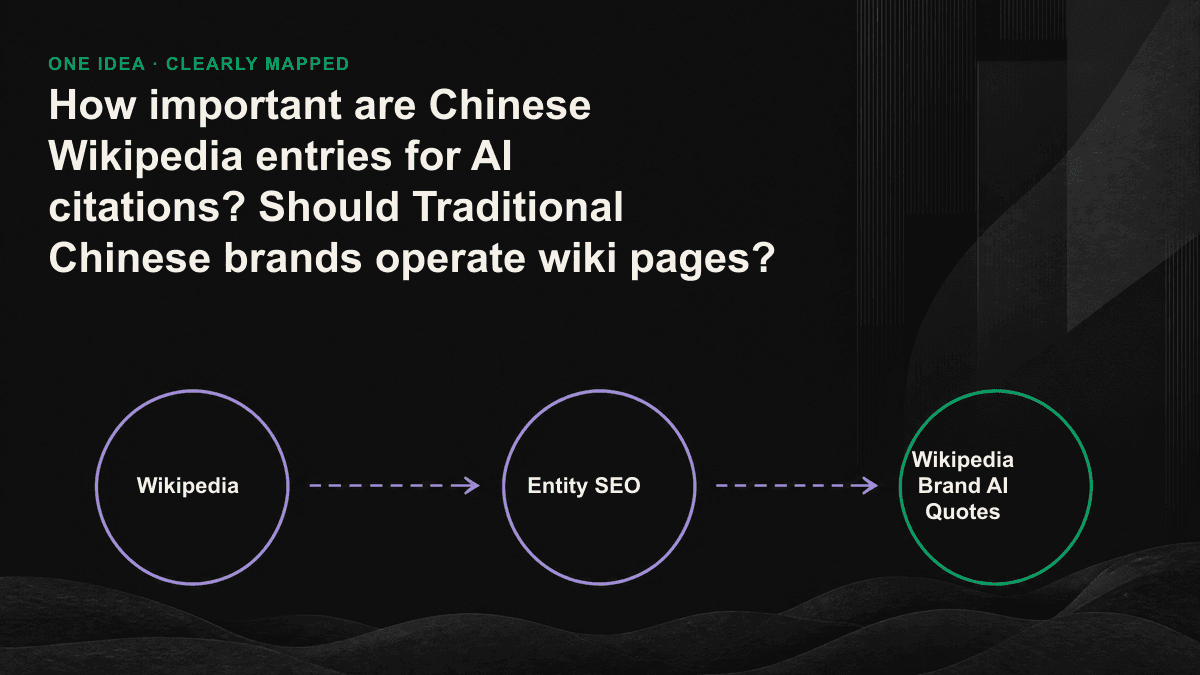
Wikipedia entries are currently one of the sources with the highest citation weight for AI, but most Traditional Chinese B2B brands should not regard “getting a Wiki page” as a GEO goal. The real question you have to solve is: does the AI recognize your entity? Wikis are just one of the ways to get there. For SaaS that has not accumulated enough media buzz, it is often the hardest to take and the most likely to be counterproductive.
Why does Wikipedia have such a high weight in AI citations?
The reason is two-fold. The first layer is the training corpus - a large language model absorbs a large amount of Wikipedia text in the pre-training stage. A large part of the model's basic understanding of a noun, a company, and a founder comes from Wikipedia. The second level is real-time search: Perplexity, Google AI Overviews, and ChatGPT searches will crawl web pages for support when answering. The probability of being caught for a Wiki entry is much higher than that of any single commercial website. When we ran AI visibility monitoring tracking for clients, we saw the same thing over and over again: whenever the question involved definitions, comparisons, or “who is this company?” the frequency of wiki links in the AI answers was significantly higher.
There is another layer that is often overlooked: the Wikidata behind Wikipedia. It is a structured knowledge base that describes "what this entity is and who it is related to" in a machine-readable way, and feeds Google Knowledge Graph, Bing and multiple engines as entity comparison tables. If a brand has a clean record in Wikidata and connects the official website, LinkedIn, and Crunchbase through sameAs, it will be easier for AI to converge the mentions scattered across the network into the same entity, instead of accidentally splitting them into three unrelated companies.
- Training corpus: A large amount of Wiki text is absorbed during model pre-training to form a low-level understanding of brands and nouns.
- Instant search: Perplexity, AI Overviews, ChatGPT When searching for answers, priority is given to grabbing Wiki entries as supporting evidence.
- Knowledge graph: Wikidata's structured data is used by Google and multiple engines to confirm "Who is this name?"
The real situation of traditional Chinese brands
Let me first clarify a common misunderstanding: the Chinese Wikipedia has only one site (zh.wikipedia.org). Simplified and Traditional Chinese share the same batch of entries, and the display is automatically switched by word conversion, so you do not need and cannot "open another entry for the Traditional Chinese version." The real threshold is notability. Wiki is particularly strict about corporate articles. It requires multiple reliable sources that are independent of each other and have substantive and in-depth reporting on you. Their own press releases, industry partners, and content farms do not count. As soon as the marketing tone appears, the entry will be put on a template and even enter the process of mentioning and deleting.
What's more critical is control. Wiki entries do not belong to you and can be edited by anyone. Even if you put in the effort to put the article on the shelves, you can't delete outdated information, negative paragraphs added by competitors, or an editor's misunderstanding of your business model. You can only discuss it slowly according to community rules. For a SaaS company that cares about the consistency of its brand narrative, this is not a plus, but a risk to watch over the long term.
Once a wiki entry is published, you are not its owner, just one of its many editors. This is where it becomes credible and why many brands ultimately decide not to touch it.— Tenten GEO Consulting Team
Should you create a wiki page: first look at the attention
The judgment method is actually not complicated: think of "do you have enough in-depth third-party reporting" as a bifurcation point. If so, the wiki is a highly profitable asset, worthy of careful development and long-term maintenance. If not, most of the hard submissions will be deleted within a few days. is it in vain and it may cause the community to mark your brand as being repeatedly promoted, making it more difficult to seriously create articles later. When there is a shortage of information, the correct action is not to compile a wiki, but to first develop external reports that can be quoted.
- More than three independent media outlets have made substantial reports on you instead of reposting press releases.
- There are verifiable milestones: large-scale fundraising, mergers and acquisitions, industry awards, or listing information.
- Be cited in academic papers, government documents or authoritative industry directories.
- The founder or the product itself is already a recognized representative case in a certain field.
You don’t need to be a wiki to let AI recognize you
For 90% of Taiwan's B2B SaaS, a more pragmatic approach is to bypass the wiki and clean the entity signals directly. The goal is the same: getting the AI to treat you as a clear, trustworthy, consistent entity: just using levers you can control.
- If it meets the attention requirements, first create a clean Wikidata project and use sameAs to connect the official website, LinkedIn, GitHub, and Crunchbase.
- The official website plus Organization and Person structured data, sameAs points to all official platforms, allowing the engine to confirm that they are the same entity.
- The entire network has a unified name, one-sentence positioning, founder and address (NAP consistency), reducing AI's hesitation about "whether it is the same company."
- Continuous accumulation of third-party mentions that can be cited: industry media interviews, professional directories, podcasts, open source projects, real reviews.
- Self-created highly extractable content: clear definitions, FAQs, and structured paragraphs, so that AI can quote from your own words instead of just quoting from Wikipedia.
A pragmatic judgment framework
To condense the whole thing into one sentence: Wikipedia does matter for AI citations, but it is the result, not the starting point. Give the outside world a reason to talk about you first, and the entity signal will naturally become clearer, and the wiki (if you really need it) will stand up. If you want to know how AI describes your brand now, which sources it connects to, and whether the gap between Wiki and Wikidata is worth filling, you can book a [30-minute GEO diagnostic session](/contact), and we will use your own brand name to test it with you during the session.