By doing an AEO audit yourself, most teams can detect about 60% of the problems. People who will read this carefully have usually gone through a round: checked the structured information, filled in the FAQ, and confirmed that robots did not block the AI crawlers. The 40% that is really stuck is not that the technology is too difficult, but that you can't see it - there is no cross-engine comparison benchmark, and there is no reference data of competing products for comparison. Therefore, "should the AEO audit be outsourced?" is rarely a question of ability, but whether you are willing to continue to work in a blind spot. The good news is that these two halves can be dealt with separately: you don’t need to outsource the whole thing, and you don’t need to carry it all yourself.
If you do it yourself, how far can it be covered?
First give DIY the credit it deserves. A large part of the AEO audit consists of technical inspections with clear rules and just follow the instructions. You can and should complete this part yourself. Outsourcing these will be a waste of budget. They have one thing in common: right and wrong are binary, and no external data is needed to judge whether something is right or wrong. AEO checklists on the Internet, including the one we compiled ourselves, are sufficient at this level. A marketing or engineering partner who understands technology can complete one round in two or three days.
- Structured data: Confirm that Article, FAQPage, Organization, Product, etc. schema tags are correct and pass Google's Rich Results test.
- Crawlability: Check that robots.txt and meta robots do not block AI crawlers such as GPTBot, PerplexityBot, and ClaudeBot.
- Content format: Organize each sub-question into a self-contained paragraph that can be extracted separately. It is recommended that the evidence be directly followed instead of laying out three sentences to get to the key points.
- Entity consistency: Make sure that the brand name, positioning, and person in charge information on the official website, LinkedIn, and other statements are consistent, and do not let the algorithm read conflicting versions.
- Basic readability: Confirm that key pages do not need to rely on JavaScript to render the content, and pure text crawling can also capture the key points.
Three walls DIY hits
The problem lies in the other half of the audit: those parts where there are no standard answers and require external data to make a judgment. This half is the key to deciding whether the AI will reference you. It is also the place where DIYers are most likely to mistakenly think that they have finished it, but in fact they have not touched it at all. The following three walls cannot be overcome with a list and your own website.
- There is no cross-engine visibility benchmark: You can optimize your website to perfection, but you can’t answer the most critical question: when users ask about your category in ChatGPT, Perplexity, and Google AI Overviews, are you included in the answer, and what is the proportion? This requires repeated sampling of the six major engines using real questions. After several manual checks, what you get is noise, not a benchmark.
- You can’t see how competing products are cited: After discovering that you are not mentioned, the next question is “Who was mentioned and why?” The answer lies in the content structure of competing products, the type of referenced pages, or a third-party list that you haven't noticed. Without reference data from competing products for comparison, optimization can only rely on guesswork.
- Failure to prioritize correctly: The most common outcome of DIY is to list thirty items to do and then get stuck not knowing which one to do first. If you don't connect each gap to "Which question does it block that will convert?", you can only sort by feeling; if the order is wrong, three months of work may not lead to any important answer.
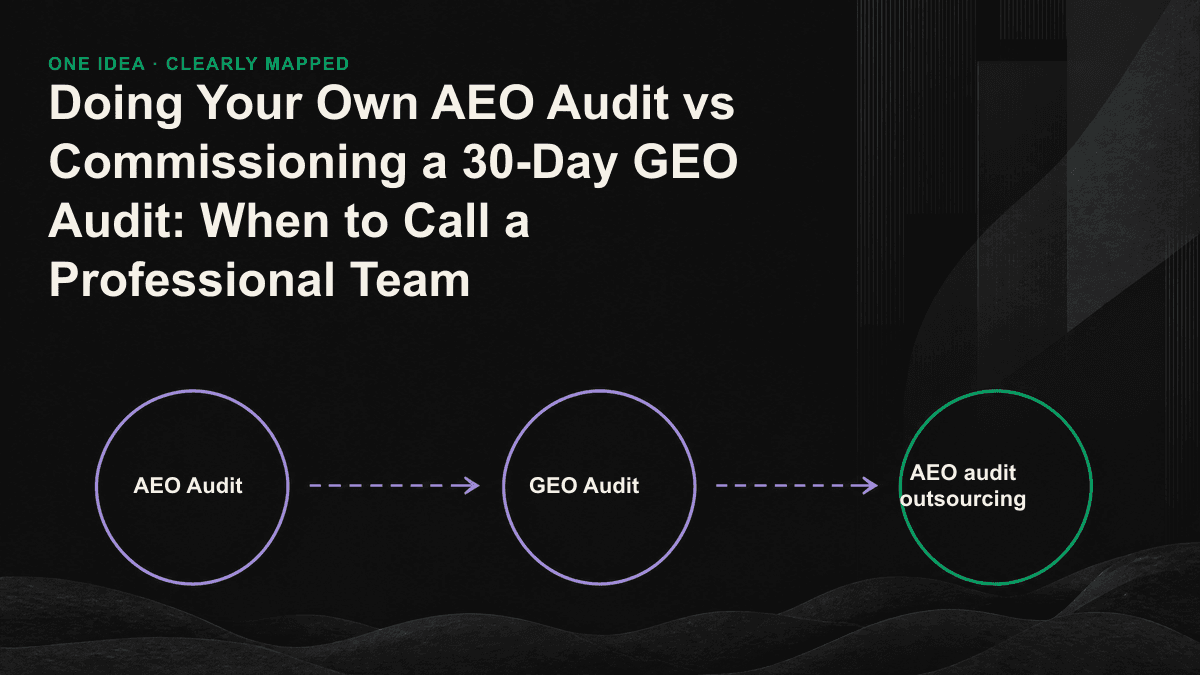
What four extra dollars did the 30-day GEO Audit cost?
The most valuable part of a complete outsourced audit is the three walls that DIY cannot overcome, plus an executable roadmap. Taking our 30-day GEO Audit as an example, what is actually delivered is four things that you can’t get by yourself, each corresponding to the three walls in front, plus a plan that you can start immediately.
- Cross-engine visibility benchmark: Use AI visibility monitoring to repeatedly sample your real questions on six major AI engines to measure the current mention rate and citation rate. There will be comparison points for each subsequent optimization.
- Competitive product citation map: Take stock of who in your category is cited repeatedly by AI, which pages and sources cite them, and change the gap you want to fill from "guessing" to "visible".
- Agent readability detection: Check whether your website is readable, crawlable, and actionable from the perspective of AI Agent, not just friendly to human browsers.
- Sorted repair roadmap: Sort all gaps by "impact on target questions × repair cost" to let you know which five things should be done first within thirty days.
a practical decision-making framework
There is no need to worry about the choice of "DIY or outsourcing". The best solution for most teams is to run the technical layer themselves first, and then outsource the measurement and judgment part. What you should really ask are the following questions.
- Someone in your category has been cited repeatedly by AI, but you are not here? If so, this is a matter of time, not whether to do it or not. The most important thing is to measure the gap first.
- Do you have anyone who can perform cross-engine sampling reliably? A one-time manual check doesn't count. What you need is repeatable, benchmarked measurements.
- After you make the change, is there any way to prove that it drives citations? Without measurement benchmarks, you will keep doing it without knowing the results.
- Is the cost of your time higher than the audit fee? The cost for a senior marketing person to spend three weeks exploring is often more expensive than one outsourcing.
If you do it yourself, you can find out where the website is broken; if you outsource it, you will know how much you are worth in the AI's answer. The former is a physical examination and the latter is a positioning.— Tenten GEO
If you want to do it yourself first
Even if you plan to outsource the work in the end, you will never lose money by doing a round of technical work yourself first. It allows you to ask better questions when entering a professional audit, and saves consultants time to double-check basic items. This round will also allow you to quickly tell whether the consultant really understands the citation mechanism when talking to you, or whether he is just selling you a beautiful report. It is recommended to start with these three things.
- Use Google Rich Results to test the structured data of the main pages and complete the FAQPage and Organization.
- Open the server log and confirm that AI crawlers such as GPTBot, PerplexityBot, and ClaudeBot can really capture your page.
- Pick the five questions you most want to be recommended by AI, ask them in person on each of the six major engines, and note whether you are included in the answers.
After running these three things, you will probably know which wall you are stuck in. If the stuck point lies in cross-engine benchmarks or competitive product comparisons, that's where outsourcing can help you make up for it. If you want to directly see your visibility gaps in the six major AI engines and which ones should be filled first, you can book a 30-minute GEO diagnostic session, and we will take you through it with your actual questions.