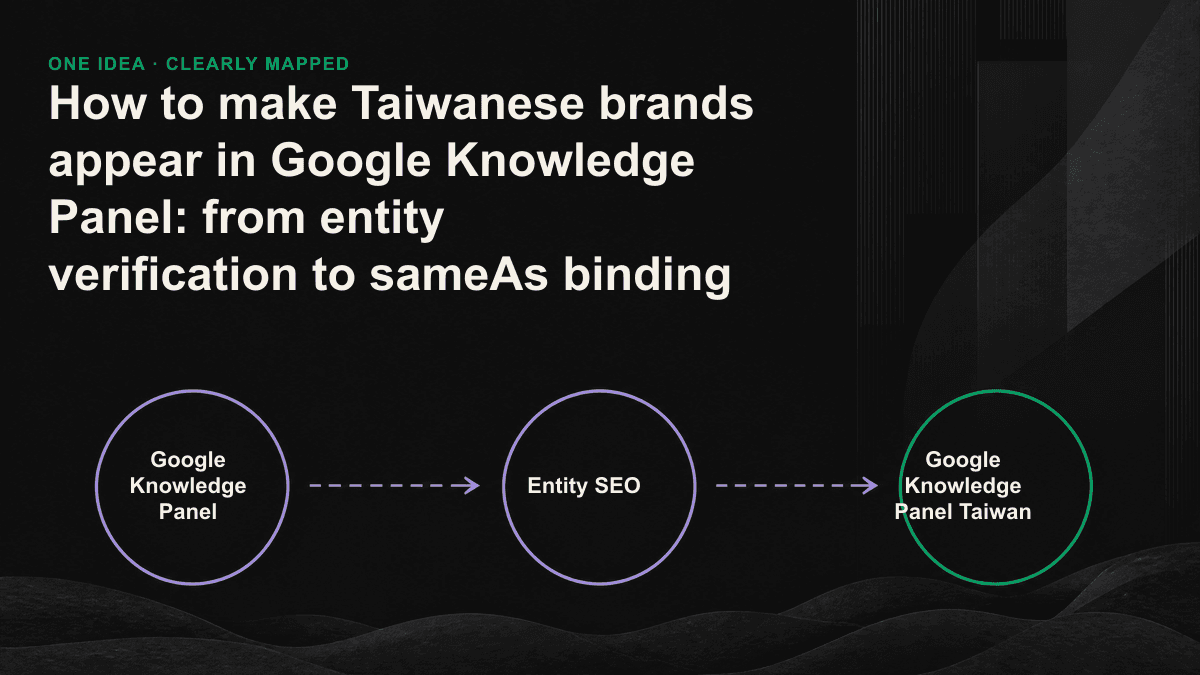
Knowledge panels cannot be applied for. The brand information card you see on the right side of Google search results is automatically grown after Google confirms from its own Knowledge Graph that "this brand is a real, independent, and worthy of labeling entity." So what really needs to be done is not to fill out a form and submit it for review, but to make Google confident enough to treat your brand as an entity. If Taiwan B2B brands want to get the panel, the key lies almost entirely in entity verification and sameAs binding.
The essence of knowledge panel: entity, not web page
Google search has long since moved from matching keywords to understanding entities. What is stored in the knowledge graph is not pages of web pages, but entities such as companies, people, products, places, and their relationships with each other. When a user searches for your brand name, Google must first find the corresponding node in the graph before it can pull up the panel. The situation of many brands in Taiwan is: the official website is beautifully designed and contains a lot of content, but Google has never registered it as a node, so searching for the brand name only brings up a few blue links, and the right side is blank. This isn't a ranking issue, it's an entity non-existence issue.
Diagnose first: Does Google recognize you now?
Measure the starting point before taking action, otherwise you won’t know whether you are lacking entity or evidence. Here are three checks that take less than ten minutes to quickly determine where Google currently places you.
- Directly search for the full name of the brand. Check to see if there is a panel on the right, or if the autocomplete of the search box brings up your brand card.
- Use the Google Knowledge Graph Search API or a third-party entity detection tool to check the brand name and see if Google will return the corresponding entity ID (usually a string starting with /g/ or kg:/m/).
- Search "brand name wikidata" and "brand name linkedin" separately, plus major Chinese media, to confirm whether your name, year of establishment, and business projects are consistent on these high-weighted sources.
The interpretation is straightforward. If the API cannot find the entity ID, it means that you have not entered the graph, so you have to start by creating an entity. If the ID is found but there is no panel, it usually means that the strength of the evidence is insufficient, or the identity signals of each platform are conflicting. You need to start with enhanced verification and sameAs binding.
Entity verification: cross-corroboration with multiple sources
Google will not believe you just because you claim on your official website that "we are Taiwan's leading so-and-so platform." What it requires is that multiple sources that are independent of each other and of high enough credibility give a consistent statement on the same set of facts: official name, time of establishment, headquarters city, founder, and business projects. This mechanism is called cross-corroboration, and it is also the watershed between physical sites and not being able to stand on the map. For Taiwanese brands, the following types of sources of evidence are worthy of priority investment.
- Wikidata: The threshold is lower than Wikipedia, you can create your own entries, and Google Maps uses a large amount of its structured data, so the reporting rate is high.
- Public company records, including the Ministry of Economic Affairs business registry and Unified Business Number lookup, provide evidence of the legal entity's identity.
- LinkedIn company page, Crunchbase, as well as local industry directories and media reports in Taiwan.
- Google Business Profile: Even if you are a pure online B2B, it is recommended to create it. It is a very direct identity signal in the eyes of Google.
- The Organization structured information on the official website serves as the authoritative source of all facts.
sameAs binding: connect scattered identities into a line
If the previous sources were separate, Google wouldn't necessarily know that they were referring to the same brand. sameAs is the line that sews them together. In the Organization JSON-LD of the official website, using the sameAs array to list your official page links on each platform is equivalent to actively telling Google: these entries and these accounts are all the same entity. This step doesn't take much work, but it is often the final step from "almost taking shape" to "really appearing".
Three things Taiwanese brands most often get stuck on
- The Chinese and English names are inconsistent: the official website lists the English name, the media writes the Chinese name, and LinkedIn uses another spelling. Google will split you into several fuzzy entities. Decide on a formal name first, and put everything else into alternateName.
- Insufficient notability: Wikipedia requires in-depth reporting by independent third parties, which many B2B brands cannot meet at the moment. In this case, Wikidata is a more pragmatic starting point.
- Only feed English signals: It obviously serves the Taiwan market, but it only appears in English sources. zh-Hant users will not be able to match the brand name when they search for it. Chinese media reports and Chinese articles must be supplemented at the same time.
Our actual experience is that most Taiwan B2B brands are stuck not with the content, but with the identity signals: three platforms and three names, and Google has to treat you as three vague things. Unifying the names first will often make the panel grow faster than writing ten more articles.— Tenten GEO Executive Team
A pragmatic execution sequence (30 to 90 days)
- Weeks 1 to 2: Unify the official brand name and one-sentence description, and complete the official website Organization structured data and sameAs link.
- Weeks 2-4: Create or correct Wikidata entries, LinkedIn company pages, Crunchbase, and Google Business profiles to ensure the facts are consistent everywhere.
- Weeks 4 to 8: Accumulate independent third-party mentions, including industry media, directories, and interviews, to build up the strength of cross-corroboration.
- Ongoing: Use Knowledge Graph API to track entity ID and panel status every month, and make immediate corrections as soon as conflicting signals are discovered.
The knowledge panel usually appears weeks to months after the signal is in place. There is no rush, but there are traces to follow every step, and it does not depend on luck. If you want to first figure out what Google currently views your brand as and what pieces of evidence are missing, you can book a 30-minute GEO diagnostic session. We will use physical inspection and AI visibility monitoring visibility tracking to help you take stock of the gaps at once.