The search layout that FAGPage tags can switch to for you has already reached zero for most websites; however, the value of writing the content as a question and answer, and each answer can be independently established, has reached the highest point in the AI search era. These two things have been talked about together for a long time, and now it’s time to take them apart: stop making schema for the expansion block of compound search results, and redesign it so that your Q&A can be cleanly extracted by the AI engine and used as a citation source.
What will Google take back in 2023?
In August 2023, Google announced that it would limit the FAQ compound search results to "well-known and authoritative government and medical websites." To put it bluntly: If you put the FAQPage tag on the page, in the past, the search results would have a whole section of questions and answers that can be opened, taking up the space of competitors and increasing clicks. After this adjustment, for commercial websites, SaaS products, and general blogs, that section of the page will disappear directly. In the same wave, the HowTo composite results were first restricted to the desktop and then removed entirely. This is not a minor fix, it’s Google taking back two structured formats that it once heavily promoted.
The first reaction of many people when they saw the announcement was "The FAQ schema is dead and can be dismantled." This conclusion is only half true. It does take away the most direct and visible rewards of the schema, which are the extra space and clicks on the search results; but it does not encounter another thing that is happening at the same time and has a greater impact - the search itself is changing from ten blue links to a generated answer, and that answer always needs a source. Whether your content is qualified to be that source is the new battlefield.
Schema is not dead, it just changed its readers
To judge whether FAQPage is still worth doing, you must first debunk a technical detail that is often misunderstood: most large language models read the rendered page text, not the JSON-LD hidden in the source code. When ChatGPT and Perplexity crawl your content, they look at the paragraphs that users actually read, not the strings in the schema field. So "I put the FAQPage tag and the AI will quote me" was a wrong expectation from the beginning. There is no shortcut to this step. You can make a simple verification: if you delete the entire visible text of the page and leave only the schema, the AI will be able to extract almost nothing; conversely, even if there is no markup at all, as long as the questions and answers on the page are written clearly enough, it will still be quoted.
But structured data is still a clear signal that is machine-readable. Google's AI overview and some search systems use schema to help determine what a page is about, which paragraph is the question, and which paragraph is the corresponding answer. It won't help you score points out of thin air. It's more like reducing the chance of machines misreading your content. The real leverage is never in the markup itself, but in the shape it forces you to organize the content into: a question with a clean answer.
- Questions that users will really ask on product pages, pricing pages, and service pages: These questions and answers already have conversion value, and the tags just mark them clearly to allow better alignment of the machine.
- AI Overview and AI Search When disassembling a page, structured questions and answers make the "question-answer" pairings more difficult to misinterpret.
- In-site search, internal knowledge base, and even the AI Agent that will search your website in the future will all have a clean question and answer structure.
- The same Q&A content can serve both web readers and AI engines, and you don’t need to rewrite it for AI.
The real value is the answer block, not the JSON-LD
What gets you cited by AI is the shape of the content, not the syntax of the markup. A unit that can be cited looks like this: a clear question written in the reader's language serves as the title, followed by a 30 to 60-word answer that can be read without scrolling up; the conclusion is stated in the first sentence, and conditions or exceptions are added later. What the AI engine extracts is always a paragraph that can stand alone. If your answer requires the reader to understand the first three paragraphs before it can be established, it will not be clean, and naturally it will not be used as a cited source. A side benefit of the FAQPage markup is that it forces you to write the content in a shape that can be cut out.
When to do and when not to touch FAQPage
- Do: The page already has real questions that users will ask, such as pricing plans, import time, data security, and refund conditions.
- Do: You want this page to be the source of answers to specific questions that are called up in AI searches.
- Don’t do it: Stuffing keywords with fake questions that no one will ask is something Google understands considers abuse and doesn’t help AI citations.
- Don’t do it: hard-pack the entire article into a FAQPage to pretend to be structured, or hide the Q&A only in the schema and not visible on the page: Google’s specifications require that FAQ content must be visible on the page.
There is another judgment point that is often skipped: whether the questions and answers on this page are also useful to "people". If a piece of content exists only for machines and is deemed redundant by real users, it will be demoted sooner or later, and the AI engine will not favor a source that reads like filler. This is why we don’t recommend leaving FAQs lying around like SEO caulking. Quotable and useful are actually the same thing over time. Don't think of them as two goals.
Implementation: Design each set of questions and answers as a quotable unit
In practice, our order is roughly as follows: start with real search terms, business and customer service questions that are most frequently asked, rather than just dreaming up keywords; give a complete conclusion in the first sentence of the answer to each question, and keep it to a self-sufficient length; use the reader's language for the questions, without using marketing terms that can only be understood by insiders; and finally add the FAQPage tag, positioning it as an auxiliary signal, not the main force. When planning each page, Tenten's GEO content engine treats each set of questions and answers as a referenceable unit that can be individually cut out and pasted into AI answers, rather than adding a piece of code after the fact.
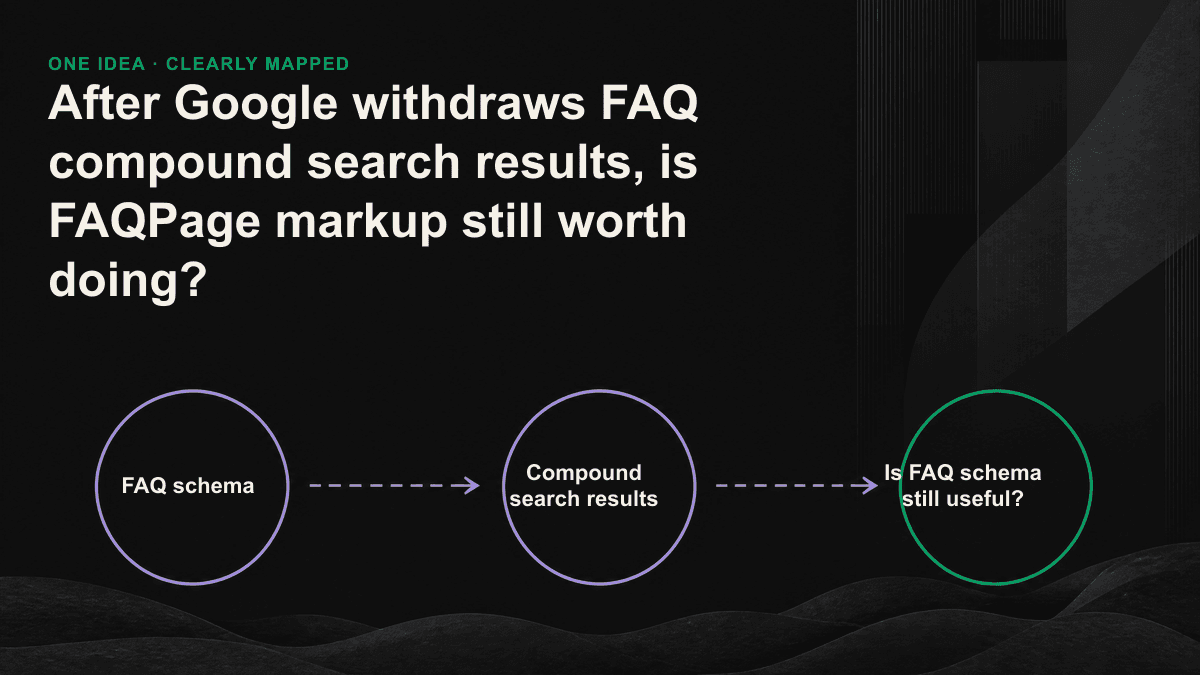
Back to the original question: Is FAQPage markup still worth doing? It's worth it, but the reasons have changed. You are not doing it for the expanded page of the search results, but to give your content a chance to be named in the answers generated by the AI. Marking is just the last mile, the real work is getting the answer into a shape that can be extracted cleanly. If you want to know which pages on your website have FAQ tags but can’t come up with a clean answer, you can book a 30-minute GEO diagnostic session (go to /contact) and we will point out the gaps directly to you.