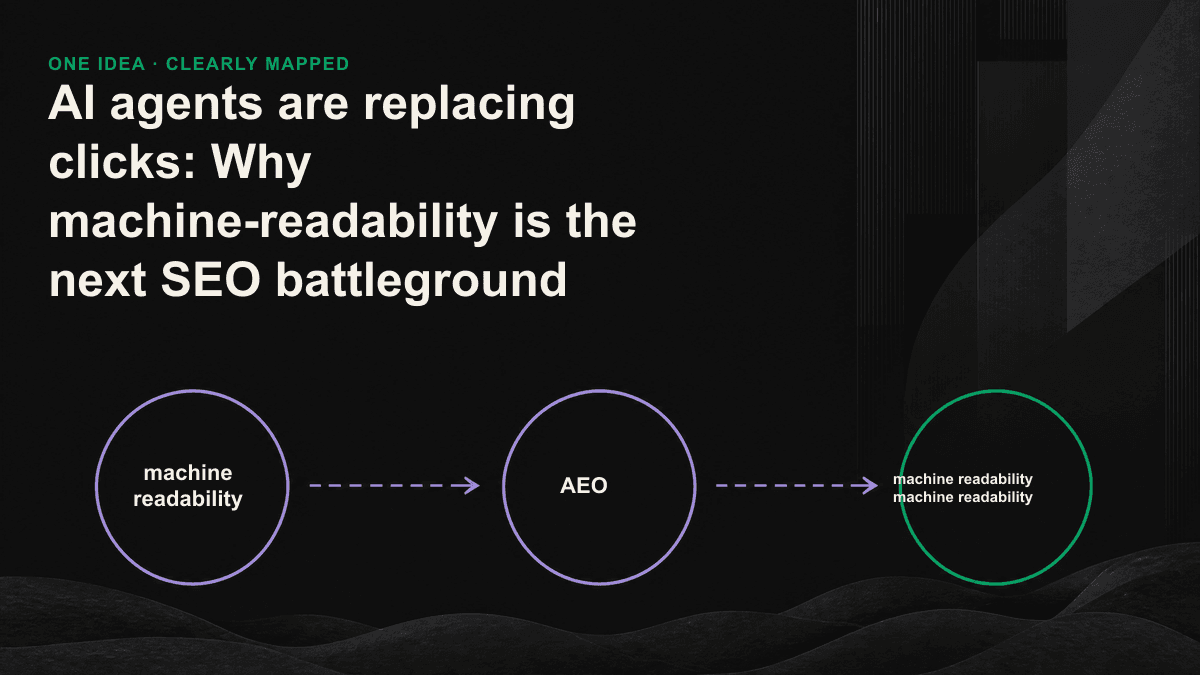
Clicks are disappearing, but most websites are still built for clicks. When users submit questions to ChatGPT, Perplexity, or Google’s AI model, the person actually reading your content is often not a human, but an agent. It won’t be impressed by the first-screen animation. It doesn’t matter whether it scrolls to the third screen or not. It won’t press the button you carefully designed. It only does one thing: tear the page apart and extract usable facts. Whether your content can be extracted cleanly determines whether you will appear in the answer. Machine-readability is the next SEO battlefield.
This may sound like a technical issue, but it is essentially a visibility issue. In the past, you optimized rankings and found ways to get links to stick on the first page; now you have to optimize "the ease of being parsed" and let the language model determine within a few hundred milliseconds what you are talking about, whether it is trustworthy, and whether it is worth citing. There are two readers for the same website: one relies on eyes and the other relies on parsers. The former will forgive your clutter, the latter won't.
The agent reads the structure, not the layout.
People rely on visual cues when opening a webpage: the title is larger, the buttons are brighter, and the key points are framed by color. The agent does not have these clues. What it gets is a string of tags and text nodes, and relies on the semantics of HTML to determine which paragraph is the title, which paragraph is the answer, and which paragraph is just the navigation bar. If your title is actually a <div> enlarged by CSS instead of an <h2>, the proxy may not recognize that as a title at all. The key points you think you are emphasizing are as equal to the copyright notice at the end of the page in the eyes of the machine.
Rendering is another level. Many websites hide their main content behind JavaScript and wait until the browser finishes running the script before adding text to the screen. People are willing to wait for that one or two seconds, but the crawlers and agents that capture the content may not wait, nor may they be able to run your front-end framework. They often look at the first HTML spit out by the server; if that HTML is empty, no matter how beautiful the content is, it does not exist for the machine.
What exactly does machine readability measure?
Breaking down "machine readability", it asks a very specific set of questions, not metaphysics.
- Semantic structure: Does the title use <h1> to <h3>, does the paragraph <p>, does the list <ul> or <ol>, or is it all stuffed in <div>?
- Plain text availability: After turning off JavaScript, is the main content still there? Is there any substance to the first piece of HTML the agent gets?
- Extraction cleanliness: whether a paragraph can be extracted independently and still retain its complete semantics, without having to rely on the three preceding and following paragraphs to understand it.
- Machine-friendly format: Do you provide structured data (schema.org), clean Markdown, or llms.txt for the model to see, making it less guessing?
- Consistency: Does the same fact in the title, text, and structured materials say the same thing, or does it contradict itself?
Why the more beautiful a website is, the easier it is to be missed
Here’s a counter-intuitive twist: the more ornately designed a website is, the less machine-readable it is. Full-page animation, lazy loading, burning text into images, and using layers of <div>s to overlap the entire page. These amazing techniques are all noise to the agent. When we do audits for clients, we most often encounter a kind of page: perfect visual score and good performance score, but after turning off the script, there is only one sentence left in the main text, and the rest is empty shell. To the person it is a complete page, to the agent it is almost a blank slate.
Another common situation is information locked inside pictures and videos. You put in the effort to make a beautiful data map. The numbers, sources, and conclusions are all on the map, but there is no corresponding text description. The model can't read the pixels in the picture, so it can't extract your point, so it turns around and cites a competitor with plain layout but honest writing of the same numbers. You win the design award, but lose that citation.
Three signals you can measure yourself now
- Turn off JavaScript and watch again: disable scripts in your browser, reload your most important pages, and see how much of the main text is left. The more left over, the healthier it will be.
- Use "View Source" to find titles: Search for <h1>, <h2> and confirm whether they are real tags or <div>s disguised as titles by CSS.
- Throw the page to AI and ask a question: directly paste the URL or content to a language model and ask it "What is this page talking about and what is its proposition?" It can't answer it correctly, and the agent probably can't answer it either.
Ranking is a competition designed for humans, readability is a competition designed for machines. When a machine becomes the first reader and it cannot read your website, it means you do not have this website.— Tenten GEO
It’s not technical debt, it’s visibility debt
Many teams classify semantic HTML, structured data, and plain text availability as "technical debt to be dealt with later when they have time." In a world where AI agents take over the search, the interest on this account is visibility. Every page that cannot be read is a reference that did not occur, an answer position that was silently taken away by the competitor. The trouble is that you don't see it in traffic reports, because unquoted content doesn't leave any trace, it just quietly doesn't happen.
The good news is that machine readability can mostly be fixed without sacrificing design. Replace the fake title with a real title, make key content appear in the first HTML, add text versions of important charts, and complete the required schema. These changes are almost indifferent to people, but they make a huge difference to the agency. The difficulty has never been the technology, but whether someone has taken the "machine as a reader" into consideration during the demand stage, instead of having to wait until it goes online to make up for it later.
If you're not sure what your site looks like to an agency, the quickest way is to test it out: turn off scripts, check tags, and throw the page to a model to ask. For a more complete inventory, our GEO audit will break down your most important pages for machine reading one by one, pointing out where they were missed and how big the gaps are. You can book a 30-minute GEO diagnostic session first, and we will go over your own page directly.