After the AEO audit is run and the checklist is completed, the next step that is most likely to get stuck is not knowing whether you have done it correctly. The problem is that you still use the SEO dashboard to see the results of AEO - the keyword rankings have not moved, and the natural traffic has even dropped, so you mistakenly think that your work is in vain. The truth is the opposite. There is no such thing as "number one" in the AI engine. It breaks your content into sentences and stuffs them into answers. The unit for measuring effectiveness is not ranking, but three things: whether the AI caught you, whether it quoted you, and whether you were included in the answer.
Stop using rankings and traffic to judge whether an AEO is effective.
The causal chain of traditional SEO is very direct: ranking in the top three, getting clicks, and bringing in traffic. AEO's link is broken in the middle - the user asks a question in ChatGPT or Perplexity, and the engine directly assembles the answer for him. He is likely to leave after reading it, without clicking on your website from beginning to end. This is called zero click. So when your brand is cited a lot but the official website traffic does not grow proportionally, this is not a failure, but the normal operation of AEO. If you treat GA’s organic traffic as the only KPI, you will cut off the entire project just when the results are about to accumulate.
Use three-layer indicators to break down the results and look at them
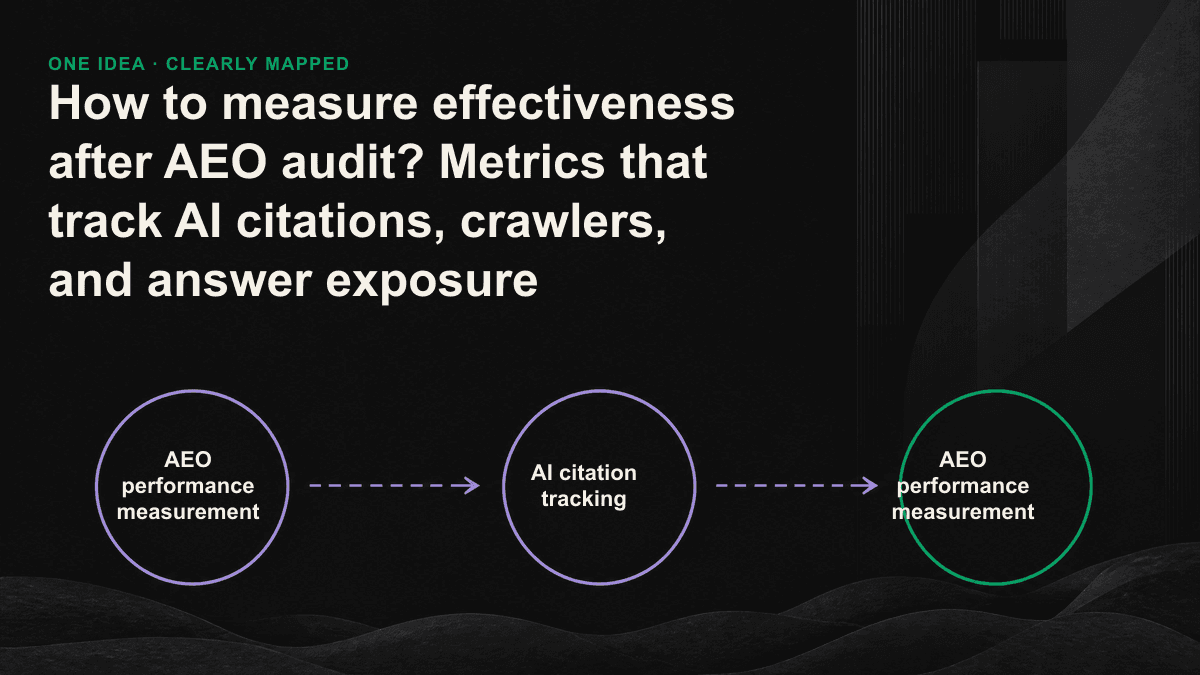
Think of AEO results as a funnel from top to bottom, with three layers in total: capture layer, reference layer, and exposure layer. The AI engine must first "catch" your page before it can "cite" you when generating answers; only if you are cited enough, your brand will be "exposed" in users' questions. If any layer is clogged, nothing will happen downstream. The essence of measurement after the audit is to confirm which layer is open and which layer is still blocked.
- Crawl layer (Crawl): Whether the AI crawler successfully crawled your page, what it crawled, and how often it came back.
- Citation layer (Citation): In the answer generated by AI, are you listed as the source and which pages are cited?
- Answer visibility: Among the questions you care about, the proportion of your brand appearing in the answers is the answer share.
Crawl layer: first confirm that the AI crawler can really get in
This layer is most often skipped, but should be measured first. Open the server's access record and filter out the user agents of the AI crawlers: OpenAI's GPTBot and OAI-SearchBot, Anthropic's ClaudeBot, Perplexity's PerplexityBot, and Google's Google-Extended for AI training and AI Overviews. You have to answer three questions: did they come, which pages were crawled, and whether they got a lot of 404s or were blocked by robots.txt. The most common situation during our actual audit is that the customer's robots.txt or CDN firewall silently blocks certain AI crawlers, and no matter how good the content is, it cannot enter the model's field of view.
Citation layer: Track how many times the AI refers to you as a source
There are two signals to catch at the reference layer. The first is referral traffic: In GA4, group the sources chatgpt.com, perplexity.ai, gemini.google.com, and copilot.microsoft.com into independent groups to see if anyone comes in from the reference link of the AI answer. The traffic volume of this batch is usually small, but the intent is very strong, and the transaction rate is often higher than that of ordinary organic searches. The second is the citation ratio: ask the AI the same batch of questions and record the proportion of your domain appearing in the source list of the answers. The former looks at the actual clicks brought by the citation, and the latter looks at the frequency of the citation itself. Both have to be pursued, because the existence of zero clicks makes the former always underestimate the true impact.
Exposure layer: measure your share of answers to questions
This layer is closest to the business and the most difficult to measure on your own. The method is to first compile a set of questions that buyers will really ask, usually ranging from dozens to hundreds of questions based on your product category, pain points, and comparative questions. This set of questions is then fed to several major AI engines on a regular basis, and two things are recorded: whether the answer mentions your brand, and whether the tone is positive, neutral, or puts you in the not-recommended category. Convert this into answer share, and you have a curve that can be compared month by month. Running dozens of questions manually is fine; hundreds of questions, across multiple engines, and if you want to follow trends, you have to rely on tools for continuous monitoring. This is what our AI visibility monitoring visibility tracking is dealing with.
Establish a baseline first, and then talk about whether there is progress
All indicators must be measured once during the audit and used as the baseline. Without a baseline, any numbers thereafter cannot tell whether progress or regression has occurred. In terms of rhythm, the crawling layer can read server records once a week; the citation and exposure layer can measure once a month. There is a delay in the AI engine updating answers. If the amount is too dense, you will only see noise. A reasonable expectation for the entire project is that the crawling layer will usually respond within a few weeks, while the citation and exposure layer will take one to three months to see trends, because the model has to be re-crawled and re-integrated before it can put you in the answer.
The AI engine doesn't tell you where you are ranked, it only decides whether to put you in the answer. Your measurement work is to turn "has it been put in?" into a number that can be seen and tracked.
Don’t step on these measurement traps
- Only ask once to draw a conclusion: AI answers are random. If you ask the same question three or five times, the part that appears stably will count.
- Use your own account and turn on the memory function to test: personalization will contaminate the results, so use a non-logged-in or clean environment.
- Only pursue brand words, not non-brand questions: The real opportunities are hidden in the questions that users don’t know you yet and only describe the problem.
- Treat the decline in traffic directly as a failure: first confirm whether zero clicks have taken away clicks, rather than a real loss of visibility.
This three-layer measurement does not require tools at the beginning. It starts with server records and a manual question list. You can honestly answer "Has the audit been repaired correctly?" The real difficulty is not in measurement, but in stringing the three layers of indicators into a dashboard that can explain to the boss and guide the next round of content. If you want to know which layer you are currently leaking from and where you should fix it first, you can book a 30-minute GEO diagnostic session. We will use your own domain and questions to show you the three-layer numbers on the spot.