Every question in People Also Ask (PAA) is a ready-made question bank that has been verified by Google, searched by real people, and is being used by the AI engine as the source of answers. When doing keyword research for Q&A content, instead of sitting in a conference room guessing what users want to ask, it is better to dig out this free list, prioritize it, and write answers one by one that can be extracted cleanly. The following is the process we actually run for our B2B customers.
PAA is an issue map, not a keyword list
The folding questions expanded by PAA reflect Google’s understanding of the intent of the same query. When you search "What is GEO", the "What is the difference between GEO and SEO" and "How long does it take for GEO to see results" that pop up are not random, but are arranged together with the confusion that the same group of searchers will ask next. Traditional keyword tools give you the search volume, that is, how many people search for this word; PAA gives you the order, where people who have searched for this word will get stuck next. For Q&A content, knowing the next question is much more useful than knowing the search volume.
There is a more practical reason. Engines such as AI Overviews, ChatGPT, and Perplexity prefer to capture the structured content of "one question and one answer" when composing answers. PAA helps you put the original sentence of the user's question in front of you. You only need to match each question with a short answer that can be directly quoted, which is equivalent to feeding both Google's featured snippets and the AI engine at the same time. If the title and format are correct, the chances of the content being cited will increase.
Three steps to expand a PAA into a whole question network
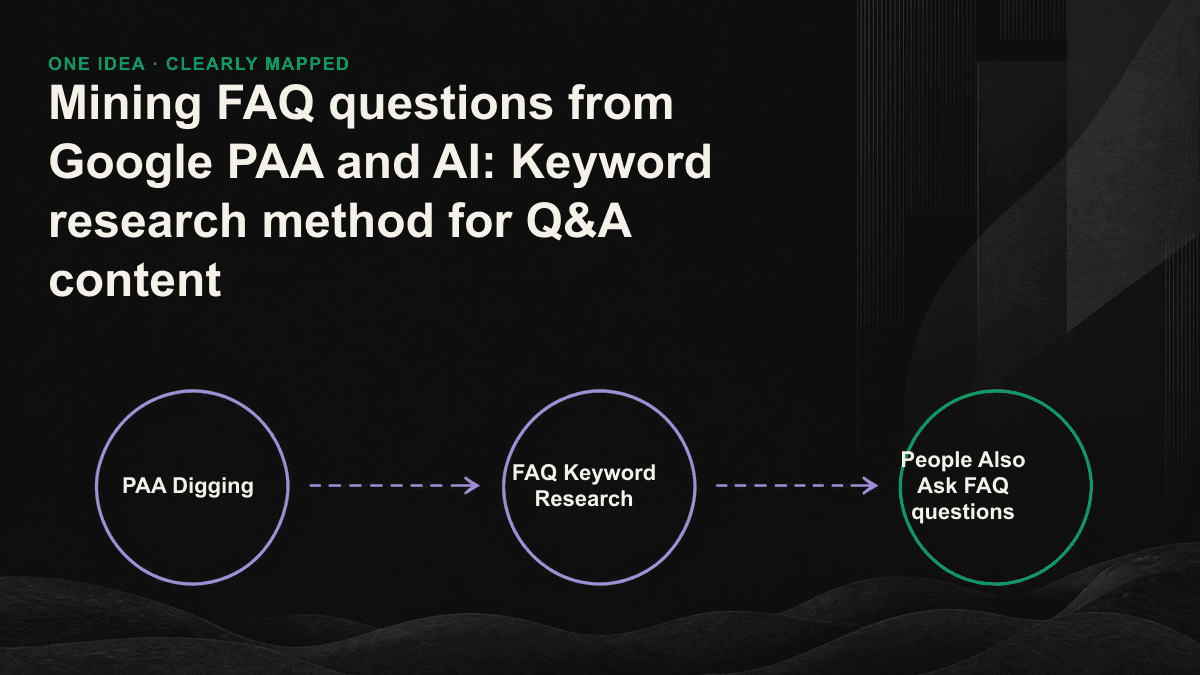
PAA has a feature that most people don't use well: every time you click on a question, Google will grow several new related questions below. This recursive structure is equivalent to a free question generator, but most people cut off four or five of the first layer and turn it off, only digging to the surface of the vein.
- Plant a seed query. Use a core topic as a starting point, such as "How to write FAQ schema", write down the first four to five PAAs that pop up, and paste them into a spreadsheet.
- Click one by one and dig down three layers. Every time one is expanded, Google will add new questions; by digging three levels in a row, one seed can usually grow 30 to 50 unique questions, all of which are included in the same list.
- Change the device and language and run again. The PAA seen on mobile devices and desktop computers is often different. If you run the Traditional Chinese and English queries one round each, you will get two sets of questions that are almost non-overlapping.
This complete set requires no paid tools. In an afternoon, a spreadsheet, and a topic, you can compile hundreds of questions that real people have asked. Then merge the repetitive words and delete the off-topic ones, and what is left is the raw material for your Q&A content.
AI questioning is the second mine
PAA reflects Google search behavior, but more and more people are asking questions directly to ChatGPT and Perplexity. These conversational engines have one thing that PAA doesn’t: ask for suggestions. After you ask a question, it will list extended questions of "You may also want to know" below. The wording is closer to spoken language, the sentences are longer, and it is more contextual.
For a comparison. Search "GEO audit" on Google and you will mostly see short questions; ask the same thing on Perplexity, and its extended question may be "What is the difference between GEO audit and one-time SEO inspection? Is it worth doing quarterly?" This kind of long-tail, situational, and almost complete sentence question is exactly the kind of question that traditional keyword tools cannot find, but is closest to the hesitation points of real people. Ask one round each of ChatGPT, Perplexity, and Gemini, and write down their follow-up questions. Your question bank will have a whole new layer of conversational long tail.
Screening: Not every question is worth writing about
After digging out two to three hundred questions, the real work came in chopping. Each FAQ has maintenance costs, and filling too many low-value questions will only dilute the page and drag down the extraction quality. When we help clients screen questions, we mainly look at three things.
- Does the intention match the commercial value? "How much does a GEO audit cost?" is far more valuable to an agency than "how do you pronounce the abbreviation GEO?"
- Can you explain the answer clearly in 60 words? If it is possible, leave it as a FAQ; if it takes a whole article to finish, upgrade it to an independent article, and then use a FAQ as the entrance.
- Have you answered the existing content? Just combine the ten synonyms of the same question into one, don't let them dilute each other by spreading across ten pages.
One question you answer quickly and accurately is better than ten questions that you squeezed in. The AI engine will always quote the one with the cleanest answer.
From questions to answer blocks that can be extracted
It’s only the first half of the game when we dig out the questions. To be cited by AI, the answer itself must be written as an "atomic answer": the conclusion should be placed in the first sentence, and the entire paragraph should be limited to 40 to 60 words, without the use of "first, second, and in summary" connectives that require context. The judgment method is very simple: if you cut out this paragraph of answer and paste it elsewhere, will it still be readable? Only if you can read it clearly can it be extracted. In practice, the original sentence of the question is used as the title, that is, the question field of the H3 or FAQPage structured data, and the independent short answer is placed in the first paragraph below, and the details are arranged later. In this way, Google featured snippets can be captured, FAQPage schema can be read, and the AI engine can quote the entire paragraph. The questions are from PAA and the format is written for extraction. The two things must be done together.
Schedule excavations into each quarter so that answering questions does not rely on guessing
Both PAA and AI questioning will change. Some of the questions I dug up half a year ago are no longer asked, and some new ones have popped up. It is more useful to schedule re-running seed queries into the calendar for each quarter, compare the old and new lists, add new questions, and eliminate outdated ones, rather than digging through them all at once. Tenten uses AI visibility monitoring to track the questions that customers are actually asked and cited in the AI engine, so that questions can be answered based on real visibility data instead of guessing. If you already have a batch of FAQs but are not sure whether they match the questions that real people are asking and AI is solving, you can book a 30-minute GEO diagnostic session to see where the gaps in your question bank are.