Google's AI overview is not scoring your entire page, but is scoring every paragraph in the pages. In the same article, there may be three paragraphs that have been pulled out and spelled into the same answer; there may be 2,000 words on the entire page, and only one sentence that has been quoted and the rest omitted. The difference is the passage range -- the paragraph ranking. If you keep the improved unit on "one page for one keyword", you'll miss the engine where it really counts.
What is it? Where does it come from?
Passage ranking is Google’s ability to announce and officially go online in 2021 in 2020. It means that even if the theme of a whole page is broad and the whole body is only ordinary, Google can single out a particular topic on the page and pull it up and respond to queries. The smallest unit in the ranking was thus down from the page to the section. This is particularly beneficial for the long run. A guide that covers 10 sub-topics, which may have been followed by the entire page because the theme was not focused enough, and now the best of which is the seventh paragraph, which can be won and seen alone.
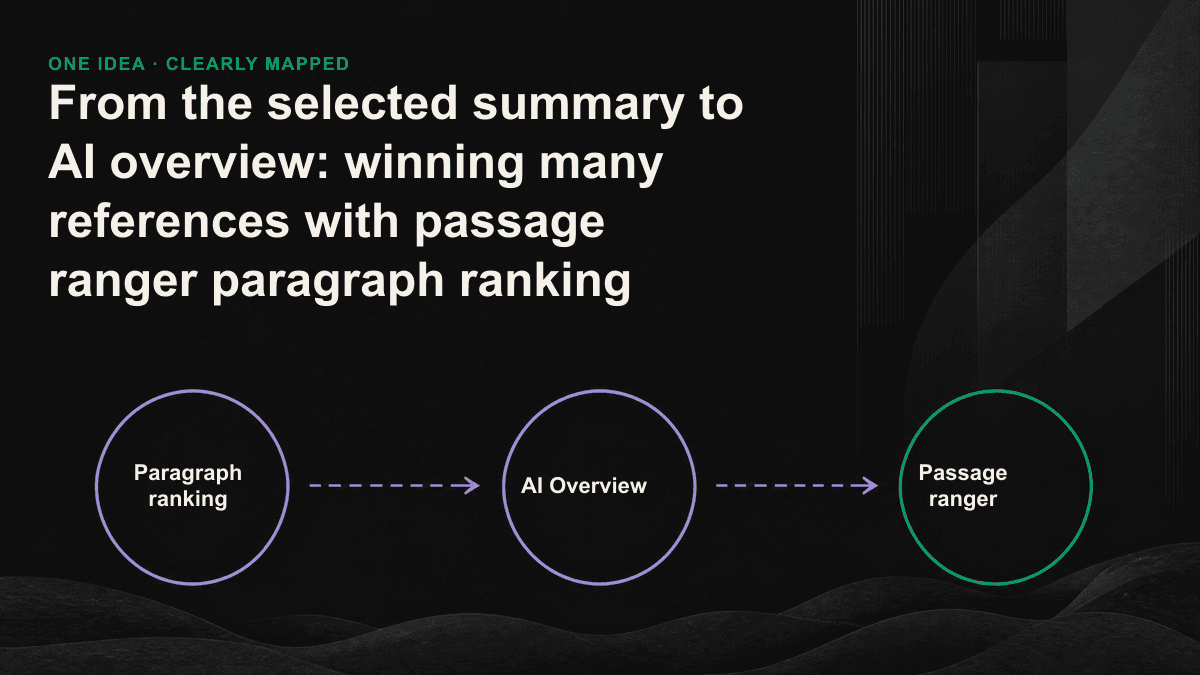
This line extends all the way to the AI search today. The Featured Snippet (featured snippet) is the first-generation system to pull a "one answer" out of the page and place it at the top of the search results; passage tangle allows Google to better locate the extracting paragraph inside the page; to arrive at the AI overview and AI mode, the engine no longer picks a single piece, but extracts the material from multiple pages and paragraphs at the same time, and gives the linguistic model a new full answer. The work you've been doing for the executive summary has not been wasted, but has been amplified -- because the more paragraphs you can extract now, the more references you can get.
Multiple quotes: same page taken more than twice
Multiple references refer to the same AI answer where your domain appears more than once. It may be two sub-points that support the answer in separate paragraphs of the same page, or it may be one of two separate articles on which you stand. This is the highest position for visibility: users have seen your brand repeatedly in the same answer, and trust build up much faster than just once. When we tracked B2B SaaS clients for visibility, we observed that the number of pages quoted, followed by brand searches, was significantly higher than the number of pages quoted single-time. And that's why we're using "the page can contribute a few quotes" as a core pointer for improving the content, not just the number one.
For a paragraph to be removed independently by an engine, it usually meets several conditions:
- Take the main words: the paragraph starts with a noun, not with the "it" in the previous paragraph.
- Take the answer: the first two sentences finish the conclusion, and the evidence is put behind it, instead of laying it to the end.
- The boundary is clear: one paragraph answers only one question, and the subject is changed so that the engine knows where to draw.
- Validation: There are specific numbers, steps or definitions, and models are bolder to quote because this reduces the risk of hallucinations.
Distinction of the page into paragraphs to be quoted
The practical operation is to re-think an article as "a set of questions" rather than "a narrative from the beginning to the end." Under this theme, users actually ask 10 to 20 specific questions, each of which corresponds to one paragraph, and the subheading (H2 or H3) of the paragraph is written in a sentence close to their question. The immediate advantage of doing this is that every part of you has a potential. In the query, the opportunity to be taken was only once from the entire page, and the result could be several hits on the page.
- Point of question: Draw up a list of sub-questions using People Also Assk, now an AI overview, real questions from clients.
- Question one: Each sub-question is written in 40 to 80 paragraphs that are self-contained, pre-conclusion, post-suppression.
- Title and title: Small titles are shown first at the level of the directory by question or clear term shorts.
- Construction data: Mark with FAQPage, HowTo and saves the cost of guessing for engines.
- Cross-checking: Throwing the whole article to an AI assistant and asking him "what's the answer to the question?" is not enough.
What does the self-contained paragraph look like?
Just take a quick look. The weak way to write is: ‘Thereby, the problem is a lot involved and needs to be considered.’ - There's no word, no answer, nothing to say. The strong way to write is: "The answer to the precise summary is about 40 to 60 words in English on average; if the Chinese text is to be extracted in its entirety, the core answer is to be contained in the first two sentences and the entire paragraph is to be contained in 100 words, the hit rate is to be significantly higher." And then there's the theme, there's the conclusion, there's a number that can be quoted, and the language model can move it almost intact. The difference is not between writing and writing, but whether or not it is independent of the context.
Consider each passage a card that can be torn off alone and read elsewhere. I can read it. It's the only way to get away.
Which paragraphs will be jumped directly by the engine?
The most common loss is the excessive reliance on pronouns and turns between paragraphs. When the beginning of the paragraph is `and that explains why', the engine has to read back two paragraphs to understand what you're talking about, and most of it simply gives up the extract. The second kind of loss is burying the answer at the end of the paragraph, all the background is laid; AI has always preferred the way the answer is written, and you bury the conclusion too deep to be drawn. And the other thing is, there's three little themes in one piece, the boundaries are broken, the engines don't know what to do. Where it ends, it doesn't work. Some of these writings may have been unharmed in the traditional SEO era, but under the rules of the paragraph ranking, you will lose the opportunity to quote.
How do you know it's been taken?
Validation cannot just read the keyword ranking. The practical approach is to take your target questions and ask Google AI, ChatGPT, Perplexity, to check whether your domain is in one answer, which paragraph is quoted, and whether there are many references in one answer. Making this a regular weekly follow-up, you can see which paragraphs have been drawn, which have been rewritten before being drawn, and which, however, are always cited by the competition. Brand Radar of Tenden does this by automating the tracking system, by targeting multiple engines, paragraph-level variability under multiple questions.
Passage ranking makes the rules of the game very white: Visibility is a win, not a page. Instead of rewriting the entire site, choose a few pages with traffic, tear the paragraphs down to the point where they can be quoted independently, and then ascertain the number of times they appear in the AI answer. If you want to know how many pages of your page are actually removed and where the gaps are, you can book a 30-minute GEO diagnostic session, and we'll run a multi-engine check-up on your key pages.