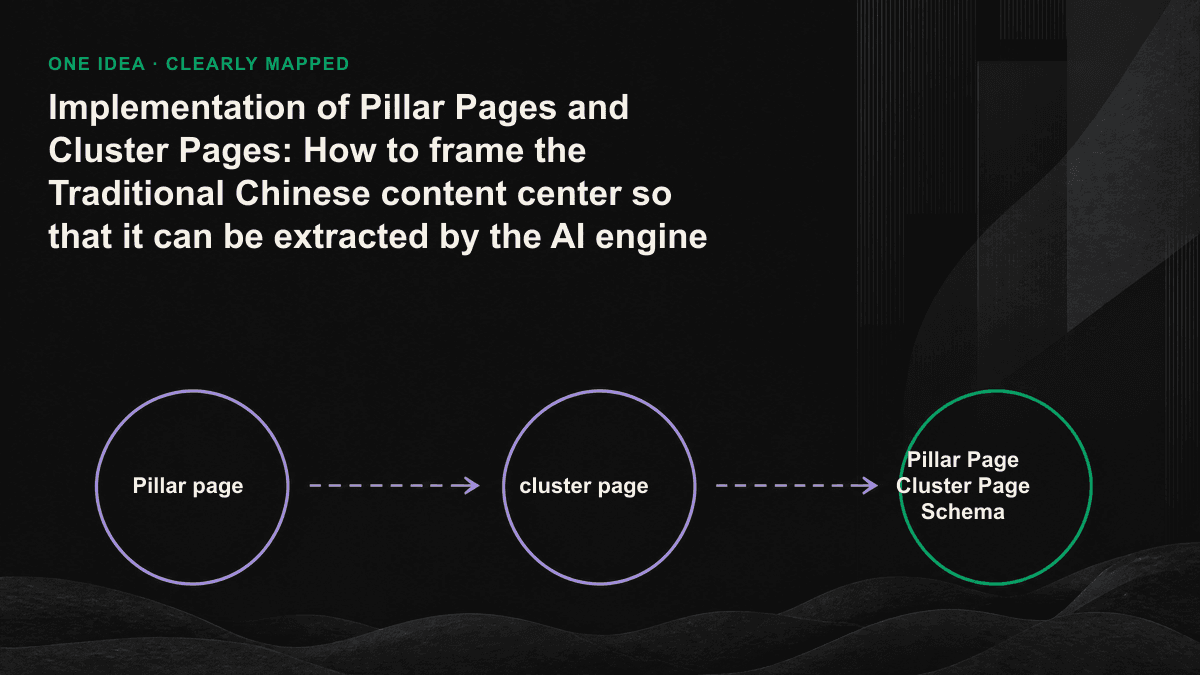
Pillar pages and cluster pages are not internal linking techniques that impart weight to the homepage. When your content is retrieved by an AI engine, what this structure does is very specific: break a topic into a set of clean pages that can be extracted independently and refer to each other, so that the model determines that your website has a consistent and complete answer to this question, rather than fragments scattered here and there, fighting with each other.
Why does LLM search eat this structure?
When the AI engine answers a question, it does not read the entire website. Instead, it first cuts the page into chunks, converts them into vectors, and then selects the paragraphs closest to the user's question to formulate the answer. This has two consequences. First, if the content is scattered in more than a dozen short articles that are repeated and have inconsistent definitions, the signal of each paragraph will be diluted, and the model may catch the version of the article three years ago that should have been removed from the shelves. Second, models tend to cite pages that "seem to be authoritative sources on the topic," that is, pages that clearly explain the definition, scope, and subtopic structure.
The job of the pillar page is to be that authoritative node: define the topic, define the scope, list all the subtopics, and connect the in-depth content of each subtopic to the corresponding cluster page. Cluster pages each answer a specific, long-tail question and are short enough to be cited individually. If the division of labor is clear, the signals will not dilute each other.
What to write on a pillar page and what not to write
A common mistake is to write the pillar page into a 5,000-word article that crams everything into it, trying to cover all the details at once. Doing so will cause the signals of each subtopic to interfere with each other, and will also make the cluster page lose its meaning. The pillar page should give a complete map of the topic: only two or three paragraphs of summary for each subtopic, plus a clear "see full description" link, leaving the in-depth content to the cluster page.
- On the first screen, put a definition of the theme that can be directly quoted. In 40 to 80 words, explain clearly "what it is and who it is for."
- Define the scope and boundaries of the topic: which sub-topics are covered and which ones are deliberately left out.
- One subsection per subtopic, a summary, and a descriptive link to the cluster page.
- A diagram or list that provides an overview, allowing readers and engines to understand the structure at a glance.
- Mark the update date and the person responsible to let the engine judge the freshness of the content.
How to keep cluster pages relevant: Practical differences between Traditional Chinese and Chinese
The gold standard for cluster pages is "Answer one question on one page, and you can read it even if you pull it out." The judgment method is simple: paste the page title into ChatGPT or Perplexity. If the question it wants to ask is not the same as the answer on your page, the question is wrong. There is a gap in Traditional Chinese that is easily overlooked. Taiwanese users search for "online seal engraving", "invoice carrier" and "labor and health insurance level". The vocabulary used is different from that in mainland China, and the word segmentation methods are also different. If the content strategy directly follows the Simplified Chinese keyword list, the cluster page will encounter errors. In practice, we first use local search suggestions, community questions and customer service tickets in Taiwan to compile a list of sub-questions, and then go back and decide on the structure of the pillar page, rather than the other way around.
Internal links: two-way, and the anchor point must have semantic meaning
There should be a two-way connection between pillars and clusters: pillars point to each cluster, each cluster points back to the pillars, and clusters in the same group refer to each other based on semantic correlation. Use anchor text with a complete and semantic phrase, such as "Traditional Chinese word segmentation and keyword selection". Do not use "Click here" or "Learn more". For LLM, anchor text is an important clue to understanding the relationship between two pages. A vague anchor point is equivalent to losing this signal in vain.
Let both crawlers and LLM catch it
No matter how beautiful the structure is, it means nothing if the engine cannot catch it. Think of crawlability as a basic checklist before going live:
- The text should be written in HTML. Do not rely on JavaScript, which is triggered by user interaction, to render the content.
- sitemap.xml lists all pillar and cluster pages, and llms.txt identifies the core pages you wish to be referenced.
- Use semantic heading levels (one h1, h2 for subtitles) to allow the engine to have clean boundaries when cutting chunks.
- Each page is self-contained: it does not assume that the reader has seen other pages, and the key definitions are clearly stated on this page.
- Supplement corresponding structured information (Article, FAQPage) for definition and question-and-answer content.
A set of directly executable build sequences
If you start from scratch, the order will determine success or failure. Have subtopics first and then pillars, don’t do the other way around:
- Take inventory of real questions: From customer service tickets, business FAQs, and local search suggestions in Taiwan, list 20 to 40 specific questions that users will really ask.
- Grouping: Group questions into 3 to 6 topic groups, and each group is a future pillar page.
- First write two or three cluster pages to test the water temperature, paste the text into the AI engine to test the extractability, and confirm that it is on topic before mass production.
- Go back and write the pillar pages: use subtopic summaries to string together the completed clusters, and add descriptive two-way links.
- Send the updated sitemap and llms.txt, and use the visibility tracking tool every 2 to 4 weeks to see which pages are actually cited by AI.
- Supplement based on cited materials: complete sub-topics that have not been extracted, rewrite pages with low extraction rates, and allow the content center to continue to grow.
Pillars and clusters are not projects that are done once and then, but are systems that are continuously adjusted as the engine references data. Most teams are stuck at the front: they don’t know which sub-topics are missing in their content center, and they don’t know which pages have not been read by AI at all. If you want to quickly see your structural gaps, you can book a 30-minute GEO diagnostic session. We will run an extractability and citation status on your actual website and point out the pillars and clusters that should be prioritized. Tenten's GEO content engine also follows this sequence to build a Traditional Chinese content center for B2B SaaS customers.