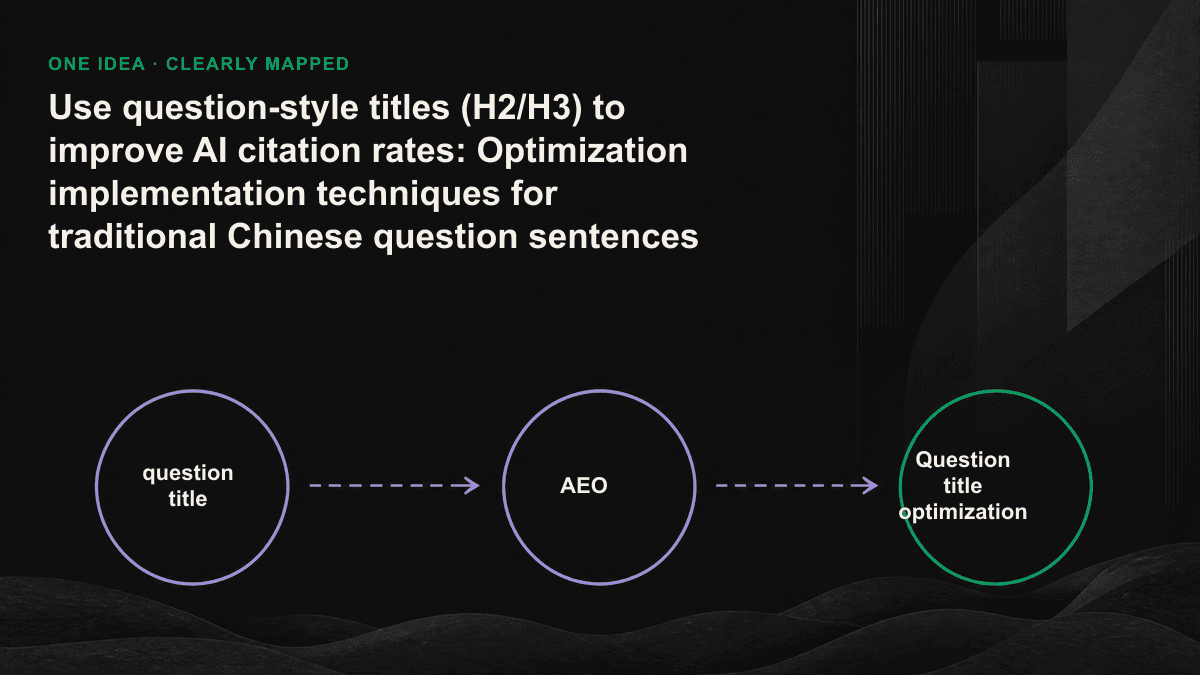
When the AI engine answers a question, it does not grasp the entire paragraph of text you have carefully written, but a group of pairs of "questions and answers". When your H2 title happens to be the question entered by the user, your content will directly hit the semantic vector when it is retrieved. Rewriting a noun title into a real question often increases the citation rate more significantly than rewriting the entire paragraph, and the changes are much smaller.
Why are question-style titles cited preferentially by AI?
When AI search processes a query, it will first convert the user's question into a vector, and then compare the fragments in the web page with the closest semantic meaning. ChatGPT, Perplexity, and Google AI Overviews all work this way. More than 90% of what users throw into the dialog box are questions or phrases with question intent, such as "How much does GEO cost?" "How does B2B SaaS do content marketing?" If your title is the noun phrase "GEO cost description", the semantic distance is not as good as an H2 that literally asks "How much does GEO cost?"
The heading level of HTML is a clear segmentation signal to extraction engines. The first paragraph under an H2 will be captured as a candidate answer to this question. The noun title leaves the judgment of "what does this paragraph answer" to the algorithm to guess; the question title means that you have marked the question yourself first, and the answer and question are tied in the same block, so you will not catch half or wrong paragraphs when extracting.
How to write traditional Chinese interrogative sentences so that they look like users would ask?
Traditional Chinese interrogative sentences have their own rhythm, and directly translating the English how-to title will often lose its flavor. The way a Taiwanese user types in the AI dialog box is not exactly the same as the keywords he enters in the search box. Conversational queries are more complete and more colloquial. What you want to align is the former.
- Use the interrogative words that Taiwanese people would really use: "how", "should it be necessary", "is it worth it", "how much" and "what's the difference", rather than the written "how" and "whether" piled at the beginning of the sentence.
- Put the subject word into the title. "Should B2B SaaS do GEO by itself or outsource it?" is more likely to be classified into the right situation than "Should B2B SaaS do GEO by itself or outsource it?"
- An H2 only asks one question. "What is GEO, how much does it cost, and how long does it take to see results?" With this three-in-one title, the extraction engine doesn't know which paragraph to answer.
- Keep the user's original vocabulary and don't upgrade their vocabulary. If a user asks "Will AI cite my website?", don't change it to "Discuss the probability of the website being cited by a generative engine."
- The length of question sentences should be between 12 and 22 words. Too short is not specific enough, and too long dilutes the topic.
Below the question title, what should the answer look like?
The title aligns the questions, and the answer is only half done if the answer can be extracted cleanly. Extractive engines prefer "self-contained paragraphs": they do not rely on the previous paragraph, do not need to scroll down, and can answer the question after reading it. Therefore, right below the question H2, the first sentence should give the conclusion. Do not lay out the background first and then slowly approach the answer.
Common mistake: writing questions in SEO accent
The easiest way to fail is to put old keywords into question marks and pretend to be questions. These ways of writing seem to have the shell of a question, but they don't get the benefits of a question.
- Keyword stacking type: "GEO Optimization Cost Price Recommendation How to choose?" No one asked this question, and the semantic meaning was broken up.
- The self-question and answer are too revealing: five consecutive H2s are all "What is...?", which reads like an exam paper and also allows the engine to judge that you are filling in FAQs.
- Asked but not answered: The title asks "how long does it take to see results", but the text talks about methodology, and the captured clips will answer the question incorrectly.
- Inconsistency in local terms: The title contains vocabulary that is not commonly used in Taiwan, which may confuse readers at first glance, and the AI’s localization judgment will also be deducted.
A rewriting process that can be followed
No need to rewrite the entire article. Just take an existing article and perform an operation on the title layer.
- Grab each H2 and H3 and ask yourself one by one: Will users use this sentence to ask AI? No, it just rewrites the object.
- Go to ChatGPT and Perplexity and actually type a few related questions, see how the sentences they answer are worded, and use that tone as the title.
- Change the noun phrase into a question and fill in the subject and situation.
- Check whether the first paragraph below each question gives the conclusion first and the word count falls between 40 and 80 words.
- Limit the question H2 to less than half of the total number of titles in the article, and leave the rest to declarative titles to maintain the reading rhythm and avoid the entire page looking like an FAQ farm.
The title is not a table of contents for humans to read, but an index of questions for machines to read. The more accurately you label your question, the less the machine has to guess what you're answering.— Tenten GEO Content Team
How do you know if the changes are effective?
Don’t just focus on organic rankings. The real signal is whether your content appears in the AI answer and which paragraph it is quoted from. In practice, we will do two things: first, take the same batch of questions before and after the rewrite, and retest them in several engines to see if citations have been added from scratch; second, use visibility tracking such as AI visibility monitoring to long-term record the position and cited paragraphs of the brand in the generative engine. Title-level changes are usually reflected in citations in two to four weeks, much faster than waiting for organic search rankings to climb. If you want to know which pages on your site deserve priority in changing titles and where the gaps are, you can book a 30-minute GEO diagnostic session. We will use your real pages to demonstrate a round of rewriting.