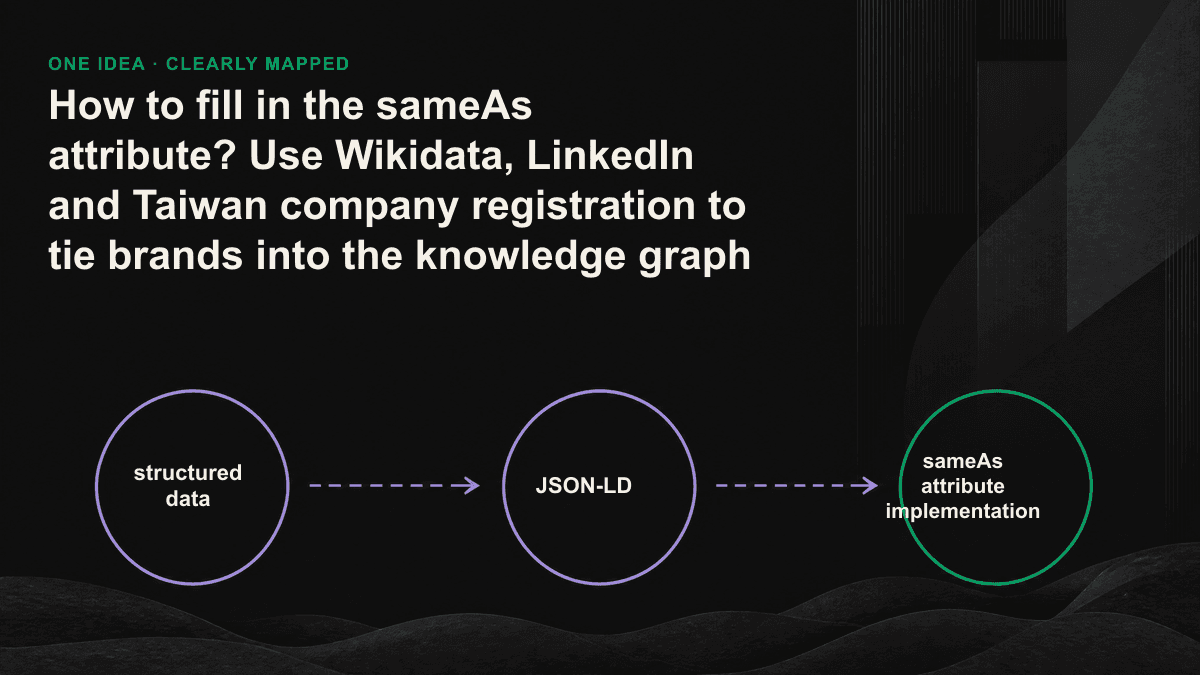
sameAs is not a decorative link for search engines to see, it is a set of identity certificates. When you point the brand's Organization to authoritative files such as Wikidata, LinkedIn, and Taiwan Company Registration, you are telling Google and the AI engine that the name on the website is the verified entity in the knowledge graph. If you fill it in correctly, your brand will be upgraded from a string of text to a node; if you fill it out incorrectly or indiscriminately, AI will only treat you as an unfamiliar string of words that cannot be verified when generating answers, and it would rather skip it than quote it.
What exactly is sameAs connecting to?
Organization.sameAs of schema.org is essentially a hook for entity disambiguation. There are hundreds of companies in Taiwan called "innovative", "intelligent" and "digital". Search engines cannot determine which one you are just based on the name on the website. Each link in sameAs is a cross-reference: Google follows the link to Wikidata, sees that the entry also points back to your official website, and is consistent, so it includes you in the knowledge graph. The AI engine will give priority to entities it recognizes and can verify when generating answers; a brand without external anchors is too risky for the model and is often skipped directly.
Which links should be filled in? The order is different.
It’s not just about cramming all social accounts into the array. There is a clear gap between the weights. Prioritize the files that can best reverse identity verification:
- Wikidata and Wikipedia: The core data sources of the knowledge graph, with the highest weight, can get a set of Q numbers as official identities.
- LinkedIn Company Page: The most trusted professional profile in the B2B scene, recognized by almost every model.
- Taiwan company records and the Ministry of Economic Affairs business registry: official evidence that the local legal entity exists, including a verifiable Unified Business Number.
- Official social accounts: Facebook, X (Twitter), YouTube, Instagram brand accounts to supplement social signals.
- Industry-type files: Crunchbase, GitHub or the industry directory in your field. You can enhance it as needed.
The logic behind filling in is not that the more the better, but that each item must be able to point back to you. A file linking to "It seems to be you, but the official website link cannot be found on the page" is worse than an empty signal, because it dilutes the credibility of the entire array. Three to six clean, two-way closed-loop links are better than a dozen contradictory social links.
Wikidata is the strongest anchor, don’t force yourself to use Wikipedia
Wikipedia has a clear notability (notability) threshold. Most B2B SaaS submissions for review will be deleted, and hard-coded entries will leave negative records. Wikidata has a much lower threshold: as long as the company is authentic and the information is verifiable, you can usually create an entry and get a Q number. That set of numbers is your ID card in the knowledge graph. After it is built, remember to fill in the official website (attribute P856) in this entry and let it point back to your domain - the value of sameAs comes from two-way confirmation, and one-way claims will be discounted.
LinkedIn and Taiwan company registration: two trump cards for local B2B
Please use the official /company/ standard URL for your LinkedIn company page. Do not use profiles or links with tracking parameters. Taiwan company registration is a card that is easily overlooked by local SaaS, but is very effective: Put your company announcement page in the Ministry of Economic Affairs' commercial and industrial registration public information (GCIS, findbiz.nat.gov.tw), or the registration link that can be found in the government's open information into sameAs, which is equivalent to using the official database to nail "this legal entity really exists and the Unified Business Number can be checked." For new brands that have not yet established a Wikidata entry, these two items are often the most pragmatic starting point.
Implementation: How to write Organization JSON-LD
Put a piece of Organization structured data on the home page that is shared by the entire site, and use @id to give it a stable identification so that other schemas (Article, Product, WebSite) can reference the same node:
{ "@context": "https://schema.org", "@type": "Organization", "@id": "https://yourbrand.com/#organization", "name": "your brand", "url": "https://yourbrand.com", "logo": "https://yourbrand.com/logo.png", "sameAs": [ "https://www.wikidata.org/wiki/Q123456789", "https://www.linkedin.com/company/yourbrand", "https://findbiz.nat.gov.tw/fts/query/QueryCmpyDetail/queryCmpyDetail.do?banID=00000000", "https://www.crunchbase.com/organization/yourbrand" ] }
The emphasis is on @id. As long as the schema of other pages uses @id to reference the same https://yourbrand.com/#organization node, the author and publisher can be unified to the same entity, instead of each page declaring an unrelated organization. After the change, run Google's Rich Results Test and Schema Markup Validator each to confirm that there are no syntax errors in the sameAs array and that each link can be opened.
Acceptance checklist before going online
- Every sameAs link can be opened, and information or links pointing back to the official website can be found on the page.
- The Wikidata entry has been filled in the official website (P856), forming a two-way confirmation with the official website.
- LinkedIn uses the /company/ standard URL and removes tracking parameters.
- The Taiwan company registration link points to a verifiable announcement page with the same Unified Business Number.
- Only one Organization @id is retained in the entire site, and other schemas refer to it.
After completing these five items, your brand will transform from a strange string of words into a well-documented entity in the eyes of the AI engine, and the probability of being cited will increase accordingly. If you are not sure whether your physical connections have formed a two-way closed loop, or want to know how AI currently describes your brand, you can book a 30-minute GEO diagnostic session - Tenten's GEO audit will take stock of your sameAs, knowledge graph signals and AI visibility gaps at once.