Before the AI engine decides whether to cite you, it first asks not "Does this keyword appear on this page?" but "Is this brand a credible entity on this topic?" The watershed between keyword thinking and entity thinking is here: the former optimizes strings, and the latter manages your identity in machine knowledge. When ChatGPT, Perplexity, or Google AI Overviews generate answers, they pick sources they know and trust, not the page crammed with the most keywords.
The era of keyword comparison is actually over
The underlying assumption of traditional SEO is word string comparison: whatever word a user searches for, that word will appear on your page. Density, title, and H1 all revolve around the same set of words. Generative engines are completely different under the hood. LLM converts text into vectors and uses semantic distance to determine relevance; it knows that "GEO Audit" and "AI Visibility Detection" are about the same thing, and it also knows that Perplexity, Claude, and AI Overviews belong to the same concept group. You fill the entire page with the four words "topic authority" and get almost no points for it, because it reads concepts and relationships, not word frequency.
What's more critical is trust in this layer. Faced with the same problem, the model can find thousands of candidate sources, but it has to decide who to believe in milliseconds. What determines the weight is the consistency and authority of your entity on the entire network: who mentioned you, which concepts you appeared with, and whether there are any contradictions in your previous and later statements. No matter how beautifully written a single article is, if there is no clear and identifiable entity behind it, there is no reason for the machine to quote your statement as fact.
What exactly is an entity?
An entity is a node with a clear identity in the knowledge graph: a company, a person, a product, a concept. It's not a keyword. "Geo audit" is a string of words that can be written in countless ways; but "a GEO agency located in Taipei, specializing in B2B" is an entity with a fixed identity, attributes, and relationships with other entities. Google's knowledge graph, Wikidata, and the parameterized knowledge within various LLMs all organize the world based on entities, not keywords.
For a machine, understanding an entity means answering three questions: what it is, what attributes it has, and which entities it is related to. When these three coincide with each other across multiple sources, the entity becomes clear; clear entities can be cited with confidence. On the other hand, models will most likely skip over vague entities with inconsistent names, conflicting statements, and no endorsement from authoritative sources.
- Keywords are query strings, and entities are nodes with identities in the knowledge graph.
- Keywords are found through comparison, and entities are understood through attributes and relationships.
- Keywords can be infinitely rewritten, and entities require consistent naming across sources.
- Keyword optimization is the ranking of a single page, and entities accumulate the credibility of the entire brand.
Topic authority: covering the entire concept space, not competing for a single ranking
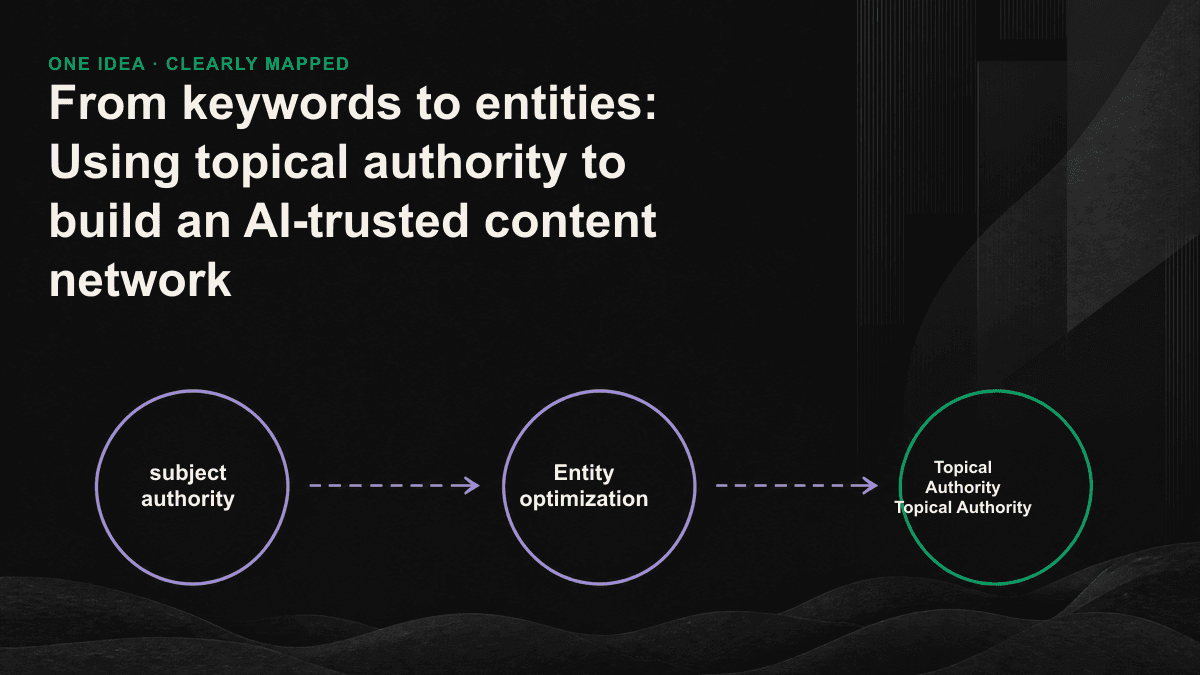
Topical Authority refers to: within a topic area, your content covers the complete concept space that readers and machines will care about, not just a few high-traffic keywords. Taking GEO as an example, a brand with subject authority will will clearly explain and connect the entire set of related concepts including GEO audit, AEO, entity optimization, schema, AI visibility tracking, and the crawling logic of each en, rather than merely write an article "What is GEO"gine. What the machine sees is a conceptual network with sufficient density, and it determines that the source is professional enough on this topic.
This also explains why it is difficult to accumulate GEO results from scattered articles. Ten articles with unrelated topics are ten isolated points in the eyes of the machine; ten articles that revolve around the same topic, are connected to each other, and share the same entity name are a network. The web has a center, boundaries, and internal relationships along which the model can build its overall judgment about you. Authority is rarely earned by a single article, but by the content of the entire piece.
A content network that builds entity trust: four levers
To implement the topic authoritatively, there are four practical places where you can directly take action. They are not marketing slogans, they are signals that machines can actually read and compare.
- Topic map: First draw a complete concept list of this topic, including one page of pillars and multiple pages of radiating content, make sure there are no obvious gaps, and then decide on the writing order. The gap is where the machine decides you're not complete enough.
- Internal links and consistent naming: For the same entity, use the same name and the same set of definitions throughout the site; then use internal links to string together related concepts, allowing the machine to follow the links to understand your topic structure.
- Physical co-occurrence: Take the initiative to let your brand and authoritative concepts, tools and standards in the field appear in the same context, accumulating correct associations instead of being diluted by random links.
- Structured data: Use schema to write "what you are and what you are related to" into a machine-readable declaration. Don't let the machine just guess.
Use schema and external consistency to let machines recognize you
If you do well on-site, you must also deal with off-site, because a large part of an entity's credibility is based on cross-source consistency. Specifically: use Organization schema to mark the name, logo, and location; use sameAs to string authoritative nodes such as the official website, Wikidata, LinkedIn, and industry directories into the same entity; use about and mentions at the article level to mark clearly which entities this article is about. At the same time, make sure your name, description, and positioning are consistent across external platforms. If the name is called this and that, the machine may split you into two fuzzy entities, and your credibility will be diluted.
Instead of just reading your latest article, the machine is integrating all the signals it has seen about you. Any contradiction will deduct your trust score.
How do you know if it's effective?
Traditional ranking tools don’t see this. What you want to ask is no longer "Who is ranked?" but "Among the questions that users will really ask, has the AI mentioned me, in what context, and with whom?" This requires continuous tracking of the brand’s visibility and context in the answers of various engines. Tenten’s Brand Radar does exactly this, turning abstract AI trust into indicators that can be viewed every week. If you want to know whether your entity is clear in the eyes of AI and what pieces of the theme network are missing, you can book a 30-minute GEO diagnostic session. We will actually run it using your own brand and point out the gaps to you.