Wikidata entries are not a bonus for SEO, but the underlying basis for the AI engine to determine whether you are a real entity. When a user asks ChatGPT or Perplexity "What does such-and-such a company do?" the model must first determine which entity this name refers to before it dares to quote information other than your official website. Without structured entities, your brand is just a string of ambiguous characters in the knowledge graph.
Why Wikidata is the foundation for AI citations
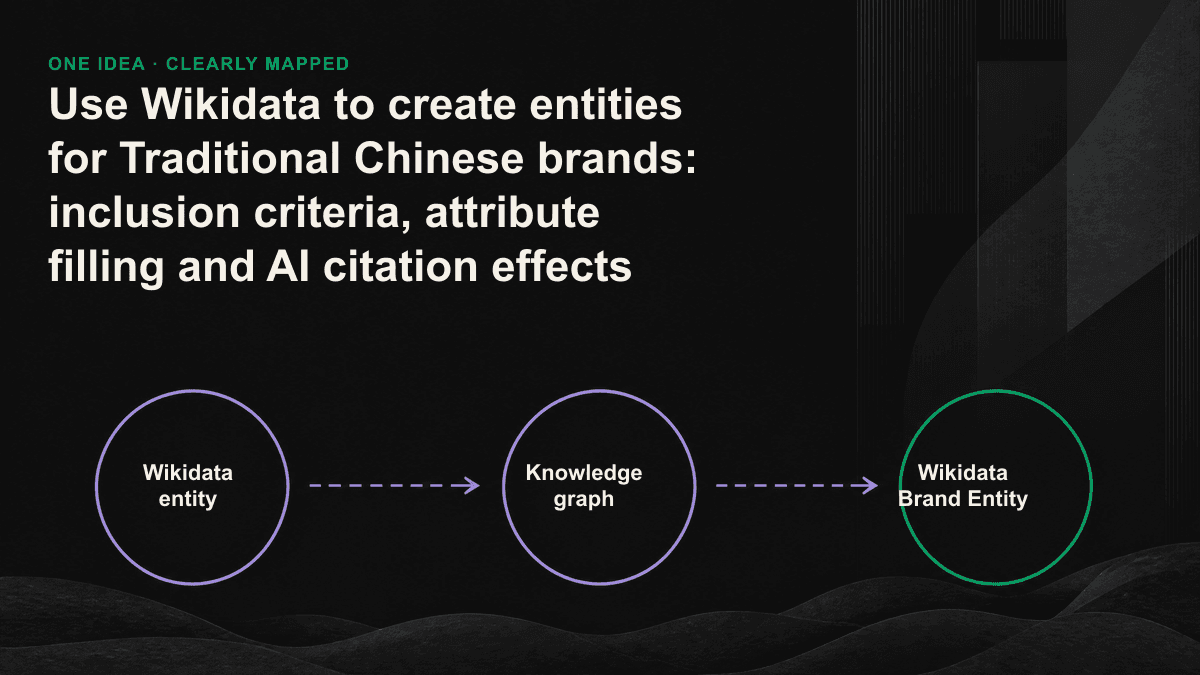
Wikidata is an open knowledge base maintained by the Wikimedia Foundation. Each entity is marked with a Q number (for example, Q95 represents Google) and then describes it with structured attributes. The training corpus of Google Knowledge Graph, Bing, and most large language models directly reference Wikidata's open materials. This means that when the model needs to disambiguate (determine whether "apple" is a fruit or a company), it relies on this type of structured entity. More importantly, Wikidata uses a unique Q number to deduplicate each entity, so the model can classify all mentions scattered on different web pages and in different languages under the same brand. If the Taiwan B2B brand does not exist on Wikidata, it is equivalent to being absent from the AI worldview. The model can only rely on literal guesses, and you cannot correct it if it is wrong.
Go through the "Inclusion Guidelines" before taking action
Many people think that Wikidata is like a social platform. By registering an account, you can create articles for your company. It actually has clear inclusion criteria (notability). If it fails to pass the test, it will be deleted by the administrator, which is a waste of time. For an entry to be retained, it must meet at least one of the following three conditions:
- Already linked to a page on any Wikimedia project, such as the Chinese or English Wikipedia that already has your entry.
- Point to a clearly identifiable entity and be supported by rigorous, publicly available sources, such as company registration information, mainstream media reports, and industry databases.
- It satisfies structural requirements, that is, it is referenced by other legal items to make the entire knowledge graph more complete.
For most traditional Chinese B2B brands, the second option is the only way to go. You don’t need to have a Wikipedia entry first (the threshold is higher and you have to prove “Wikipedia-level popularity”), but you need at least two to three reliable sources that are independent of your own official website. Instead of wasting time trying to get included in Wikipedia, it is better to lay the physical foundation of Wikidata first.
Traditional Chinese brands are most often stuck at the source level
The typical dilemma for Taiwanese SaaS startups is: the product is very solid, but public reports are almost always reprinted from their own blogs or press releases, lacking third-party support. At this time, instead of rushing to create an entry, it is better to fill in the source first. The Ministry of Economic Affairs' commercial and industrial registration disclosure information, 104 or LinkedIn company pages, China Credit Bureau, and industrial media reports with editorial review are all references that administrators will accept. A practical criterion is: if this information is paid for or published by yourself, it is not considered an independent source; only information that can prove "others talk about you" has weight. When Tenten helps clients with GEO audits, physical source inventory is often the first step. First, confirm whether there are qualified references, and then decide whether to send out entries.
The attributes must be filled in so that AI can understand them.
After the entry is created, what really determines whether the AI can reference you is whether the property (marked with a P number) is filled in completely and accurately. B2B brands must at least complete the following items:
- Instance of (P31): Marked as business (Q4830453) or enterprise, this is the key starting point for AI to determine "you are a company".
- official website (P856): Fill in the main URL of the official website and firmly bind the entry to your website.
- inception (P571): Date of establishment, establishing credibility for the timeline.
- Country (P17) and headquarters location (P159): indicate Taiwan and Taipei, which are particularly important for traditional Chinese local queries.
- industry (P452): Fill in industry entities such as software and SaaS to let the model know your field.
- Label and description: Be sure to add label (brand name), description (one sentence positioning) and alias (common alias, English name) in two languages: zh-Hant and zh-tw.
The language tag is the most easily overlooked step, but it directly affects Traditional Chinese queries. Only fill in the English label. When the model faces the Chinese question "What is the name of this Taipei company?", it lacks a clean corresponding point. It also makes sense to write zh-Hant and zh-tw separately: the former covers traditional Chinese in a broad sense, and the latter accurately points to the vocabulary habits of Taiwanese readers.
Every statement must have a source
This is the most common mistake newbies make: filling in attributes without adding a reference. Under each statement, stated in (P248) or reference URL (P854) should be listed, and the date of access (P813) should be attached. Statements without sources are easy to be removed by other editors and the trust weight when cited by AI will be reduced. In practice, if a statement "founded in 2018" can be linked to company registration information as a source, it is far easier for the model to adopt it as a fact than a single number. Making the source solid is equivalent to endorsing your own entity.
After it is built, how long does it take to see the AI citation effect?
Don’t expect to be cited by ChatGPT the next day. Wikidata data must first be absorbed downstream: Google Knowledge Graph is usually crawled within a few weeks, and the language model will not be reflected until the next training or retrieval update. A more pragmatic expectation is that three to six months after the entry is created, you will first see the physical card appear on Google, AI Overviews will start to treat you as a confirmed entity, and then the correct brand description will gradually appear in the answers of Perplexity and ChatGPT. It should be reminded that just because an entry has been created, it does not mean that it can be left alone. If the information expires, the product is transformed, or the company is renamed, it should be updated later, otherwise the AI will continue to refer to it with the old description. This is not an instant switch, but a solid foundation, so that every subsequent piece of content and every mention will be accumulated on the same entity.
Wikidata entries are the starting point for Traditional Chinese brands to be recognized in AI searches, but they are only one piece of the physical strategy. Whether your official website structured information, third-party mentions, and visibility on AI visibility monitoring are consistent with each other will jointly determine how AI ultimately describes you. If you want to know which piece of your entity is missing in the AI engine, you can book a 30-minute GEO diagnostic session. We will run your brand through actual queries and point out the gaps that should be filled first.