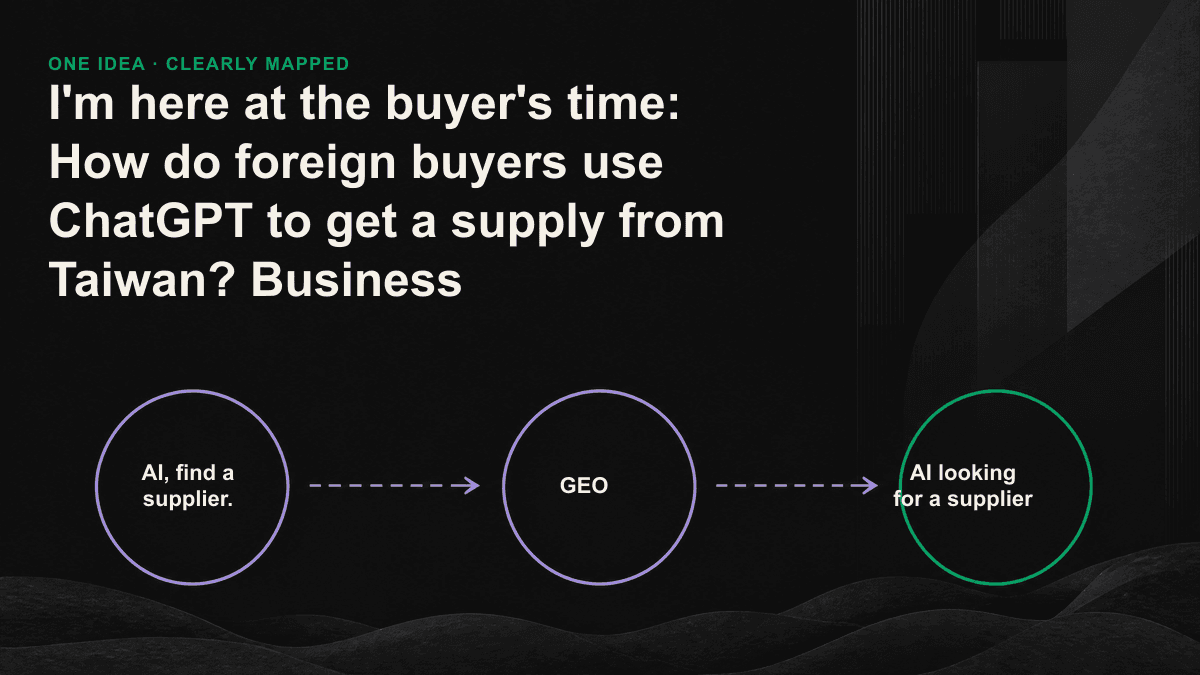
Overseas buyers no longer always begin on the first page of Google. They open ChatGPT and ask for three Taiwan manufacturers that can produce an IP67 waterproof connector at a monthly capacity of 100,000 units with UL certification. Seconds later, they receive a shortlist with reasons. If your factory is absent, you may never receive the request for quotation, and you will not know you were skipped.
Supplier Discovery Is Moving from Search to Conversation
For the past 10 years, a procurement engineer in Germany or the United States might search Google, browse Alibaba or Taiwantrade, compare several sites, and send a round of inquiries. Now that process is compressed. The buyer asks ChatGPT or Perplexity which Taiwan manufacturers can meet the requirement, lets AI eliminate 80 percent of the field, and investigates the remaining two or three suppliers. Search has not disappeared; it has become a verification step rather than the point of discovery.
This shift is especially disruptive for Taiwan's hardware and OEM supply chain. Its strengths have long been the ability to make a product, control cost, and deliver reliably, but those advantages often remain in sales conversations, quotations, and trade-show materials. AI systems can cite only what they can read. If they cannot find evidence of the capability online, they behave as if it does not exist.
How AI Chooses Which Taiwan Suppliers to Recommend
A generative engine is not running a database query. It builds the answer from training material and pages retrieved at the time of the request. When a buyer asks for a Taiwan factory in a specific category, the model favors companies described consistently across multiple sources, with clear specifications and an unambiguous identity. The following signals matter most.
- The website describes product specifications, processes, and capacity in clear sentences an engine can extract, not only in marketing adjectives.
- Independent sources such as industry directories, media, or business platforms mention the company and describe it consistently with the official site.
- Certifications, minimum order quantity, lead time, yield, and other facts buyers need appear as text instead of being locked inside a PDF catalog or image.
- English content is complete and consistent. Most overseas buyers ask in English, so strong Chinese pages alone cannot support the recommendation.
- Structured data identifies the business as a manufacturer, helping machines distinguish it from a trading company.
None of these five points is mysterious. Each is an engineering problem that a team can inspect and correct one by one.
Why So Many Taiwan Factories Are Invisible in AI Answers
In manufacturing GEO audits, we often find a capable factory with a website designed for people but unreadable to machines. The home page shows a large image and a phrase such as "professional manufacturing, quality assured," while every meaningful specification sits inside a catalog available only after submitting an email address. To ChatGPT, the site is almost blank.
Capacity and Certification Hidden in a Catalog Might as Well Be Missing
AI crawlers may not parse a gated PDF and will not complete a form. If "monthly capacity of 30 million units and IATF 16949 certification" appears only on page 7 of a catalog, it effectively does not exist for the model. Publishing those facts as plain text on the relevant web page is usually the highest-return first step.
A Chinese-Only Site Cannot Answer an English Query
For export-oriented factories in Taiwan, 80% of prospective buyers may be overseas. Yet many English sites contain only machine-translated product names while the substantive material remains in Chinese. When a buyer describes the need in English, the model has too little English evidence to recommend the factory with confidence.
Four Steps That Help AI Find the Factory
The goal is not to rebuild the website. It is to add the factual layer machines need and the company has never published. Work in this order.
- Turn specifications into sentences. Give each product line a clear paragraph covering materials, tolerances, certifications, capacity, and typical applications so individual statements can be cited.
- Create one page for each capability. CNC turning, injection molding, SMT assembly, and important industry applications each deserve a direct title and self-contained explanation.
- Earn consistent third-party mentions. Maintain complete matching information on Taiwantrade, industry-association directories, and credible B2B platforms so AI can cross-check the claims.
- Track visibility in AI answers. Test natural procurement questions regularly in ChatGPT, Perplexity, and Gemini to see whether the company appears and whether the description is accurate.
From Being Found to Being Selected
Entering an AI shortlist is only the admission ticket. The buyer will still visit the site, compare details, and decide whether to request a quotation. Visibility and content quality are two sides of the same task: machines need clear facts to place the company in the conversation, and people need the same clear facts to trust it enough to inquire.
An AI buyer will not announce the visit. They ask, read a list without your company, and move to the next supplier. The only visible symptom may be fewer inquiries at the end of the quarter. Measure instead of guessing. Book a half-hour GEO diagnostic session to run real procurement questions for your product lines and see exactly where the visibility gap begins.