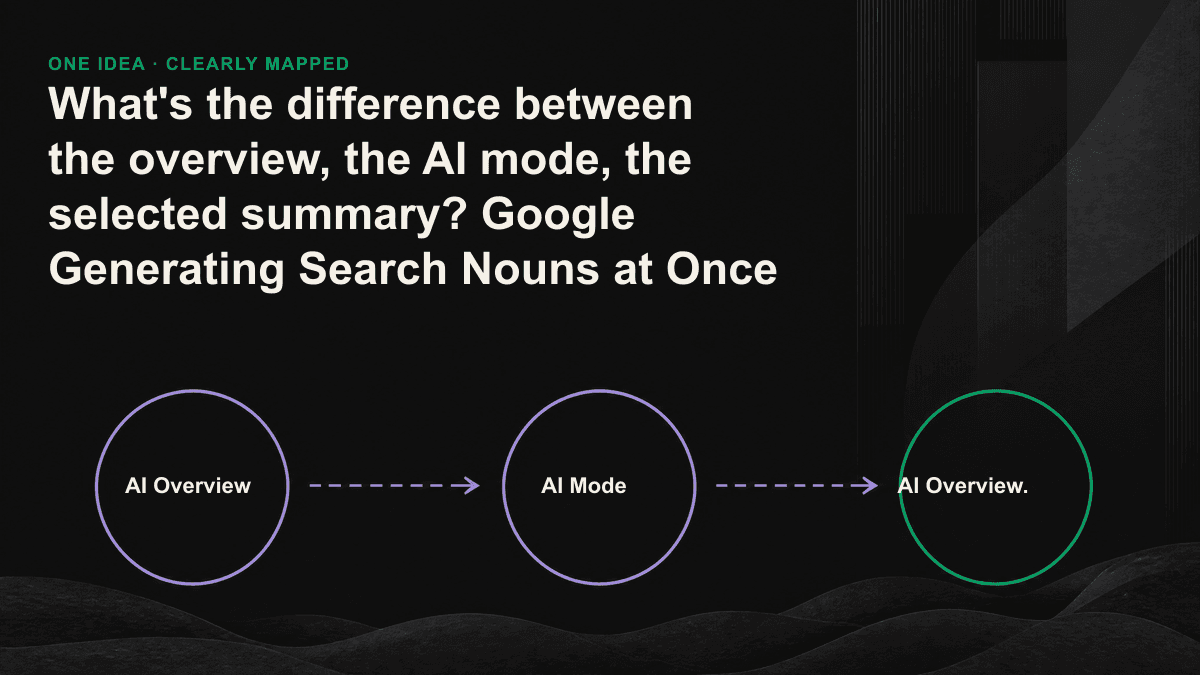
AI Overview, AI Mode, Excerpt Summary is not the same three callings. They are three separate blocks on the Google search page, with different triggers, different sequencing, and different ways to quote you. Moving the old practice of trying to get a Featured Snippet to grab an AI overview, most of it will fail. And this is the article that makes clear to you which one of Google's creative search terms emerged over the years.
Three positions, one table first.
Open a Google search, you may see several patterns of answers at the same time. If there is a summary generated by AI and attached to several sources, it's an AI overview; if you click an independent tab and ask each other in a conversation, it's an AI mode; if you see a text or list that is framed and taken directly from a web page, it's a Featured Snippet. The three can appear first in the same query or only one. First you know what they look like, then you talk about strategy.
Excerpt summary: AI overview for the forebear
Featured Snippets have appeared in Google since 2014 and are often called position zero. Google takes the text, list, or table that most directly answers the query from a high-ranking page and displays it above the organic results, with the click leading back to the source. This format is the precursor to AI Overviews because both put the answer in front of the user. Repeatedly earning Featured Snippets shows that Google can extract your content cleanly, which is also useful for AI Overview citations.
AI Overview: SGE changed name
The forebear of AI is SGE (Search General Exchange), Google was launched as an experiment in May 2023, and the I/O Congress in May 2024 officially changed its name to AI Overviews and became fully online in the United States. The way it works is that Google uses Gemini to create a summary of your queries, and at the same time lists a few quoted source links, and the user can read the answer without having to click on any page.
The real impact on the content operation is in quoted logic. The Featured Snippet is "the whole move" and the AI overview is "multi-source integration": Google may look at five or six pages at the same time, drawing one sentence each. So your goal was to become "the only page taken" and "one of the sources quoted." This explains a common phenomenon: many of the traditionally strong pages do not have access to the AI overview because the ranking is not as high as being taken by a machine.
AI Mode: Turn search into dialogue
AI mode is a full-generated search interface launched by Google in 2025, a separate tab driven by Gemini. It interacts with the largest difference in the AI overview: the AI overview is a summary of a single query, and the AI mode allows users to ask, compare, and collect, like talking to a search assistant.
It uses a "Query fan-out" approach behind its back: you ask a question, the system will automatically tear it down into several queries, search for each other's sources, and then synthesize an answer. This means that you need to be able to answer the main question and the surrounding questions that users may be asking. The more sub-issues are covered by a single article, the greater the chance of being repeated in the AI mode.
Passage Ranking and Grounding: How Engines Select Supporting Text
To understand why the three above positions quote you, you need to know two bottom lines. The first is paragraph sorting, which Google has been leading since 2020, so that it can assess only one section of the page, not the whole page ' s relevance; in a long text, if there is a precise answer to a question, the paragraph may be singled out. The second is grounding, which means that AI generates answers by returning the content to a searchable source with a reference on which both the AI overview and the AI mode determine who to quote. These two mechanisms point to the same action: cutting the contents into one section, each self-contained segment, and putting the questions and answers close to each other, so that the machine is clean.
Words are fast matching
- Featured Snippet: Since 2014, Google has displayed an answer extracted from one page above the organic results, with the click leading back to that source.
- SGE (Search General Experience): The AI overview period is known as the introduction in 2023 and the change of name in 2024; see old Venti SGE, speaking of the current AI overview.
- AI Overviews (AI Overviews): Abstracts from Gemini that combine multiple sources with references, appear on the search results page.
- AI Mode (AI Mode): Independent dialog search tab, launched in 2025, supports continuous queries and queries.
- Paragraph Sorting (Passage Ranking): Google evaluates the ability of a single paragraph on the page to be relevant so that a long section can be singled out.
- Growing: AI sets the generating content back to a verifiable source with a reference link.
Which one should you take first?
The answer depends on your Query Type and Buyer Course. If the keyword for the target is a clear information type question ( "X what" "Y"), then the Featured Snippet is the same as the AI summary: the structured question paragraph can feed both positions. If your product involves comparison, choice, multi-temporal decision-making, the AI model will be more important, because the user would have been asking the questions, and you have to keep the content up to the questions.
Definitions are only the starting point. The useful questions are which brands currently hold those three positions and where your gaps sit. Contact us for a GEO diagnostic session lasting an estimated 30 minutes. We will test a real buyer query, map the cited sources, and show you where to start.