More than half of the sources cited in AI Overviews did not rank on the first page of organic search. After analyzing 1,000 Taiwan keywords, one signal stood out: a page earns the citation when it contains a passage the model can extract cleanly and use as an answer. Domain authority alone does not decide the result. Ranking gets a page into contention; extractability determines which source is named.
How We Ran the Analysis
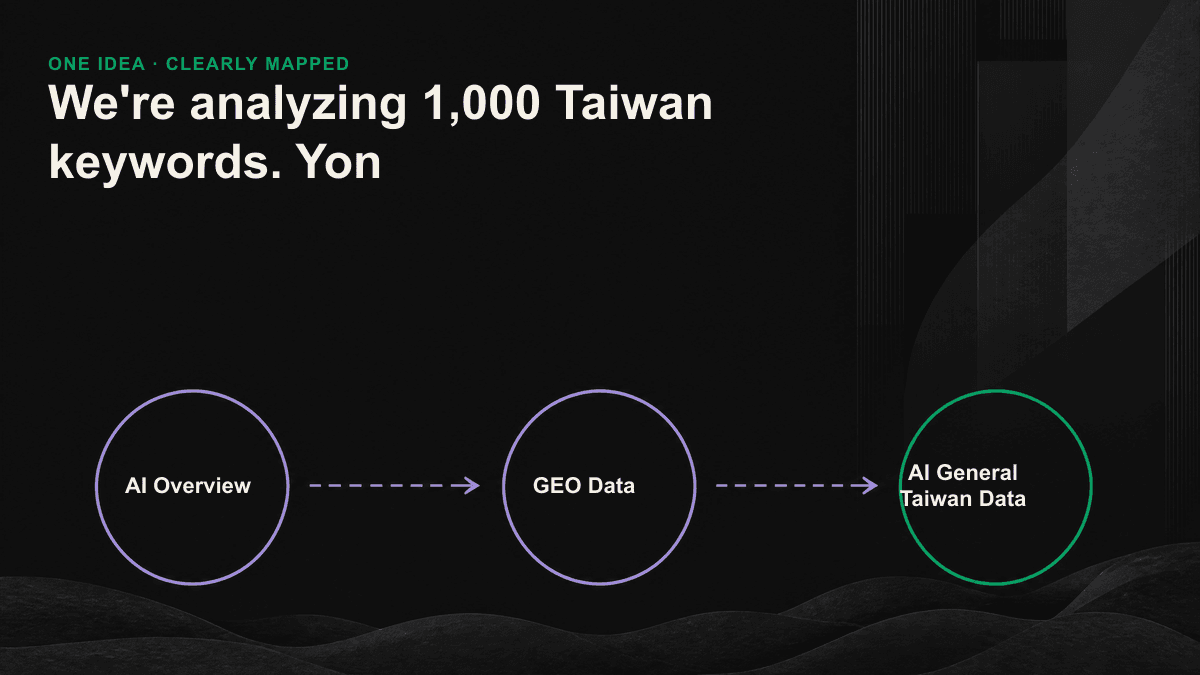
We selected 1,000 Taiwan keywords centered on B2B software, business services, and professional procurement, with a smaller set of high-interest consumer decisions for comparison. Every query used Traditional Chinese in a Taiwan search context. For each keyword, we recorded whether an AI Overview appeared, which sources it cited, which passage it extracted, and where that passage appeared on the original page. We analyzed desktop and mobile separately during the first half of 2026. Repeating the same queries reduced one-off variation, making this a trend study rather than a one-day snapshot.
- Sample: 1,000 Traditional Chinese Taiwan keywords, led by B2B and professional queries
- AI Overview trigger rate: about 34%, highest for informational questions such as what something is, how to do it, or which option is better
- Average citations when an AI Overview appeared: about 5.2 sources
- Cited sources ranking in the top ten organic results: about 46%
- Recorded dimensions: trigger rate, number of sources, extracted-passage format, and location on the page
Rank Position Has Limited Influence on Citation Selection
The counterintuitive result is that only forty-six per cent of cited sources already rank in the top ten of organic search. More than half come from the second page or lower. AI Overviews works more like a Featured Snippet: it determines the form of answer the query requires, then searches the full index for the passage that fits. It does not simply lift a section from the highest-ranking page. This is passage ranking, where the engine evaluates individual passages rather than entire pages.
We repeatedly saw the same pattern in business-software comparisons. The page ranking second buried its answer in a 300-word argument that readers had to finish before reaching the conclusion. The page ranking fourteenth explained the difference in two sentences and a three-column table. AI Overviews cited the latter. For an engine, the passage that directly answers the query is more valuable than a complete but difficult-to-extract essay.
The Four Most Frequently Cited Content Structures
The extracted passages clustered around a small set of formats. Four structures accounted for most of the citation list, and each shared one property: clear information boundaries. Removing the passage from the page did not break its meaning.
- Direct definition: The first or second sentence below the title defines the term in a form close to "X is..." Because the sentence is already an answer, it is especially likely to be cited.
- Step-by-step list: Break "how" or "which" questions into 3 to 7 points. AI Overviews often extract the complete list with little or no rewriting.
- Comparison table: Place two or three options side by side with consistent fields. This format is easy to use for questions such as "What is the difference between A and B?"
- Question heading and short answer: Use an H2 or H3 that matches a real query, followed immediately by a 40 to 120-word answer. Together they form one extractable Q&A unit.
Which Domains Appear Most Often in the Citation List?
Dcard, PTT, and major media outlets remain common sources for consumer queries. This matches the Taiwan habit of using forums to find firsthand experience. The pattern reverses for B2B and professional procurement keywords. Official documentation, product comparison pages, and advisory content with a named author, visible update date, and verifiable sources account for most citations. On professional topics, AI clearly favors accountable, traceable pages. Content-farm pages may still rank, but they rarely entered the citation lists in this sample. Brands that invest in credible professional content can earn that preference.
On a professional topic, an AI engine is more likely to cite a short answer with a named author and date than a full page of anonymous prose.
What Does a Cited Passage Look Like?
- Length usually falls between 40 and 120 Chinese characters. Longer passages are often cut off; shorter ones may not contain enough information to answer the question.
- Put the conclusion at the beginning. The first sentence should answer the question without introductory background.
- Match the language of the query. Reuse the terms people type so the engine can connect the passage to the question.
- Answer one question per paragraph. Do not combine several topics and blur the information boundary.
What This Means for Your Content
You do not need to redesign the entire website. Choose the 20 to 30 questions for which an AI citation matters most, then confirm that each has a corresponding page or passage that makes sense on its own. Next, make three small changes: move the definition directly below the heading, turn dense arguments into lists or tables, and give each important passage a question-based subheading. These edits rearrange existing material rather than add more content, but they can sharply improve extractability in AI Overviews. This is often the first layer of work in Tenten's GEO content engine.
To learn which passages AI Overviews can extract from your pages and which high-value questions still exclude your brand, book a 30-minute GEO diagnostic session. We will test your own keywords and identify the specific gaps rather than hand you generic advice.