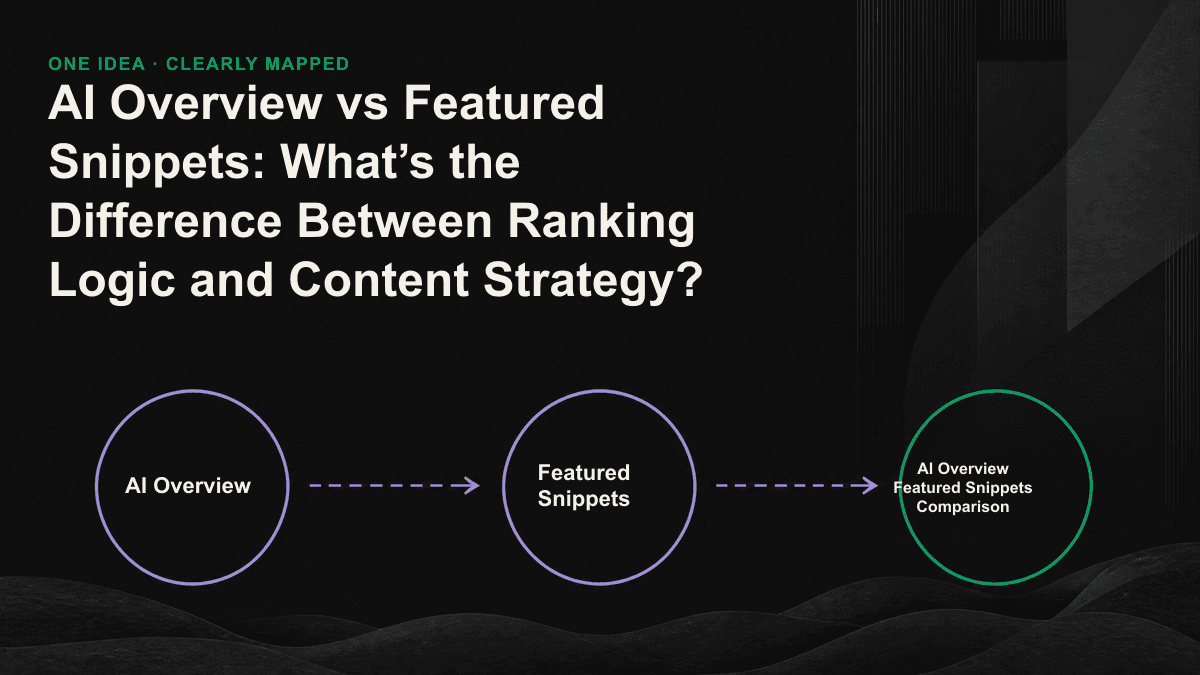
The Featured Snippet is Google picks out a phrase from a single page that is at the top of the search; the AI overview is to untangle several sources, reorganize them, and then create a completely new answer in a generation model. The same article may be self-contained on both sides, or only one side may be self-selected, because their decision self-determination mechanisms are financially different.
Bloodline: AI overview grows on the foundation of featured snippets
The two formats share the same foundation. Featured Snippets taught Google to identify a passage that directly answers a question, and passage ranking made that selection more precise within long pages. AI Overviews builds on the same passage-level understanding, then uses a generative model to combine several sources into a coherent answer. Content that performs well in Featured Snippets therefore often gives AI Overviews the kind of passage it can cite.
Ranking logic: extract a paragraph from a single page, or combine multiple sources into one article
You ask for a question, and the task of the self-snippet is to find the plain that can answer the most direct order in all the running ages, and then copy it. It first determines that the value of this question is not worth generating an answer, then retrieves the relevant paragraphs from multiple sources, and then recast, merged and referenced by model. Let's break down the keys.
- Number of sources: Featured snippets come from one page; AI overviews typically synthesize three to ten more sources.
- Presentation method: The Featured Snippet is a copy of the original text; the AI overview is a model rewrite, and your sentences may be disassembled or reassembled.
- Trigger: The Featured Snippet corresponds to a single query; the AI overview splits a question into several sub-questions (query fan-out), searching for separate answers and consolidating it.
- Placement ownership: Featured excerpts have clear source URLs and clicks; AI overview scatters references in folded links, making clicks more difficult to obtain.
- Stability: Selected snippets are relatively stable; the source and wording of the AI overview may change every time it is generated.
Query fan-out is the Biggest digging line between the two. You ask the "GEO of B2B SaaS, what to do," and AI's overview is a few sub-questions behind it: What's the GEO, what's the difference between SEO, what's the structured content to be prepared, what's the measure of effectiveness? This means that, rather than merely the best answer to that you don't have to answer them all in one article, but that you have clean and capable answers for each sub-issue.
Why does the performance of the same piece of content diverge?
When we help recipients track, we often see three biographies. The first is getting a quick summary, but not going to the AI overview, most of which is correct, but the subject matter is not broad enough, and the model finds a more complete source. The second is quoted in the AI overview without a pre-selection summary, which is usually a particular piece of your puzzle, but a single paragraph of the entire page is not strong enough to be exclusive. The third is that there is no one on either side, and the problem is often not in the text, but in the structure: there is no clear question-and-answer session, no marked entity, or too much information in the paragraphs, so that the model is not clean.
Content Strategy: How to Write Featured Snippets
The core of grabbing featured snippets is to let a paragraph form its own answer and be understandable without relying on context. There are clear routines for how to do it. The key is to put the question type and answer first in the format.
- Question as title: Use a question that readers will actually type as H2 or H3, with the answer immediately below.
- Let me give the conclusion first: the first sentence is the direct answer from forty to sixty, and the background and details come later.
- The format matches the question type: use a paragraph of text for definition questions, an ordered list for step questions, and a table for comparison questions. Google will choose the layout according to the question type.
- Only answer one thing in a paragraph: don't use the same paragraph background, answer and extension, it will be confused when the model is extracted.
Content Strategy: How the AI Overview is Cited
The reference of the AI overview is different. What you want to win is not a single place, but being seen as a credible, capable source on multiple sub-issues. This involves a single page and the depth of the whole subject, the consistency of the cross-site narrative and whether the model will recognize you as a clear entity.
- The topic should be deep and broad: write all the sub-problems around a topic, and let the model encounter you repeatedly during fan-outs.
- Consistent statements across sites: Only when the brand name, product definition, and key figures are consistent on the own site, third-party reviews, and catalogs can the model dare to quote them.
- Mark entities clearly: Use schema and clear naming to mark companies, products, and people as entities that the model recognizes.
- Be verifiably specific: numbers, dates, and sources are more likely to be accepted and referenced by generative models than adjectives.
- Mentioned by others: AI overview prefers sources of third-party corroboration, and mentions in the media, communities, and reviews will accumulate credibility.
How to measure and choose
The method of measurement must also be changed. For featured snippets, it’s enough to look at rankings and clicks. The tools are mature and the numbers are clear. References to the AI overview are scattered in folded links, and the sources and wording may change every time they are generated, making them almost invisible to traditional ranking tools. A pragmatic approach is to fix a set of real problems that are most important to the business, regularly use ChatGPT, Perplexity and Google AI Overview to measure them, and record the frequency, location and reworded wording of their own citations. Tenten’s Brand Radar does just that, turning your visibility across AI engines into trackable numbers.
Don’t rush to rewrite the entire site just yet. Pick three to five questions that are most important to closing the deal, see who is currently cited in the featured snippets and AI overview, and then go back and check whether your answer paragraphs are clean enough and the topic breadth is sufficient. If you want to know where your gaps in the AI engine are, you can book a 30-minute GEO diagnostic session, and we will run it for you on the spot using your actual queries.