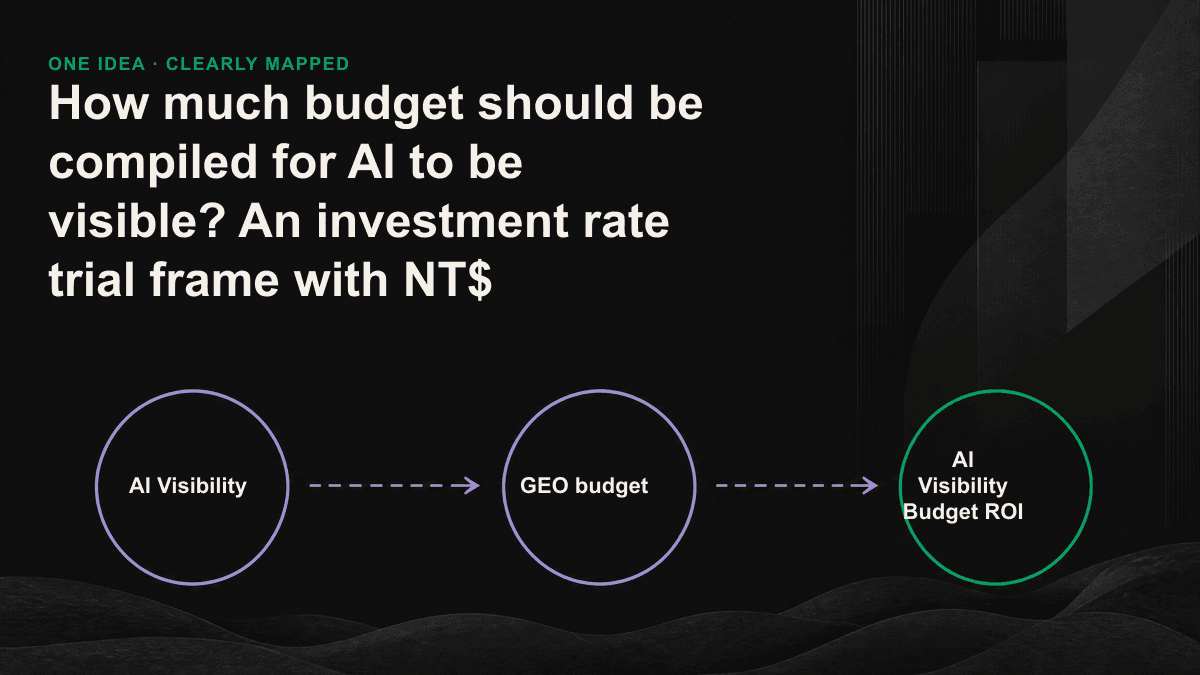
AI's visibility can be priced, tracked, and calculated for every dollar, as a fee ad -- if you want to set a bill for "one quote in the AI answer." Most of the B2B teams are stuck in the budget compilation, not because they don't have enough money, but because they don't convert visibility into comparable financial units, and they just throw and cut. This article gives you a frame to start with NT$, and allows you to compare the same table with SEO, the paid ad at the next budget meeting.
First, for AI, quote the value of the coin.
The starting point of the budget is not "how much to spend," but "how much to expose at once." In the context of ChatGPT, Perplexity, Google AI Overviews, users often ask questions close to decision-making: "GEO agent for B2B SaaS recommends "XX tools compared to YY tools." Your brand has been added to the answer to the list of candidates at the last mile of the buy week, which is closer to a deal than a normal organic search.
The method of calculating is straightforward: push back with your current funnel number. Suppose your average customer is about NT$300,000 a year, and the transaction rate from QC to the deal is 20%, that NT$60,000. If the flow of the AI quote produces one qualified query per 100 exposures, the expectation of the quote is NT$600. It doesn't have to be precise, but it has to be there -- without it, every budget discussion behind you goes back to the debate.
Three budget levels, three business segments.
Companies with different degrees of maturity should have a significantly different investment. Rather than copying someone else's budget, you should be sure of your position.
- Establishment period (AI hardly mentions you): The goal is "to go to the top." The budget is focused on a few high-business-intensity issues, starting with branding. This stage is paid for the quoted "no" and not for ranking motion.
- The competition runs (sometimes mentioned, but lost to the competitor): The goal is to "win by name." The budget shifts to contrast and situational content, structured data, and topics that are being cited by competitors. The pay mark was changed from exposure to ‘citation’.
- Defensive period (already cited brand): The goal is to "maintain and expand." The budget is revised to monitor and update content on a continuous basis to avoid diluting the answers by new entrants. The focus of the drop in international remuneration for each dollar in this segment is to keep the high-value issues in place.
Most of the Taiwan B2B SaaS fell between the establishment and the competition. The drop point determines whether you should put 80% of the budget in production or in monitoring and fine-tuning. Mistake, money spends on the right actions, wrong timing.
Break ROI into four traceable variables.
Al's visible pay is hard to calculate because it's often seen as a vague whole. Opened up with four variables, each of which is energy-capable and can be set up with KPI: Quoting overlay rates (how many of your target questions appear), Quoting Ratio (the sum of your competing competitions on the same subject), Quoting the quality of supplies (resulting positively or being ranked sub-optimal), and downstream switching (how much of the resulting flow of references is ultimately being asked for). You're the producer of this budget.
In practice, the first three variables require an answer to the continuous scan of the AI engine by the Visibility Tracking Mechanism -- that's exactly what Brand Radar is doing: to record regularly the status of your and the competition's references in the specified group of questions, so that "does it progress this month" no longer depends on the impression. The fourth variable uses existing analytical tools and UTM to mark the flow of the AI source and to retrieve your original funnel. After all four variables have a number, the budget is paid.
A NT$ trial example
Put something on it into a table. A B2B SaaS, a competing B2B SaaS, is investing NT$ 300,000 quarterly on GEO content and monitoring, locking 40 high-intensity problem groups.
- 24 topics (coverage rate 60%) were quoted at the end of the season on 40 topics, 15 of which are positive recommendations.
- These references bring about 3,000 visits from AI sources and receive about 30 qualified queries based on 100:1.
- For every eligible inquiry NT$60,000 expected to produce a weighted line of about NT$1,800,000; if only one third of the final turnover is recognized, about NT$600,000 still contributes.
- Contrast NT $300,000 input, approximately twice the quarterly recovery, and content assets will continue to be quoted in the subsequent quarter, with international costs falling from one quarter to the next.
The most common three budget areas
First, consider AI visibility as a free by-product of SEO, without budgeting. In fact, the structure of the content, the logic of reference, and the measurement methods of the two are different, depending on the SEO, which is usually neither. Second, it stops after a single investment. AI's answer is dynamic, the competition will add to the content, the engine will be updated, the monitoring will stop, and the hard-earned quote will be released. Thirdly, it's just exposure without quality. The damage caused by being listed as "no recommendation" or "subsequent" by AI may be greater than it was not mentioned, a situation that has to be captured by the variable that leads to the quality of supplies.
The real question at the budget conference is not "Shall we do the AI Visibility" but "How many quotes we can buy and how many downstream inquiries we can make for each dollar."— Tenten GEO Counsellor's point of view
First take-back: Start with the diagnosis.
There's a premise in the above frame: you have to know where you stand now. The coverage rate is 10 per cent or 60 per cent, which high-value topics are being monopolized, which quotes are actually deductions -- these are not measured, and any budget figures are guessed. It would be reasonable to take 30 days to make a visual base plate, record the starting points of the four variables, and then decide how much to throw in the first quarter. If you want to know your current visibility gap and a reasonable budget drop point, you can book a 30-minute GEO diagnostic session, and we'll use your own funnel parameters to fill out this trial sheet in the first edition.