To monitor the visibility of brands in AI answers, the first step is not to buy tools, but to write down a list of questions. Most of the teams are stuck on "what platform to use," but they don't figure out what to ask, how often to ask, what to remember. Tools can be completed later; a well-designed list of questions, with a fixed check rhythm, you can start with a free account today.
Distinguishing first: references, quotations, references.
Before monitoring AI, make sure you track which signal, otherwise the report will only be an incomparable piece of information. ChatGPT, in its answers, takes your brand name, connects it to your web page, or puts you on the list when "supposing a few manufacturers", which is three completely different levels of visibility. If you mix them into a "doesn't show up," you'll be seriously mistaken for your real position.
- Reference (mention): AI wrote your brand or product name in its answer, but not necessarily attached to the source. This means that you are in the training data of the model or the results of the search, which is the most visible.
- Quote (citiation): AI clearly uses your web page as a source with clickable links. It means that it trusts you at the moment enough to prove the answer, more valuable than being mentioned.
- Recommendation: In a question like "What's the alternative?", "Who's the recommended one?", AI initiated your candidacy. It's the closest, the hardest place to get.
Step 1: Develop a list of questions that can be repeated
Question list is the foundation of the entire monitoring package, and it's worth the afternoon design. It needs to be reused, cover the real context of the buyer, and always use the same approach, so that the results of the different engines are comparable over time. First, lock 10 to 20 questions, rather than be greedy -- you're looking for a set of regular samples that can be tracked over time, not one-off random questions. How does it work? The most frequently asked questions in business, the doubts of the client before the transaction, and the keywords that you want to win, each of which is a question of translation into natural language.
- Question of type: Users don't know you, they only describe needs. For example, "What services are available in Taiwan to SEO agents of B2B SaaS?" This question examines whether you have entered the AI's initial candidate list.
- Comparative problem: Users hesitated between several options. For example, "A tools and B tools are suitable for small and medium enterprises." See if you'll be taken as one of the benchmarks for comparison.
- Recommendation question: Users want direct advice. For example, "help me recommend three GEO consulting companies." This is the closest question to a deal.
- Brand issues: Users already know you and want to verify. For example, "Tenten GEO is what it does and how it is judged." Look at how AI describes you and is right.
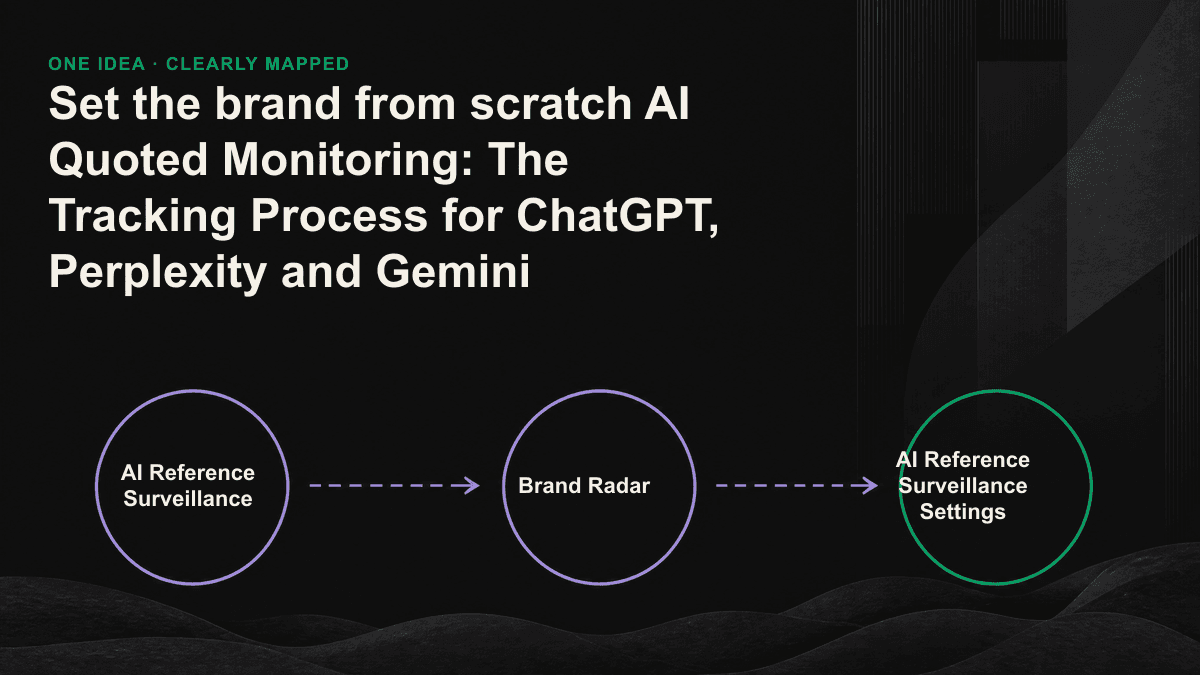
Step two: ChatGPT, Perplexity, Gemini.
ChatGPT
Paste your question on a question-by-issue basis with ChatGPT, which opens the search function, and record three things per question: do you have any mention of you, whether your source link is attached in the line or at the bottom of the answer, and what it describes you as? It would be preferable to ask the same question once or twice in separate conversations, because the model's answers are random and a single result does not represent the whole picture. And if your brand doesn't show up at all, who wrote it down right now -- the source is where you're going to get in.
Perplexity
Perplexity is the best of all three, because each of its answers is a list of sources, quotes or not, and is appropriate for the main field of monitoring. After an issue-by-issue survey, focus is on two things: whether your domain is in the source card and in the next row. It also lists "relevant questions" at the bottom of its answer, which is a free-of-charge list of questions that expands to include a sample of the next subject that the buyer might pursue.
Gemini
Gemini affects two surfaces: its own conversation interface and AI Overviews at the top of Google Search. Test the conversation interface as you would ChatGPT and Perplexity, entering each prompt and recording mentions and citations. Test AI Overviews by searching the target keywords in Google and recording the websites cited in the summary. Taiwan teams cannot ignore this surface because Google remains the first stop for many B2B buyers, while the generated summary absorbs clicks that once went to the top organic result.
Step three: make it a fixed rhythm.
The value of monitoring comes from the trend, which requires a fixed rhythm to grow. On the tool, a simple trial sheet is sufficient: the bar engine and the signal type, each of your topics in the row, the percentage of each cell being mentioned or quoted, and the date of this round at the bottom. On the rhythm, most B2B brands run one round a month, and once they've been rewritten or released important content, they can be added. The point is never how high the frequency is, but the same list, the same question, is used every time to compare each number. Three months running in a row, you've got a visible curve, not just a few random screenshots.
The monitoring is going after trends, not single results. The real question to be answered is: in your questions this season, whether the occupancy rate cited by AI is up or down, and which are the issues behind.— Tenten GEO
When you set up this monitoring set, you usually see one thing very quickly: the visibility gap tends to be concentrated on a few types of questions rather than a complete fall. Find out what kind of stuff, put it on top, have the highest rate of reporting. If you're going to skip the phase that you're searching for from zero, get a visualization point that uses your own questions, cross-cutting the main AI engine, you can set aside 30 minutes for a GEO diagnostic session -- we'll show you where the gap is and which one we should fill first with in real numbers.