AI citations do not appear in a standard traffic dashboard. They are scattered across individual conversations, so without active monitoring you will not know whether ChatGPT, Perplexity, or Google AI Overviews recommends the brand, omits it, or describes it incorrectly. Citation alerts replace occasional manual checks with a Slack or email notification whenever visibility changes.
Why Real-Time Awareness Beats an End-of-Month Surprise
AI answers can change faster than search rankings. A model update, a competitor's well-structured comparison page, or a redesign of your own product page can remove the brand from a recommendation within days. With a monthly check, the gap may persist for 30 days before anyone notices. Factual errors are even more urgent: a model can state the wrong price, feature set, or target industry with confidence, and a buyer may act on it. Real-time alerts are not for constant screen-watching; they exist so the team can respond when something important changes.
Define the Signals You Need to Monitor
Decide which signals matter before monitoring begins, or irrelevant mentions will overwhelm the system. AI visibility has several layers, and each calls for a different response. For B2B SaaS, being recommended as a solution and being cited as a source sit closest to a buying decision, so monitor those first.
- Mention only: The answer names the brand but neither recommends it nor links to it.
- Recommended as a solution: AI includes the brand among the suggested options for a specific need.
- Cited as a source: The answer uses your content and includes its URL, the most valuable GEO outcome.
- Listed with competitors: The brand appears on the same list, so order and descriptive language become the deciding signals.
- Factually incorrect: The model mentions the brand but gets its pricing, features, or positioning wrong. Give this the highest priority.
Build Your Prompt Set
The alert system is only as useful as the questions it receives. Asking "What is Tenten GEO?" proves little because the prompt already names the brand. Monitor questions people ask before they know you. A practical set covers four angles, with three to five questions in each, adapted to your core keywords and target buying situations.
- Category recommendation: "Which GEO agencies in Taiwan specialize in B2B SaaS?" Check whether the brand reaches the shortlist.
- Comparison: "Which is better for a small or midsize team, Tool A or Tool B?" Check how the model describes each option.
- Problem solving: "AI search never cites my website. What should I do?" Check whether your content is used as an answer source.
- Brand verification: "What services does Tenten GEO provide, and what do they cost?" Use this prompt to catch factual errors.
Choose a Monitoring Method: Manual Checks, Scripts, or a Tool
The same prompt set can be monitored at three levels with very different costs and response times. You do not need the most advanced setup on day one, but you should know which level you are using and what would justify an upgrade.
- Manual checks: Save the prompt set, run it weekly in ChatGPT, Perplexity, and Gemini, and record each result. The approach costs nothing but is slow, easy to forget, and difficult to compare over time. It suits an initial set of fewer than 10 prompts.
- Scheduled API script: Send prompts through each provider's API, compare the answers for the brand or URL, and send a Slack or email alert when the result changes. The engineering work is manageable and supports near-real-time monitoring.
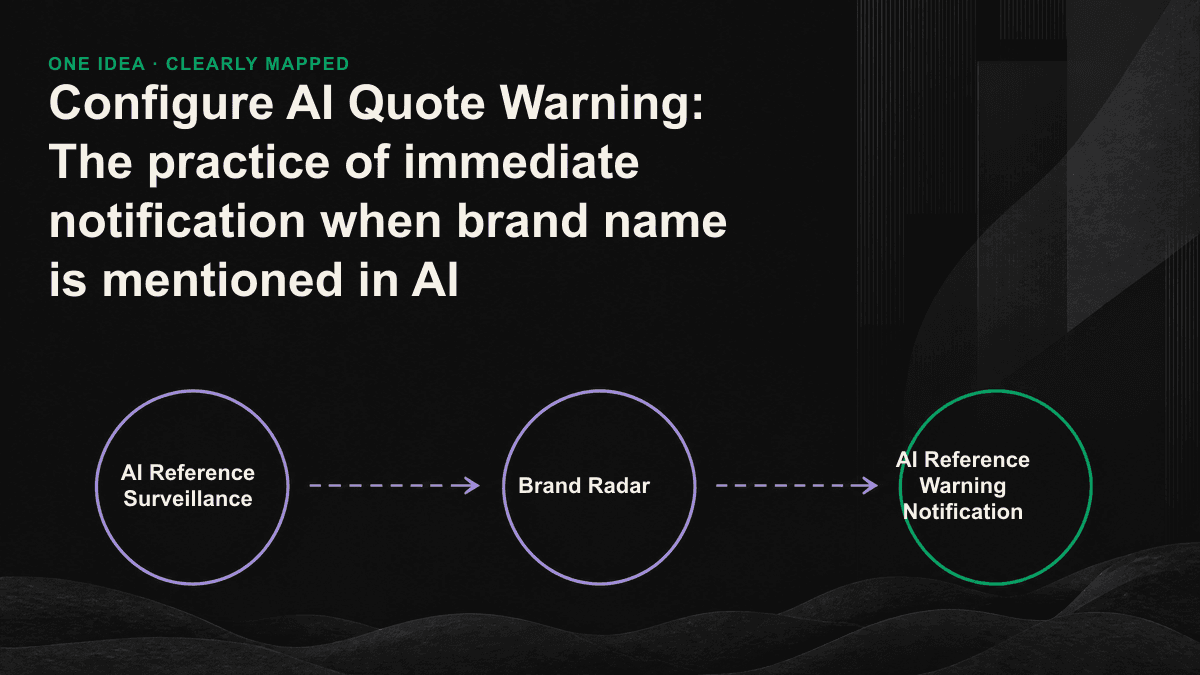
- Dedicated monitoring tool: A platform such as Tenten's Brand Radar runs the prompt set across engines, tracks mention and citation rates against competitors, and notifies the team when a metric crosses its threshold. It removes most of the build and maintenance work.
Set the Trigger Conditions and Monitoring Frequency
Monitoring and alerting are different. Nobody needs an "everything is unchanged" email after every run; those messages are quickly ignored. Alerts should fire when the state changes in a way that calls for action.
- A citation that appeared before is now gone.
- A new competitor appears in the answer.
- The model states the wrong price, feature, or service scope.
- A platform that never cited you starts doing so. That is good news worth reinforcing.
What to Do After an Alert Fires
An alert is only the starting point. Monitoring without a follow-up action merely confirms that the brand was missed. Give every alert type a clear next step.
- Omitted: Check whether the relevant page has a clear question-and-answer structure and self-contained passages. Add a direct answer where needed.
- Misrepresented: Correct the source page, add the appropriate schema, and align the visible wording with the facts you want the model to repeat.
- Competitor cited, brand absent: Capture the cited passage, study its structure, coverage, and evidence density, then produce a more complete answer.
AI citation alerts are easy to configure; the difficult part is turning them into a weekly review-and-response habit. If you do not know whether major AI platforms mention, cite, or misdescribe the brand, or you still lack a stable prompt set, book a 30 minute GEO diagnostic session through /contact. We will test your actual keywords and show where the monitoring gaps begin.