"Your organic traffic is not falling, but your brand is being quietly filtered out by AI. This is the year 2026 when a number of B2B sales directors failed to account for the gap in the dashboard. When potential clients throw "which is best for us" to ChatGPT, Perplexity or Google AI Overviews, whether your website has been clicked on is not the most critical variable; and whether it has been selected by AI or omitted. The buyer's research phase is moving ahead to the interface, and that journey will leave no session of your analysis tools. The marketing director faces a real gap: when a part of the demand is shaped and selected where you can't see it, does the KPI in your hand reflect the real volume of the company in the market?
Why is the old performance dashboard going blind?
Over the past 10 years, B2B performance measures have been based on a clear funnel: exposure brings session, session brings MQL, MQL to industry. On every level, there are numbers of GA4, advertising backstage or CRM. AI's answer broke the chain. Users in Perplexity have asked "What are the regulatory tools for medium-sized SaaS" and read a reply with three or five brand names, probably without a link. If your brand appeared in that paragraph, it would be a free, high-trust recommendation; if it did not, it would simply disappear from the list of candidates. You can't remember either.
Zero click search is not a new word, but AI pushed it to a new scale. Former users will see at least your title and description, and now even the blue link list may be replaced by a synthetic answer. The definition of exposure is being rewritten: it used to mean page numbering, and now it means whether or not it was included in that only paragraph.
AI, what exactly is visibility measuring?
AI's visibility is not a single number, but a set of signals describing the "place of your brand in the generation answer." Take it apart and look at at at least five for long-term tracking:
- Rate of mention: In response to a set of questions about your business, AI refers to the proportion of your brand.
- Quoting: In the same set of answers, the number of times you are quoted is equal to the volume of the main competition, the voice of the AI world.
- Situational correctness: AI was right about you, right about you, wrong about your location, price or function.
- Advocating strength: Are you first chosen, placed in a list section, or are you only taken in "other options"?
- Source Visibility: AI quotes which pages to make up the answers, whether these pages are your own or whether third parties are speaking for you.
These five pieces come together to form a full visible map. The citation rate is misdirected: a brand that is often mentioned, but often misdirected, and is sometimes hurt more than not at all.
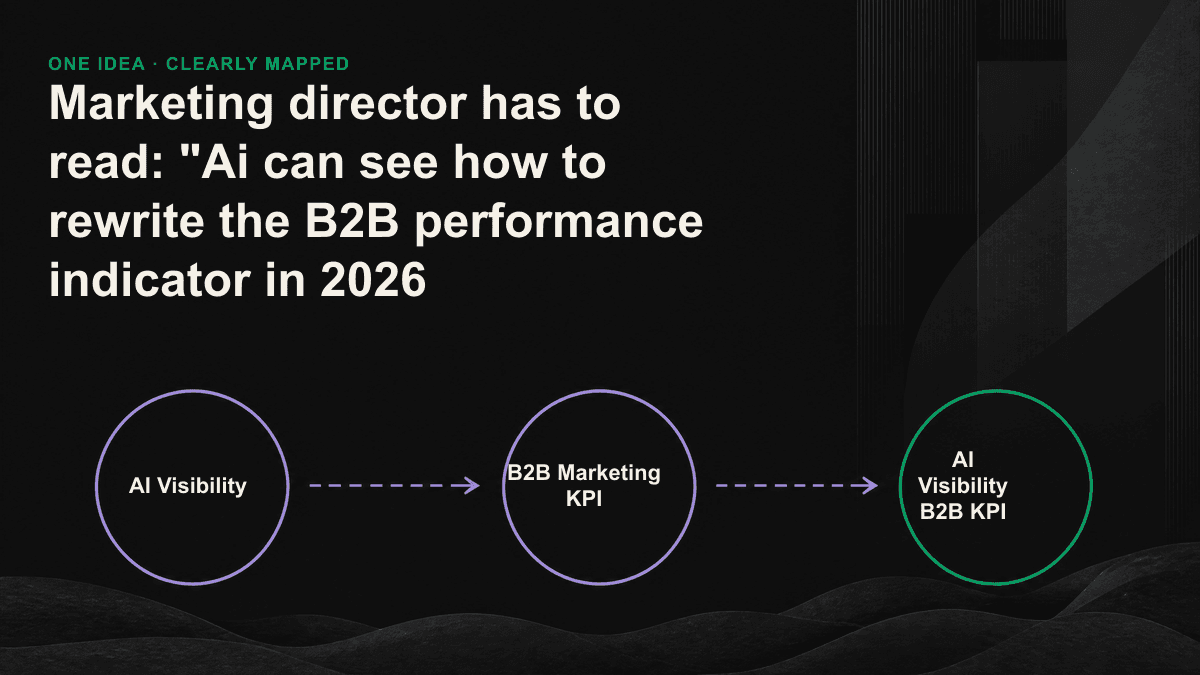
Four should go into 2026.
Translating AI's visibility into a language that the board can understand means adding new columns to the existing traffic and list of indicators. The following four are our suggestions for B2B clients to receive quarterly reports:
- AI Visibility takes place: the percentage that is referred to by AI in your definition of core questions is the total rating of visibility, suitable for the northern star indicator.
- Competition Reference Gap: You and the top three competitions have a difference in quotes in AI's answer, which directly reflects market ownership.
- AI Helpers: Put "know through the AI tool" in the form and interview, quantifying how many business start points are actually on the interface.
- Content citation: How much of the content you publish is actually taken by AI as the source of the answer, measuring the efficiency of the content engine.
These indicators need not wait for expensive construction to start. For the B2B team, which is estimated to have fallen on hundreds of thousands of new yuan a season, it is sufficient to keep track of a core set of 50 to 100 issues and to take a snapshot every month. The focus is on the same set of topics, rather than on a one-time, beautiful report.
It'll be more honest and harder.
AI-influenced opportunities often travel through dark traffic. A user sees a recommendation in ChatGPT, then searches for the brand or types its URL a few days later. GA4 credits the visit to direct traffic or branded search, erasing AI's contribution. The most practical way to recover that signal is to ask the customer, not to add a more complicated tracking code.
The marketing director should start now.
You don't need to reset the measurement system in a season, just tear it down into an enforceable sequence:
- A core set of questions: Listing 30 or 50 questions that target clients will really ask AI before the next list.
- A baseline measure: Recording the situation of you and the competition, as a starting point and as a basis for comparison.
- Put two or three AI visibility indicators in existing monthly newspapers, in parallel with traffic, list of names, to get the team used to watch.
- Completing the content: In response to AI, you misspoke or omit your subject, produce a structure that is clear and clean of the references.
This shift will not force you to lose the old finger all night, but without looking at the price of AI's visibility, it will be visible in a business analysis six months later: you will find a group of high-intensity clients who say they don't know how to find you, which is usually the signal that AI is making recommendations for you or for your competition. You want to know if your brand is mentioned or omitted in the main AI engine, and you can book a 30-minute GEO diagnostic session, and we'll run through your core questions and point to the gap.