Ask an AI engine what a SaaS company does and it can often give a complete answer with sources. Ask the same question about a traditional manufacturer or accounting firm and the answer may shrink to a sentence or confuse one company with another. Company size is not the main difference. Industry is. It shapes the baseline from which a brand can be mentioned and cited, which is why comparing every company with one overall average gives a misleading result.
Why Citation Baselines Must Be Industry-Specific
An AI engine can answer only with information it finds in training data or live retrieval, and that information needs to describe a company clearly. Industries begin with very different conditions. SaaS companies live online through product pages, documentation, pricing, comparisons, and community discussion. Much of a manufacturer's value remains in catalog PDFs, trade shows, and sales conversations. Professional-services firms sit between them: they publish plenty, but often as long essays or case narratives that do not contain a clean passage an engine can quote. Applying one benchmark to all three produces the wrong diagnosis.
A Practical Ranking Across Three Industries
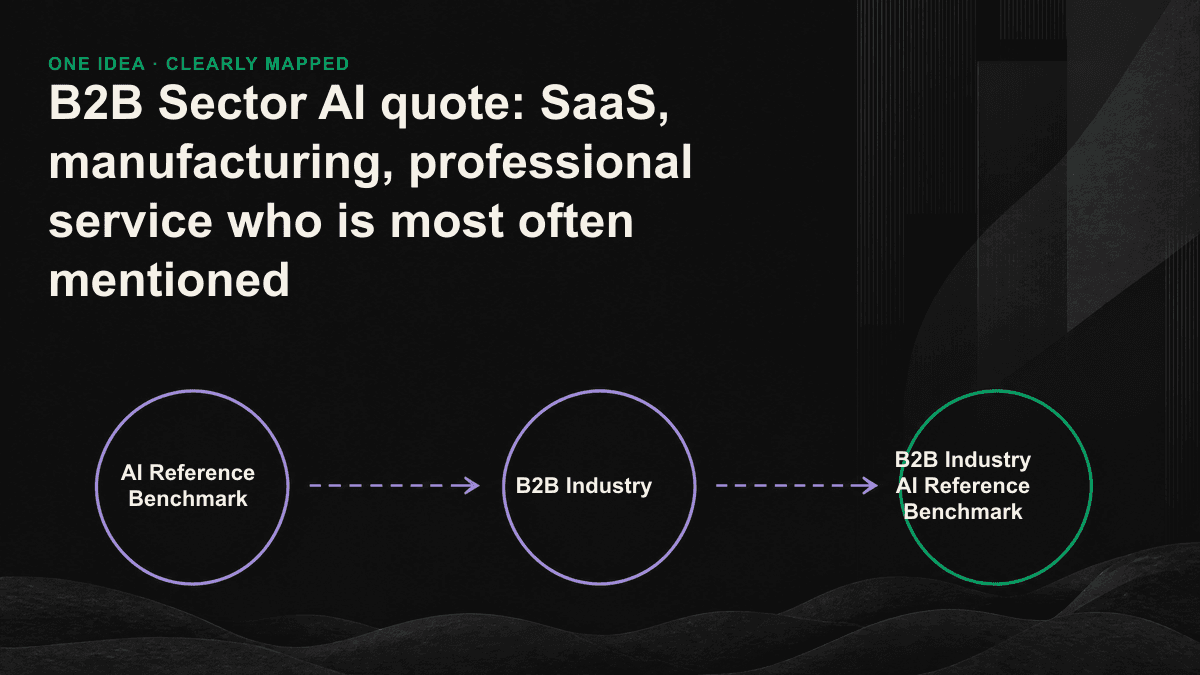
In client GEO audits, we run the same category, comparison, and recommendation questions across ChatGPT, Perplexity, and Gemini. We record how often each brand is mentioned, cited, and recommended. The starting results show a fairly stable order: SaaS leads, professional services sit in the middle, and traditional manufacturing trails. This reflects each industry's content infrastructure, not a lack of effort.
- SaaS: Public content is abundant. Product sites, documentation, third-party comparisons, and reviews give AI systems multiple sources to cross-check. Even before formal GEO work, many SaaS brands appear in category questions, giving them the strongest baseline of the three industries.
- Traditional manufacturing: Public, structured Chinese content is scarce, while valuable information remains in PDF catalogs and sales relationships. Even a market leader can disappear from supplier-recommendation questions, so manufacturing usually begins with the fewest citation opportunities.
- Professional services: Consultants, law firms, accounting firms, and agencies publish frequently, but much of the material is a long article or case story. Without concise definitions, lists, and direct answers, the firm may be mentioned by name without receiving a linked citation.
This ranking describes a starting point, not a ceiling. We have seen manufacturers move from almost no citations to consistent inclusion within a few months after publishing structured specification pages and FAQs. We have also seen consulting firms with large archives remain mentioned but uncited because every useful point was buried in long prose. The benchmark shows where you begin; execution determines how far you move.
Why SaaS Starts Ahead
SaaS has a structural advantage. A well-run product site already contains feature pages, pricing, integration directories, documentation, and release notes. These pages use clear sections and precise terminology, making them easy for AI systems to extract. The industry also publishes tool-versus-tool comparisons and discusses purchasing choices openly in communities. Models can therefore confirm what a company does through several independent sources. For SaaS teams, GEO often means turning an existing mention into a linked citation or recommendation, not building visibility from nothing.
Where Manufacturing Loses Visibility
Manufacturers do not lack knowledge; the knowledge sits where AI systems cannot easily read it. Specifications remain in downloadable PDFs, quotations require a sales call, and technical details are exchanged at trade shows. A factory that is famous within its field can therefore look like an unexplained name to an AI engine. That large gap is also a large opportunity. Publishing core product specifications, applications, and common questions as clearly structured web pages turns knowledge locked in documents and sales conversations into a source an engine can cite.
Professional Services Publish Plenty but Remain Hard to Quote
Consultancies, law firms, accounting firms, and marketing agencies usually have blogs, opinion pieces, and case studies. The issue is form, not volume. AI systems favor passages that answer a question cleanly through a definition, a sequence, or a direct response. In a 3,000-word narrative, the useful point may be buried under several layers of setup, so the engine cites a clearer source instead. The best GEO lever for professional services is often to restructure existing expertise: add a self-contained summary, turn the service process into a list, and answer the questions clients ask most often.
How to Place Your Brand Against the Right Baseline
Once you understand the industry order, compare your brand with the right peer group rather than the market-wide average. The process is straightforward.
- Set a baseline. Use a fixed group of category, comparison, and recommendation prompts across the main AI engines. Record how often the brand is mentioned, cited, and recommended.
- Compare with true peers. Put the result beside companies in the same industry and at a similar scale. A mention alone is weak for SaaS, while consistent citations can put a manufacturer ahead of most competitors.
- Identify the kind of gap. No mention at all usually means the necessary content does not exist. A mention without a citation means the information exists but is difficult to extract. The first problem requires new content; the second requires better structure.
- Retest on a fixed schedule. Run the same prompts every month and watch the trend. A single snapshot can mislead; movement over time is more useful.
Industry benchmarks keep teams from using the wrong standard. A SaaS brand should not celebrate a mere mention, a manufacturer should not give up because its baseline is low, and a professional-services firm should not assume expertise will be cited automatically. Book a 30-minute GEO diagnostic session to compare your brand with the right industry baseline and identify the first structural gap to fix.