The subject of the most important investment in the next season will not appear in the search line of the keyword tool, but will be hidden in a list: those ChatGPTs, Perplexity, Google AI Overviews will take the initiative to recommend the competition and never mention your problems. This list is your AI recommendation gap, which is closer to real business opportunities than any search estimate.
Retrieval liner, miscalculating
It's traditional to rate keywords by search volume, difficulty, business value, and to name a few. This logic is established when the user opens a blue link one by one. The situation has changed. When B2B buyers evaluate software, it becomes more and more common to ask AI: "What are the X tools for a medium team?" and "What is the difference between A and B products?" AI returns a list of selected short names and users often do not even see the search results page. You're third in a key line, but there's only two in AI's answer, and you're not in it, and that ranking brings real visibility close to zero.
So the question is no longer "which keyword search is high," but "Ai is endorsing the competition and skipping me on which shopping decisions." These two lists are often not matched. It's often the most popular word for search, and you're often recommended, with a limited return value; it's a question of a medium search, but a selection, and AI only recommends the competition: that's the gap.
What's AI's recommendation gap?
AI recommendation gap means that the mainstream AI engine recommends certain brands as answers to critical decision-making questions about your class, and your brand is not included in those themes. It has three features worth remembering.
- In question, not keyword. The gap responds to "a complete question asked by the user for AI" such as "What project management software supports SOC 2".
- Prepare competition. You're not just not ranked, you're recommended, you're absent, which makes the gap urgent.
- Can be filled out directly. The reason for most of the gaps is that you don't have a clean, AI-exposed quote to answer that question.
Four steps to find the subject of the competition being recommended by AI and you absent.
This is a process that can run the first edition in one afternoon and then systematize.
- List the decision questions buyers actually ask during evaluation, comparison, and selection. A set of 30 to 60 questions can usually cover the core of a category, including "best tool for...", "X vs. Y", "Does X have...?", and "alternatives to X."
- Ask multiple engines and record brand names. On the same subject, ChatGPT, Perplexity, Google AI Overviews, Gemini, write down the brands recommended in each answer and the source URL cited. The different engines are very different.
- Mark the gap. All the competitions that are named, you're not mentioned, are marked as gaps, and at the same time, the AI quotes who -- that's usually the one you want to go beyond.
- Cause of the category gap. Is there nothing at all? There's content, but the structure is loose, AI can't get out? Or is there a content but a lack of authority, AI? Three causes respond to three different remedies.
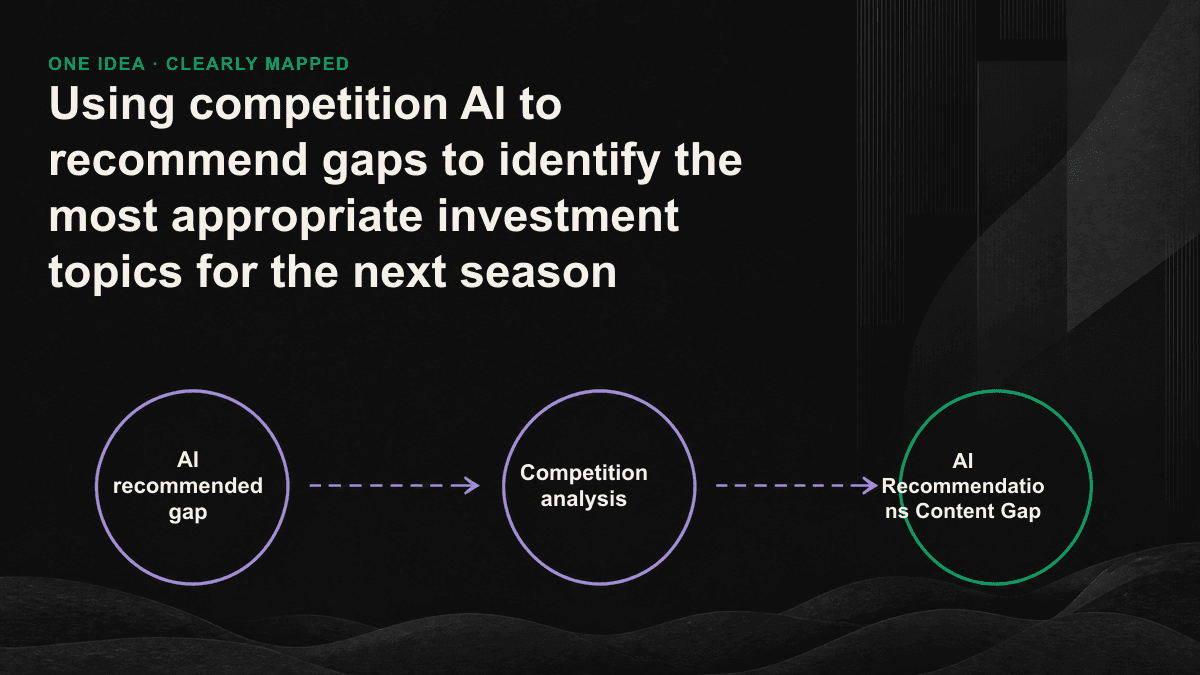
Translation of gap into content priority
Finding the gaps is just the material, the sort of decision. We're going to score each gap in three dimensions when we line up for the next season. One is the proximity of the decision-making approach, which is usually the highest in comparison and alternatives; the other is the concentration of competition, which, if the same competition is repeated on multiple topics, represents a rivalry among the soldiers of the class and deserves to be taken back first; and the third is complication, which is best served by a gap in the structure, by rewriting existing pages, with clear conclusions and schedules, which can often be taken back by engines in a few weeks. Three dimensions multiplied, with the highest scores being in the first few pages of the next season.
A practical sorting example
Suppose you're a family doing API monitoring of SaaS. After running the process, you found out that "the best API monitoring tool" you and the three competitions were recommended for low value; that "the API monitoring tool to support GraphQL" was only recommended for two competitions, that you were absent, and that the issue was close to shopping; and that "Datadog's alternative" was listed as five, without you. With a three-dimensional score, the second issue of the decision is close to and remediable (you actually support GraphQL, but not a clean piece), at the top; the alternative is highly focused but medium-compensability is second. The first issue of the highest search volume is not worth investing first.
The real change in content gap analysis is the point of your sorting -- from which word traffic is high to which problem is AI making a deal for the competitor.— Tenten GEO
Next step
This set of processes you can run for one round by yourself, and simply throw the issue of 30 to four engines and write down who's recommended, it's enough to overturn the existing content schedule. This is what our Brand Radar can see tracking and GEO audit is designed to do if we want a version that sets the gaps, causes and priorities straight to the team. If you want to see how much you've got in the class, you can set aside 30 minutes for a GEO diagnostic session, and we'll be there to show you some questions about your core decision.