Following the visibility of the competition in the AI engine depends not on "how many times have you been mentioned" but on "where in the context of questioning, AI gave the recommended position to someone else." The same type, in other words, ChatGPT, Perplexity, Gemini may have given a completely different list. Without a matrix that separates questions from the situation, you'll get the impression that you can't make a decision.
Just ask a few questions, why can't you always decide?
Most people check AI's visibility by opening ChatGPT and asking "What's the best XX tool" to see if they're on the list. The problem is that AI's answer is extremely sensitive to questions. Ask "best" and "suitable for small and medium-sized enterprises" and "cheap" and "passenger in Taiwan". One sample was just a snapshot, a change of time, a change of mobile devices, a change of account log-in status, and a drift. If you want to see where the competition is holding you down, you have to fix the question and measure it back.
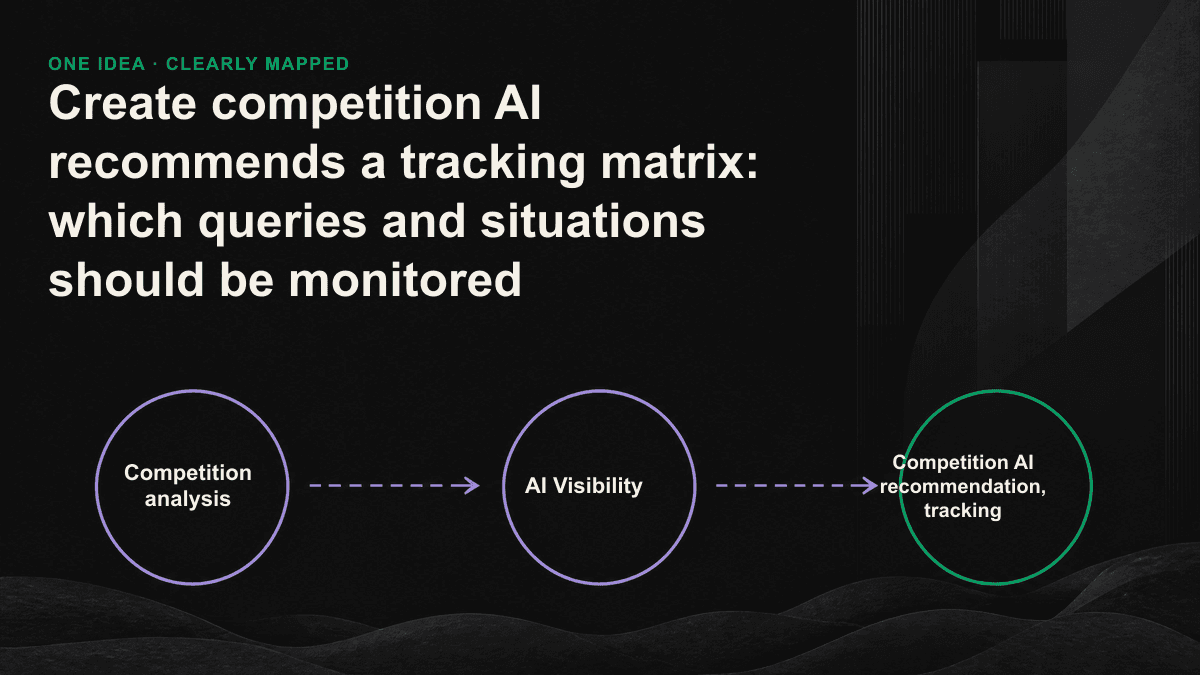
Two axes of the matrix: a question and a question.
A capable tracking matrix with "questioning intent" and "buying context" on the axis. Each of the two axes that crosses is a set of questions to be monitored. The advantage is that you know how much you've been mentioned in your whole body and that "Ai will skip you when it comes to what kind of buyer and what kind of demand." The gap can be filled with coordinates.
- Type explorer type: "What XX software is available? "The buyer is still counting the options."
- Compartment: "A and B are more appropriate?" Buyers have received two or three.
- The selection type: "A tool suitable for a remote team with limited budget" is clearly limited.
- Alternative: Are there any XX alternatives? The buyer is not satisfied with the tools available.
- Trust certificate type: "XX Is this company reliable?" Buyer is doing a final check.
The shopping landscape of the axis addresses the identity and scene of the buyer: a first-time introduction, a change of tools already in place, a particular industry (ecommerce, finance, manufacturing), a specific scale (below 10 versus 200), a specific region (the Taiwan border). In the same context of the "best CRM" and "Taiwan small and medium-sized ecommerce businesses" and the "cross-border business security team", the logical answer would have been different, and AI would have been following this line.
Which questions should be monitored: a list that can be copied directly?
Replace the next "class" with your class, "competition" with your main competitor, "your brand" instead of yourself, is a set of foundational questions that can be fixed. It is suggested that each group should be asked about each engine.
- "What kind of tools should be considered?"
- "What's the difference between your brand and the competition?"
- "How many small budget-limited teams recommended?"
- "What are the local Chinese-language customers in Taiwan?"
- How does it work? Is there a better alternative?"
- Which one was the fastest hit when it came into the < class?
- "How does this company feel and trust?"
What do you want to record in each cell?
It's too wasteful to say "was mentioned." The same measure actually contained a lot of signals, and they were taken together, and the rest of the text knew where to start.
- Whether or not we're mentioned in the next line.
- Which competitions and how many times each of them appear in the same category.
- AI cited sources: official websites, third-party evaluations, community discussions, comparison platforms.
- Whether the words we use on our side are accurate, and whether there is any information of time or error.
- Cross-engine differentials: What's the size of the list for ChatGPT, Perplexity, Gemini, Google AI Overviews?
Tracking frequency, range of competition and how to run
When the list of questions is fixed, it is recommended to run at least once every two weeks, and to be measured after significant product updates, fund-raising, adaptations, price adjustments, etc. The competition is a lot of money, and locking in AI will actually bring three or five of your counterparts -- that's the real competitor in the same recommended position. If you want long-term automation, you can trace the results of each cell to a comparable time series, using Brand Radar's visibility, instead of each manual cut-off, based on an image.
AI won't tell you why it didn't choose you. The value of the matrix is to tear this silence into a visible gap.
From matrix to hole.
A filled matrix turns the vague anxiety of "we don't seem to be good in AI" into a sort of sort of to-do: which questions need to be added first and which situations need a page. A clear comparison page, which references have to operate. If you want to see where you've got a gap in your primary situation, you can book a 30-minute GEO diagnostic session. We'll run a test with your type and show you the first version of the matrix.