To learn who AI recommends in your category, you can run a small trial yourself and get a rough share-of-voice ranking. The decision is whether you need to update that number every week, compare it across four models, and report it to a manager or client. If so, the manual process usually starts breaking down by the third week.
AI Share of Voice
AI Share of Voices: When users ask a question about your type in ChatGPT, Gemini, Perplexity or Google AI Overviews, your brand is mentioned, recommended, and how much is spent on competitions. It's different from the keyword ranking. AI doesn't give you ten blue links, it says, "I suggest you use A, B, C," either in those three names or in the middle zone. For B2B SaaS, it's a cruel line -- a shopping line that asks AI before writing a list of needs, you can't get to the primary election without being mentioned.
Make it yourself: How far can a trial run go?
Manual version of logic is easy. First, you list the real questions you're going to ask, and then you throw them into the AI, and you copy the brands that appear in your answers, counting the number of times, the number of places, the number of positives or the number of reservations. You can see who's the default answer in AI's eyes. This round is usually enough to break the team's "I think we have a good voice".
- Lists 30 to 50 real purchases in the subject category, with three expressions of comparison, recommendation, alternative.
- Run one round each at ChatGPT, Gemini, Perplexity to record whether the brand is mentioned, sorted and spoken.
- The citation rate and the average ranking of each competition is calculated using a trial scale to calculate each household's voice. That's right.
- Write down the source URL cited by AI, and back up why it recommended each other.
After this round, you'll have two very useful things: a current competitive volume map and a list of the addresses that AI uses as sources. The latter tends to be more valuable than the ranking itself, because it simply tells you which pages you want to be on the list first. We're in the first step of most GEO trials, and that's exactly what we're doing.
Where would the manual version collapse?
Question in AI is unstable. Three times the same question may result in three slightly different brand lists, as the model itself is random. You're running out of ranks today, you can't run again tomorrow, let alone keep up with a month of numbers. It's too small a manual sample, and it's over the signal -- you think some competition dropped, but it was just that day that different answers were drawn.
The second pit is maintenance costs. Four models, 50 questions, three more times each to lower the random error, six hundred inquiries, and manual reading of the tone and formatting. One project, one full-time job every week. By the third week, most of the teams will have stopped silently, and the trial scale will become an overdue snapshot, and the purpose of tracking the trend will disappear.
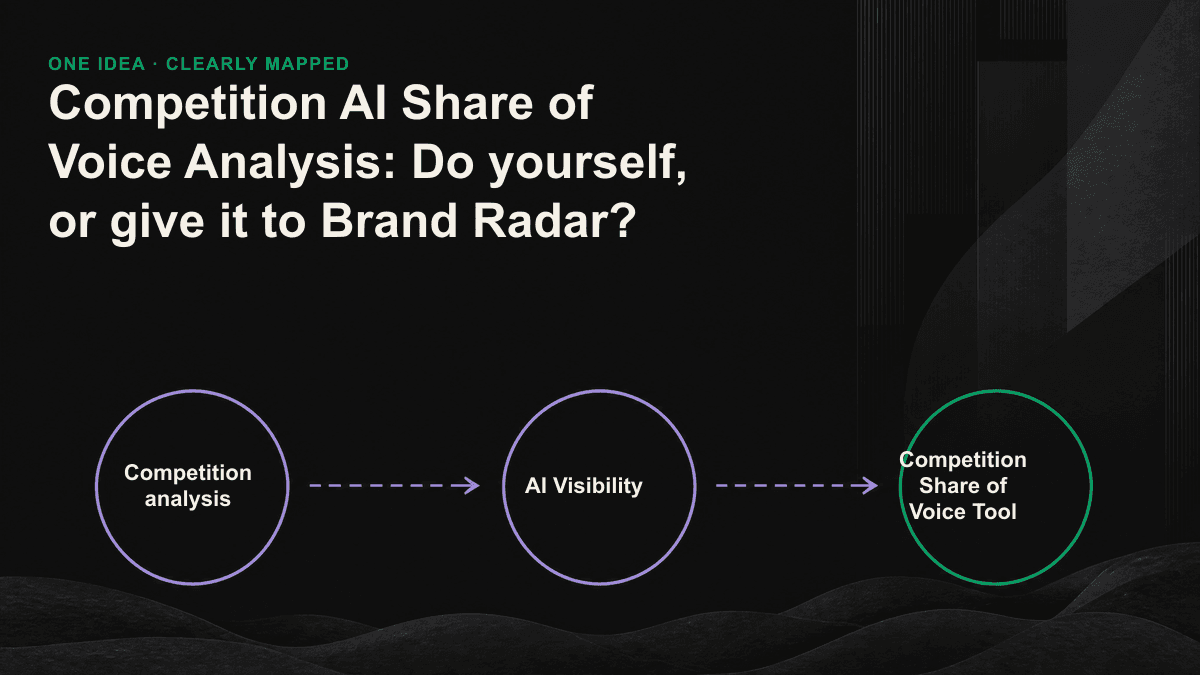
Brand Radar solves the problem of repetition, not intelligence.
Handing the measurements over to the tool and buying not a smarter analysis, but a replicable discipline. Brand Radar's kind of AI is visible, and it's essentially the process that you do manually automating, and pulling the sample to a scale that humans can't -- it's only credible that each issue is repeated, cross-model synchronised, fixed frequency executed, and each number is built on the same method.
- Runs regularly across models like ChatGPT, Gemini, Perplexity and eliminates random errors in single sample Bad
- Tracks the citation rate, average ranking and speech changes between you and the specified competition, drawing into comparable time series
- Mark out the source page that AI actually refers to every recommendation, indicating the citation gap that you should fight for.
- "Why does this monthly volume change" target specific content or news events rather than just one score?
How?
There's no need to change the brand, look for use. First, do you want a diagnosis or a continuous monitoring? I just want to know where I'm standing right now, so I can run one round without paying. And second, who's gonna show this number? If you want to go to a Board briefing or a quarterly review, you need consistent, traceable data, and you can't get through it manually. Number three, how fast are you changing? The number of competitions, the type of AI answer week changing, the frequency of updates is everything, and this is the real value of auto-engineering.
Practical approach: Manual, then automatic.
Start with a manual baseline that maps competitor share of voice and citation sources. That first pass tells you whether the gap is worth addressing and which questions deserve long-term tracking. Once AI visibility becomes an ongoing metric, let software handle repeated collection and keep people focused on content decisions. If you want to see the baseline for your own brand, set aside 30 minutes for a GEO diagnostic session built around a real buyer question.