A shopper in Taiwan opens ChatGPT or Perplexity and asks, "Which additive-free skincare brands do you recommend?" The cited sources are usually not brand websites. They are more likely to be a Dcard beauty thread, a Mobile01 unboxing review, and one or two trade-press articles. For ecommerce brands, the pages that decide visibility now sit on third-party sites. Even a strong product page may not be enough to earn selection on its own.
How AI Systems Choose Sources for Shopping Answers
To answer a shopping question, a generative engine retrieves a group of Chinese-language pages it trusts, summarizes their information, and attaches citations. It favors several signals: recent enough content, a source mentioned repeatedly elsewhere, and a page structure that makes the answer easy to extract. In Taiwan, pages with all three properties are concentrated on a small group of community and media platforms rather than spread evenly across brand sites.
You can verify the pattern yourself. Ask Perplexity a category question such as, "Which affordable pet wet-food stores are available in Taiwan?" Then open the citation list. Dcard, Mobile01, ETtoday, and Yahoo News will often occupy most of it, while branded DTC sites appear late or not at all. If your site never enters the retrieved source set, even complete product copy cannot influence the answer.
The Four Layers of Taiwan AI Citation Sources
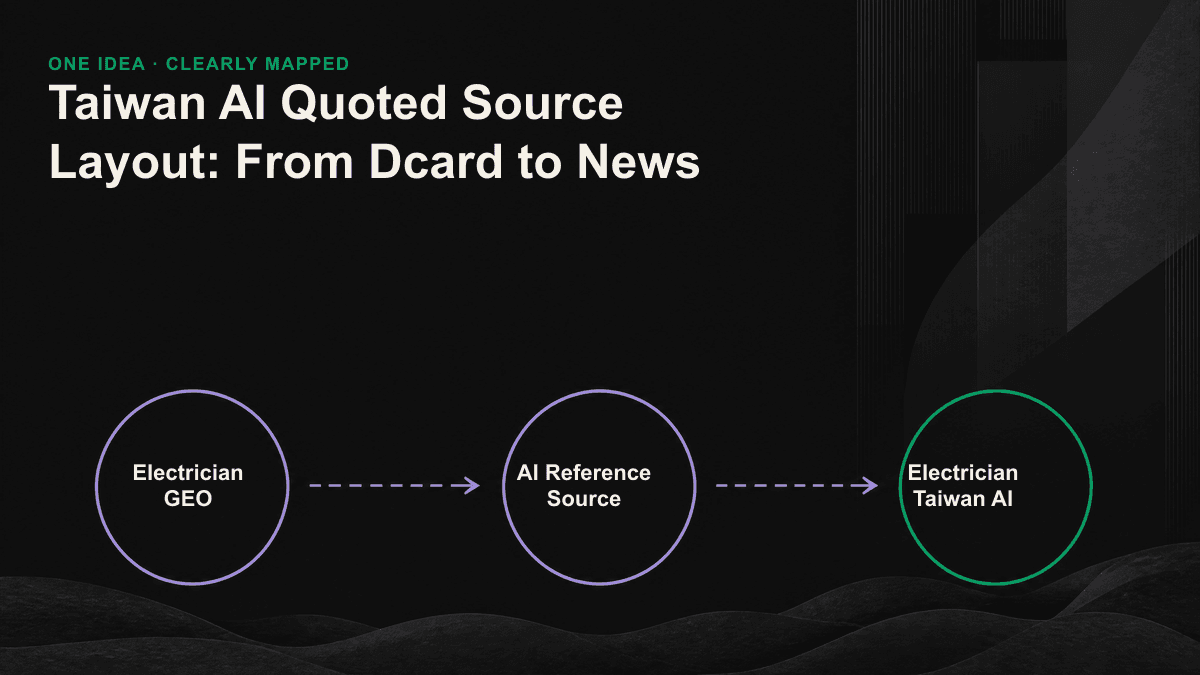
Before putting every resource into official-site SEO, map the citation environment. For ecommerce clients, we separate sources into four layers. Each layer plays a different role in AI retrieval.
- Community reputation: Dcard, PTT, and Mobile01. Real discussions and unboxing reviews show engines how people evaluate a product and appear frequently in shopping answers.
- Media coverage: Business Next, Business Weekly, Economic Daily News, ETtoday, and INSIDE. These publications provide structured facts about a brand's background, fundraising, and products.
- Authority definitions: Chinese Wikipedia, .gov.tw, and industry-association sites. These sources define a brand or category, and many engines reuse the same description once it is established.
- Owned assets: The official site, brand blog, and product pages. This is the only layer you fully control, where you can support the trust earned by the first three layers and supply details an engine needs.
Start with Dcard Reputation and Make Real Discussions Extractable
Community reputation is difficult to create quickly, but it deserves early attention. Do not pay writers to flood a platform with false reviews. Platforms and AI anti-spam systems increasingly recognize repetitive posts released in a coordinated burst, and detected manipulation can weaken the brand's signals. The useful work is making existing, genuine discussions easier to find and interpret accurately.
- Use an official account to respond to existing Dcard and Mobile01 threads about the brand. Add accurate specifications, ingredients, and after-sales information so correct facts remain on a well-established page.
- Put real unboxing experiences and usage notes into active community threads instead of starting a new post with no discussion. Engines are more likely to pick up pages with sustained comments and current conversation.
- Respond publicly to negative feedback instead of trying to remove it. A named brand response that explains the issue clearly can become the official position an engine cites.
Media Coverage Turns Brand Claims into Trusted Evidence
Media reporting acts as independent support. When Business Next or Economic Daily News covers a company's fundraising, revenue growth, or product innovation, the facts move from "the brand says" to "a third party reported." A major funding round is not the only story worth pitching. Specific operating figures, a focused niche market, supply-chain work, or credible sustainability practices can all provide a reportable angle. Prepare a fact page in advance so journalists can quote the details accurately and AI systems can later retrieve the coverage.
We tracked one skincare client whose official-site content improved for three months while its AI citation rate rose only slightly. After two industry-media reports went live, citations for the same queries moved up within two weeks.— Tenten GEO project observation
Wikipedia and .gov.tw: The Most Undervalued Authority Layer
Chinese Wikipedia entries for brands and product categories serve as a factual baseline for many engines. If a category page names a competitor as a representative example, that company is more likely to appear in a general answer. An ecommerce brand may not qualify for its own entry because Wikipedia has clear notability requirements, but it can help keep related category, technology, and place-of-origin entries accurate with reliably sourced information. The .gov.tw domain and industry associations are also easy to overlook despite their authority. When a product involves testing, certification, origin labels, or subsidy lists, an accurate brand record on an official page places it inside one of the source sets engines trust most.
How to Close the Right Gaps in 90 days
- First month, map the current state. Ask the main engines 10 category questions, record the sources cited for each one, identify the layer where the brand appears, and find the largest gap. We usually track this citation-rate baseline for clients with AI visibility monitoring.
- Month 2, strengthen community and owned assets. Consolidate official fact pages, improve product-page structure, and use official accounts to participate honestly in existing Dcard and Mobile01 discussions.
- Third month, pursue one media story and verify the brand information on Wikipedia and relevant official pages so the authority layer can begin accumulating.
The four layers reinforce one another: community discussion can lead to media coverage, media coverage can support Wikipedia and official-site facts, and all of those sources can return in AI answers. The system needs continued maintenance rather than a one-time campaign. In a GEO diagnostic session lasting 30 minutes, we use real category questions to identify the layer holding back your visibility.