The "About Us" page is not written to show feelings to customers, but is the first reference file used by the AI engine to confirm "who you really are." ChatGPT, Perplexity and Google's AI summary Before answering "What B2B SEO agencies are there in Taipei?", you must first be treated as an identifiable entity and included in its knowledge graph. This action usually starts from the most stable and authoritative page of your official website. The About Us page of most B2B companies only has a founder story and a team photo, which is almost blank to a machine.
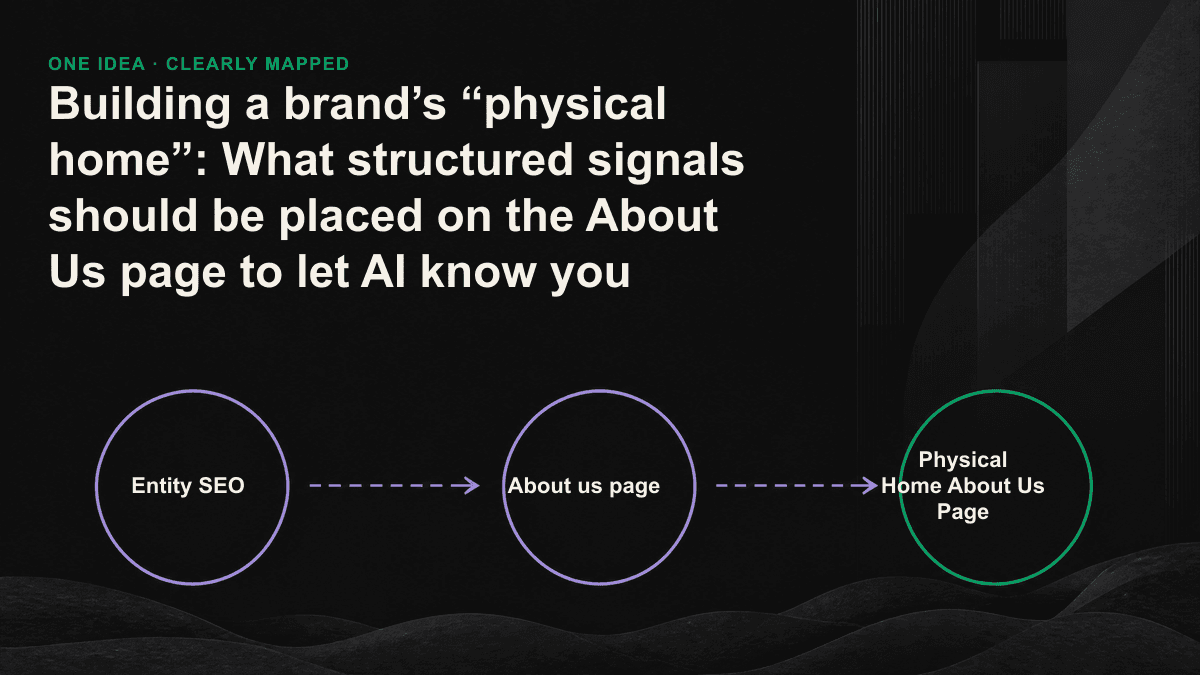
What is the brand’s “entity home”?
The knowledge graph breaks the world into "entities" and "relationships between entities". Your brand is an entity, and the founder, service, city, and industry category are all nodes connected to you. When AI answers a question, it actually finds nodes on this graph, reads attributes, and determines credibility. The entity home is the official authoritative source you designate for your node - a URL that clearly declares "This is me and these are the facts about me." For most companies, this page is /about or about us.
Why specify one page instead of spreading the information throughout the site? Because AI does entity resolution: it collects various mentions about "Tenten GEO" on the Internet, determines whether these mentions point to the same object, and then merges them into a single entity. If you write one version of your name, address, and year of establishment on each of the three pages of the official website, the machine will have to work hard to disambiguate it, or even determine it as two or three different objects. Giving it a clean, consistent, traceable source takes the guesswork out of it.
The structured signals that a entity home should send
Structured signals refer to the fact that machines can read them directly and can be cross-verified with each other, not a marketing adjective. "We are passionate and pursue excellence" is not helpful for entity analysis; "Tenten GEO was established in Taipei, focusing on B2B SaaS SEO and GEO" is the content that can be extracted and compared. A qualified entity home should at least have the following signals.
- One-sentence definition: Use "subject + category + scope" to describe what you are. For example, "Tenten GEO is an SEO/GEO/AEO agency located in Taipei that serves B2B SaaS." Put it at the top of the page.
- Consistent entity name: Use the same official name and abbreviation for the official website, community, and directory. Do not write separate names in Chinese and English.
- Verifiable facts: year of establishment, city, founder, team size, core services, representative industries.
- Founders and key members: Include names, titles, and links to their LinkedIn profiles.
- sameAs external links: to your official profiles on LinkedIn, X, Facebook, Crunchbase, Wikidata.
- Organization structured data: Use schema.org's JSON-LD to mark up the above facts into a machine-readable format.
- External relations: service pages, representative cases, awards and partners, and linked together with internal links.
sameAs: the line connected to the knowledge graph
Among all signals, sameAs has the highest reporting rate. It is an attribute of schema.org and has only one purpose: to declare "the entity described by this page is the same as the entity described by these external links." When you list your LinkedIn company page, Crunchbase entry, and Wikidata number in the Organization tag, you actively tell the AI that these files scattered everywhere are the same you, please merge them. In practice, sameAs must cover at least three types of sources: community archives that you have full control over, third-party business databases, and the knowledge base itself; the three provide self-declaration, third-party evidence, and knowledge graph anchors respectively. Credibility can only be established after intersection. When Tenten does GEO audits for clients, sameAs deficiencies are a common problem for almost every company.
Make facts machine-readable using Organization schema
No matter how clearly we write about ourselves, it is still a piece of natural language that the machine needs to understand. Organization structured data (JSON-LD) directly provides key-value pairs, with zero ambiguity when extracting. This tag is placed on the entity home page and covers at least the following fields.
- name and legalName: the name in daily use and the legal registration name.
- url: Points back to the entity home page, declaring it to be the official source.
- logo: A stable, publicly accessible image URL.
- foundingDate and foundingLocation: founding year and city.
- founder: founder, ideally embed a layer of Person tag and its sameAs.
- address: marked with PostalAddress, exactly the same as the footer, Google business, and directory.
- sameAs: the external file link array mentioned earlier.
- description: The definition of that sentence is consistent with the text that can be seen on the page.
Disambiguation and Consistency: Don’t let AI get the wrong person
Entity resolution is most afraid of name collision. If there is another company, a person, or even a product with the same name as yours, AI may mix the two information together, causing your brand to inherit the wrong attributes. The method of disambiguation is to actively draw boundaries in the entity home: clearly write down the industry classification, location and service targets, and use these limitations to narrow down the possible targets. Consistency is the basis for disambiguation - if the same address appears in three ways on the official website, footer of the page, Google business, or industry directory, the machine will doubt whether they are the same location. Choose a standard writing method that is consistent across the entire network, including punctuation and abbreviations; there is no technical threshold for this, but it is something that most companies cannot do.
Make up your network and start taking action
An entity is not an island; part of its value comes from relationships. The entity home should be like a hub, connecting to service pages, representative cases, founder interviews and award records, and these pages should also be connected back to the entity home. This set of two-way connections tells the AI: what related nodes this entity has and how they are connected to each other. An About Us page with only stories and no external links is an isolated point without edges on the knowledge graph, making it difficult to judge as important or credible.
The AI engine will not cite you because your copywriting is impressive; it will cite entities that can be confirmed, cross-referenced, and traced to their sources.— Tenten GEO
Compare the above signals one by one with your own About Us page, and you will usually find three or four gaps: no sameAs, schema does not match the visible text, and the address is written inconsistently. It is not difficult to repair these. What is difficult is knowing which one to repair first and which one will have the greatest impact on your property. If you want to quickly take stock of what signals are missing in your entity home, you can book a 30-minute GEO diagnostic session (/contact), and we will point out the areas that need to be fixed first on the spot.