When AI systems answer a Taiwan-focused question, they favor sources they trust rather than simply choosing the highest-ranking page. In Traditional Chinese results, .gov.tw domains and established local media often carry more weight than ordinary brand marketing. To earn citations from ChatGPT, Perplexity, and Gemini, connect your claims to those trusted sources instead of spending another round polishing promotional language.
Why .gov.tw Carries Special Weight with AI
During retrieval and generation, large language models assign each candidate source an implicit trust score. Taiwan government domains have several practical advantages: they publish first-hand data, identify the responsible agency, show clear update dates, and often cross-reference the same figures across agencies. When an AI system needs evidence for a claim about Taiwan, statistics from the Directorate-General of Budget, Accounting and Statistics, sector reports from the Ministry of Economic Affairs, and policy documents from the Ministry of Digital Affairs are easier to verify than a blog post. The prose is not the advantage. These sites begin with a structural edge in the model's trust assessment.
Consider an article about the size of Taiwan's SaaS market. A sentence claiming that the software market is growing quickly gives AI nothing to verify. A sentence stating that information-services output reached X billion dollars in 2024, according to the relevant government statistics, gives the passage an anchor. The citation opportunity improves because the number and authoritative source appear together in a verifiable claim; the link itself is secondary.
Local News and Industry Media Provide a Second Layer of Authority
Government domains establish factual authority; local news and industry media establish credibility around events. CNA, Economic Daily News, Business Next, iThome, and TechOrange appear frequently in AI answers about Taiwan technology and business because their reporting is edited, dated, and widely referenced by other sites. When they cover your company, product, or viewpoint, the model gains independent support rather than another claim from the brand itself. This is the layer many companies lack, and a more detailed official site cannot replace it.
The Taiwan Authority Sources Worth Mapping
- First-party facts from .gov.tw: The Directorate-General of Budget, Accounting and Statistics, National Development Council, Ministry of Economic Affairs, Ministry of Digital Affairs, Ministry of Finance, and local-government open data for statistics, regulations, and policy definitions.
- National news and business publications: CNA, United Daily News, Economic Daily News, and Commercial Times for events, milestones, and market developments.
- Industry and technology media: Business Next, iThome, TechOrange, and INSIDE for specialist coverage of B2B, SaaS, and technology.
- Chinese Wikipedia: A source that AI systems retrieve frequently, useful for establishing basic entries and links among brands, people, and products.
- Local communities such as Dcard, PTT, and Mobile01: Sources of real user language and long-tail questions that official publications rarely cover.
A Step-by-Step Method for Weaving Authority into Content
- Give every important claim a first-party source. Link statistics, market share, regulations, and definitions to the relevant .gov.tw page, and name the unit and year in the sentence.
- Use official terminology and official figures. AI systems compare sources, so language and numbers that match government and news records strengthen consistency.
- Earn attributed coverage from local news or industry media. One report with original numbers and a clear viewpoint is more valuable than 10 posts on your own blog linking to one another.
- Create or strengthen Chinese Wikipedia entries for core entities, keeping the name, incorporation year, and business description consistent with the official site.
- Place the brand and authoritative sources in the same coherent passage so AI systems encounter them within one semantic context.
The sequence matters. First, build a verifiable foundation with primary sources. Next, earn attributed outside coverage that provides independent support. Finally, use co-citation to connect that accumulated trust to the brand. Skip the first two stages and AI may cite the source you linked without ever mentioning you.
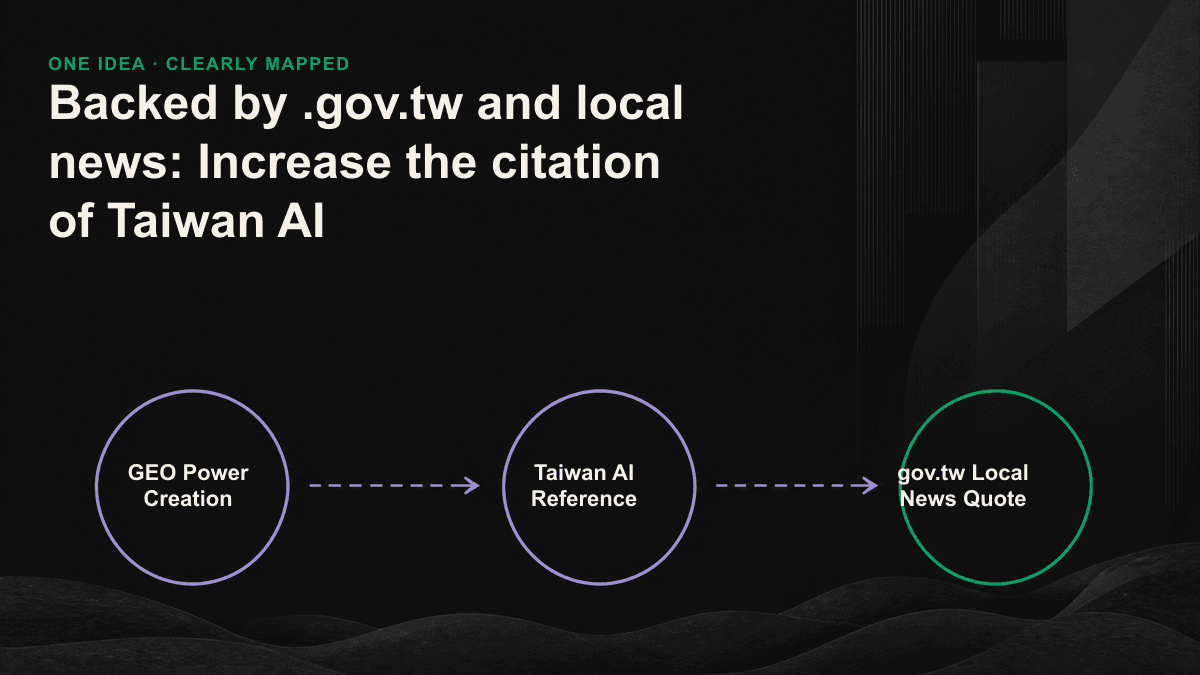
Co-citation: Put Your Brand Beside Sources AI Already Trusts
AI systems judge credibility partly by the company a source keeps. When a brand repeatedly appears in cited passages beside government statistics and CNA reporting, the engine begins associating it with the reliable sources for that topic. In practice, this means building a coherent semantic neighborhood: let your analysis, official figures, and relevant news events support one another in the same article instead of treating them as unrelated fragments.
Three Common Mistakes That Undermine Trust
- False citation: Claiming a government report contains a figure that does not appear on the source page. A failed cross-check can reduce confidence in the entire passage.
- Relying only on your own domain: When every supporting link points back to the brand, AI reads the page as a one-sided claim rather than independent evidence.
- Mixing in mainland Chinese sources or terminology: For a Traditional Chinese query, mismatched language and local context can dilute the authority signals you are trying to establish in Taiwan.
How to Tell Whether the Work Is Paying Off
Measure citations, not organic traffic. Run a fixed set of target questions across ChatGPT, Perplexity, Gemini, and Google AI, then record which sources appear, whether the brand is mentioned, and which sources sit beside it. Tenten's AI visibility monitoring tracks that presence and the brand's co-citations with .gov.tw and local news over time. Without measurement, the next move is a guess. With it, you can see which primary source to add and which publication to pursue.
Authority compounds over time. Keep adding verifiable sources to your content and earning independent coverage that supports the brand. To see where your AI citation gaps are and which authority relationships are still missing, book a 30-minute GEO diagnostic session. We will run your actual target questions and list the gaps one by one.