Ask ChatGPT manually, "Who will you recommend in this domain?" and see if your brand is there. It's the first move of most small and medium-sized enterprises to check AI's visibility. This move will systematically mislead you. You'll probably get three different answers. So what you see is "somethin' mentioned" or "not at all." It's often just one of the results, not the truth.
Two ways, not the same question.
First of all, the two terms are clearly defined. The question that was answered manually was a very narrow one: at this moment, this time, in this set of words, did I appear? Automated monitoring answers another question: on a set of fixed tips, what is my rate over the past 30 days, who is usually behind it, which page is connected to it? The former is a snapshot, the latter is a trend.
Why is the gap so big from the model itself? The output belt of the generated model is random, and the same input does not guarantee the same output; OpenAI, Perplexity, Google is adjusting the search and sorting logic. One manual query equals one sample to the whole body, which is almost meaningless in statistics. What you need is a double sample ratio, not a single one.
Manual queries: cheap, intuitive, but naturally unstable
Manual queries are not useless. To quickly ascertain whether a newly made page has been seen by a platform, or to find out, on a temporary basis, what a high-value prompt looks like right now, or to open the Perplexity question as quickly as possible. It costs almost zero, and it gives you direct access to the actual language and source of reference generated by AI, which is not available in the report. Trouble is, it starts lying to you when you try to deduce it from this time.
- There's only one sample: a single result can't tell whether you're stable or just this time.
- There is no timeline: after you published the news, you changed the content, you were discussed in a forum, there was no change in the visibility, and you couldn't leave a face-to-face look.
- When the scale is scaled up, it collapses: Serious tracking usually takes a dozen sets of tips on four to five platforms, reruns hundreds of queries per week manually, no one finishes and does not agree.
What are the three things that auto-detect?
The value of auto-monitoring is not the human cost of the word "automatic," but the three things it can't do manually, pressing down the sample error.
- Repeat sample: The same set of prompts to run multiple rounds per day or week, replace the one-time no-no with the `incident ratio', and even the randomity of the model.
- Cross-platform and cross-model: ChatGPT, Perplexity, Gemini, Google AI Overviews have different access and rankings, covering them at a time, not just the one you're used to.
- Leaves a time series: it's only when you've got data on each result that you can see whether it's up or down after an adaptation or an article.
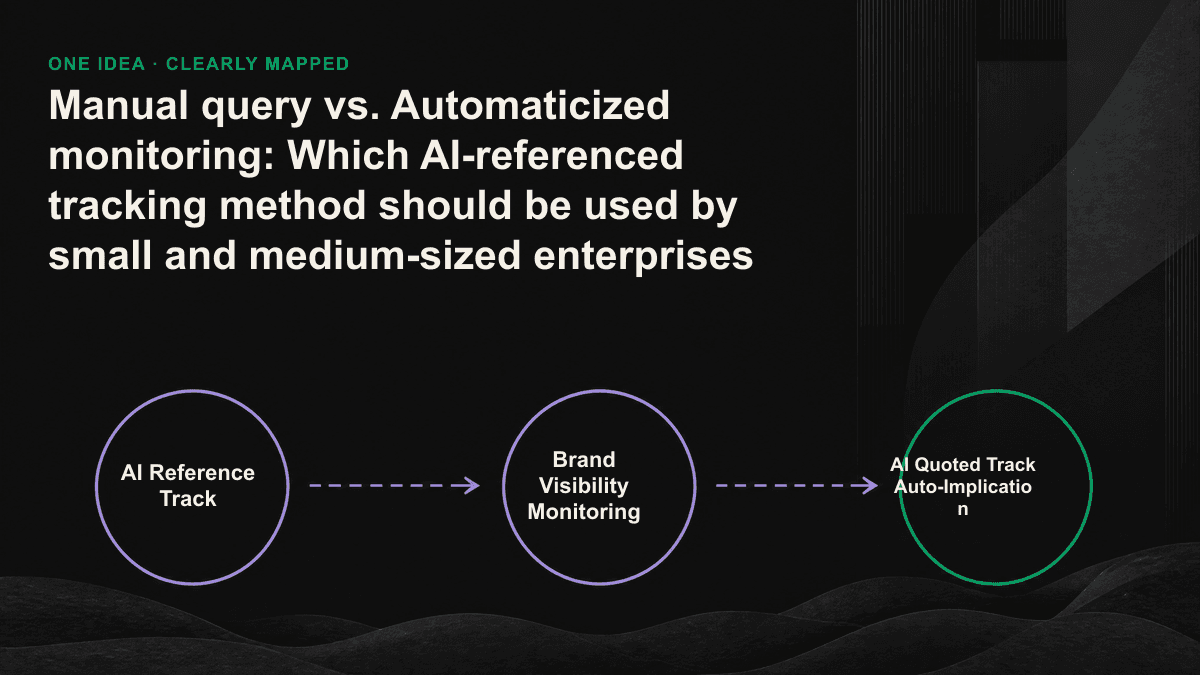
What about small and medium-sized enterprises: four qualifications
Not every company needs a monitoring system. It's better than the tools that fix it. The next four conditions, the more they fit, the more they should be upgraded manually to automation.
- You're tracking more than ten sets of prompts, and they're distributed over two or more AI platforms.
- The organic traffic or inquiry brought by AI has begun to influence the judgment, and you need to make a case to the boss or the client.
- You're on a continuous basis or doing PR, and you need to verify that every move is not actually pushing up the visibility.
- You're the type where the competitions are stealing the AI, and you need to know where you are.
Don't think of it as a "stable quote."
It's worth pulling out alone because it's the most expensive misunderstanding. It was quoted once and steadily by AI, making decisions that are far from universal. The former may be just a little bit of information, but the latter means that the model really sees you as a reliable source of the subject. The criteria for the determination are simple: the same set of tips is ten times continuous, you're stable eight or nine times, you're lucky one or two times. It's not natural for a manual inquiry to give this denominator. You only see molecules.
AI Visibility is not a question, but a ratio. The question you should ask is not whether I was quoted, but what percentage I was quoted on those questions and where I went.— Tenten GEO consultant team
A practical way to start.
Start without one step. First, by hand, you list 10 to 20 of your most interesting phrases, usually those with purchase intentions or directly comparing you to the competition, asking each of them three to five times on the main platform, and if they appear or not, you have a rough but true benchmark. When this is done every week and cross-references across multiple platforms, it's a time machine for auto-monitoring, and Tenten's Brand Radar is running this duplicate sample and time series into a regular report. If you want to know where your current citation rate and the gap are, you can go to the /contact about a 30-minute GEO diagnostic session, and we'll run you a round with your real prompt.