For a professional-services firm, the greatest GEO risk is being described incorrectly rather than going unseen. If ChatGPT calls a management consultancy a web-design agency or Perplexity classifies an accounting firm as a bookkeeping service, trust erodes before the first conversation. Traditional SEO cannot solve an entity-understanding problem with rankings alone. This guide explains what Tenten's professional-services GEO program delivers, how the process works over 30 days, and which firms should begin now.
Why Professional Services Need a Different GEO Approach
Professional-services purchases take time, carry high value, and depend heavily on trust. Before making contact, a buyer may ask AI which Taipei consultants specialize in B2B brand strategy or which industries a particular firm serves. Those answers are now often generated outside your website. If the available evidence is thin, outdated, or confused with a similarly named company, the engine will describe you cautiously and recommend a competitor whose information is clearer. Judgment and credibility are difficult to restore with a few additional blog posts once the entity itself is misunderstood.
What a Professional-Services GEO Program Should Include
Many services sold as GEO are still keyword research and link building under a new name. That is not enough for professional services. A credible program needs at least four connected components; if one is missing, the engine's understanding of the firm breaks at that point.
- Entity clarity: establish exactly who the firm is, which service category and industries it serves, and which similarly named organizations are unrelated. Professional-services brands are frequently confused here, yet this layer is often ignored.
- Citable content: turn the firm's methodology, service scope, and working practices into structured, self-contained passages an engine can extract as an answer.
- Structured data and trust signals: combine suitable schema, cases, demonstrated results, and third-party references so the engine sees evidence rather than unsupported self-description.
- Visibility tracking: measure citation share and descriptive context across major AI engines so the team knows what improved and what remains wrong.
Tenten's Delivery Process Over 30 days
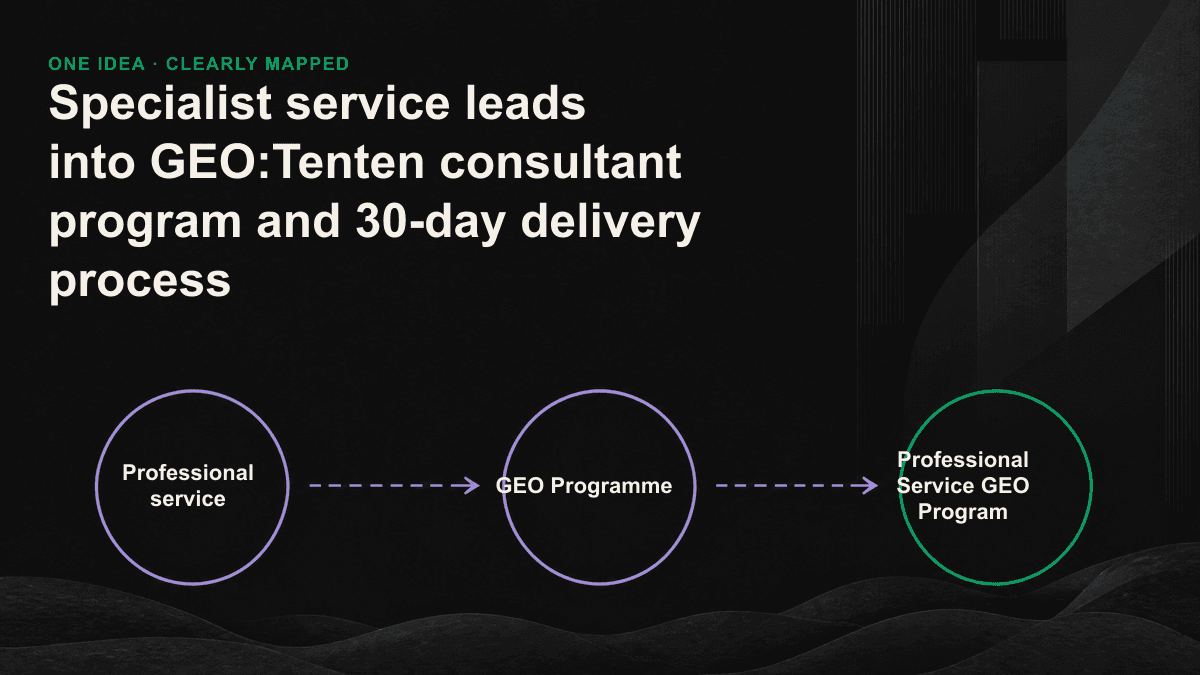
We organize the work as a 30-day loop so the firm can observe how AI's understanding changes within a month instead of signing a six-month engagement before seeing evidence. The process is transparent, and every stage produces an output the team can review and use.
- Days 1 to 7, GEO audit: use AI visibility monitoring to test the brand across ChatGPT, Perplexity, and Google AI Overviews. Record missing citations, inaccurate descriptions, and the competitors appearing beside it, then deliver a prioritized gap list across entity, content, and structure.
- Days 8 to 14, entity and structural repair: fix the most damaging foundations first by clarifying the brand entity, completing structured data, and removing signals that cause category errors.
- Citable content production, from 15 to 24 days into the program: answer the questions buyers genuinely ask AI and express the firm's methodology and services as clear passages that an engine can quote directly.
- 25-30 Days, retest and handoff: run AI visibility monitoring again, compare citation share and description accuracy with the first-week baseline, and deliver the next priority list.
What the Deliverables Look Like
Professional-services buyers do not want a stack of opaque dashboards. Our deliverables are designed for direct reporting to partners and management: a GEO audit showing which engines cite the firm, how they describe it, and which important questions omit it; a log of entity and structural fixes with the reason for each change; citable content ready for the website; and a before-and-after AI visibility report showing what moved during the 30 days. These are the program, not optional reporting extras.
Three Common Mistakes Before Starting
The same three objections appear repeatedly. First, stable website traffic does not prove that nothing is wrong because losses inside an AI answer may produce no click for analytics to record. Second, publishing more blog posts is not GEO if the engine still confuses the firm with another entity. Third, GEO is not a one-time repair: models, source data, and competitors all change, so visibility needs ongoing measurement and maintenance.
Professional-services firms often lose in AI search because of the sentence used to describe them, not because of a keyword position.— Tenten GEO consulting team
Which Firms Should Begin Now?
If the service carries a high price, the sales cycle is long, and buyers research before making contact, the way AI describes the firm directly affects whether it enters the shortlist. That is especially true for consulting, legal, accounting, agency, and B2B SaaS businesses, where accurate brand understanding is part of the sale. Book a 30-minute GEO diagnostic to see what AI says today and where the gaps lie. We will show the results with AI visibility monitoring and help determine whether the 30-day program is justified.